Wednesday, December 09, 2009

4th Sunday of Advent - yayness

For the 3rd Sunday of Advent - Gaudete!

Rejoice! It's Gaudete Sunday coming up! :)

Rorate Caeli ...

Jesus, Mary, I love You; Save Souls!

Labels:

Monday, December 07, 2009

Beethoven's Heiligenstadt Testament

I was enthralled when I read this:


The Heiligenstadt Testament (translation)

For my brothers Carl and [Johann] Beethoven

Oh you men who think or say that I am malevolent, stubborn, or misanthropic, how greatly do you wrong me? You do not know the secret cause which makes me seem that way to you. From childhood on, me heart and soul have been full of the tender feeling of goodwill, and I was ever inclined to accomplish great things. But, think that for six years now I have been hopelessly afflicted, made worse by senseless physicians, from year to year deceived with hopes of improvement, finally compelled to face the prospect of a lasting malady (whose cure will take years or, perhaps, be impossible). Though born with a fiery, active temperament, even susceptible to the diversions of society, I was soon compelled to withdraw myself, to live life alone. If at times I tried to forget all this, oh how harshly I was I flung back by the doubly sad experience of my bad hearing. Yet it was impossible for me to say to people, "Speak louder, shout, for I am deaf." Ah, how could I possibly admit an infirmity in the one sense which ought to be more perfect in me than others, a sense which I once possessed in the highest perfection, a perfection such as few in my profession enjoy or ever have enjoyed.--Oh I cannot do it; therefore forgive me when you see me draw back when I would have gladly mingled with you.
My misfortune is doubly painful to me because I am bound to be misunderstood; for me there can be no relaxation with my fellow men, no refined conversations, no mutual exchange of ideas. I must live almost alone, like one who has been banished; I can mix with society only as much as true necessity demands. If I approach near to people a hot terror seizes upon me, and I fear being exposed to the danger that my condition might be noticed. Thus it has been during the last six months which I have spent in the country. By ordering me to spare my hearing as much as possible, my intelligent doctor almost fell in with my own present frame of mind, though sometimes I ran counter to it by yielding to my desire for companionship. But what a humiliation for me when someone standing next to me heard a flute in the distance and I heard nothing, or someone standing next to me heard a flute in the distance and I heard nothing, or someone heard a shepherd singing and again I heard nothing. Such incidents drove me almost to despair; a little more of that and I would have ended me life -- it was only my art that held me back. Ah, it seemed to me impossible to leave the world until I had brought forth all that I felt was within me. So I endured this wretched existence -- truly wretched for so susceptible a body, which can be thrown by a sudden change from the best condition to the very worst. -- Patience, they say, is what I must now choose for my guide, and I have done so -- I hope my determination will remain firm to endure until it pleases the inexorable Parcae to break the thread. Perhaps I shall get better, perhaps not; I am ready. -- Forced to become a philosopher already in my twenty-eighth year, oh it is not easy, and for the artist much more difficult than for anyone else. 'Divine one, thou seest me inmost soul thou knowest that therein dwells the love of mankind and the desire to do good'. Oh fellow men, when at some point you read this, consider then that you have done me an injustice; someone who has had misfortune man console himself to find a similar case to his, who despite all the limitations of Nature nevertheless did everything within his powers to become accepted among worthy artists and men. 'You, my brothers Carl and [Johann], as soon as I am dead, if Dr. Schmidt is still alive, ask him in my name to describe my malady, and attach this written documentation to his account of my illness so that so far as it possible at least the world may become reconciled to me after my death".
At the same time, I declare you two to be the heirs to my small fortune (if so it can be called); divide it fairly; bear with and help each other. What injury you have done me you know was long ago forgiven. To you, brother Carl, I give special thanks for the attachment you have shown me of late. It is my wish that you may have a better and freer life than I have had. Recommend virtue to your children; it alone, not money, can make them happy. I speak from experience; this was what upheld me in time of misery. Thanks to it and to my art, I did not end my life by suicide -- Farewell and love each other -- I thank all my friends, particularly Prince Lichnowsky's and Professor Schmidt -- I would like the instruments from Prince L. to be preserved by one of you, but not to be the cause of strife between you, and as soon as they can serve you a better purpose, then sell them. How happy I shall be if can still be helpful to you in my grave -- so be it. -- With joy I hasten to meed death. -- If it comes before I have had the chance to develop all my artistic capacities, it will still be coming too soon despite my harsh fate, and I should probably wish it later -- yet even so I should be happy, for would it not free me from a state of endless suffering? -- Come when thou wilt, I shall meed thee bravely. -- Farewell and do not wholly forget me when I am dead; I deserve this from you, for during my lifetime I was thinking of you often and of ways to make you happy -- please be so --

Ludwig van Beethoven

Heiligenstadt,

October 6th, 1802

Taken from www.all-about-beethoven.com

Labels:

Little Baby Jesus, Christmas Preparation

December, the month dedicated to the Divine Infancy
Second Sunday of Advent
St. Nicholas - Bishop, Confessor
J.M.J.
DEVOTION to the INFANT JESUS of PRAGUE
"The More You Honor Me, The More I Will Bless You."
DEVOTION to the Infant Jesus of Prague is devotion to the Child Jesus. It is veneration of the Son of God, who in the form of an infant chose a stable for a palace, a manger for a cradle, and shepherds for worshipers.Our Savior grants special graces to all who venerate His sacred Infancy. The image of the Child Jesus known as the "Infant Jesus of Prague" was in reality of Spanish origin. In the 17th century, this beautiful statue was brought by a Spanish princess to Bohemia and presented to a Carmelite monastery. For many years this statue has been enshrined on a side altar in the Church of Our Lady of Victory in the city of Prague. It is of wax, and is about nineteen inches high. It is clothed in a royal mantle, and has a beautiful jeweled crown on its head. Its right hand is raised in blessing; its left holds a globe signifying sovereignty.
So many graces have been received by those who invoke the Divine Child before the original statue that it has been called "The Miraculous Infant Jesus of Prague." We read the following in an old book printed in Kempt: "All who approach the miraculous statue and pray there with confidence receive assistance in danger, consolation in sorrows, aid in poverty, comfort in anxiety, light in spiritual darkness, streams of grace in dryness of soul, health in sickness, and hope in despair.
"No colic is so painful, no fever so violent, no malady so dangerous, no peril so great, no tumor so malignant, no insanity so raving, no complaint so irritating, no assault of Satan so furious, no pestilence so infectious, no swelling so serious, as not to be dispelled or cured by this blessed Child. The Holy Infant puts an end to enmities, frees prisoners, saves those who are condemned to death, brings obstinate sinners to repentance and blesses childless parents with offspring. In short, He is become all to all."
In thanksgiving for the numerous graces and cures received, the miraculous statue at Prague was solemnly crowned on the Sunday after Easter, in 1655.
What is said of the original statue may be applied also to the images of the "Little King" which are venerated everywhere, in churches and chapels, homes and schools, monasteries and convents the world over. From small beginnings, this devotion has grown to great proportions, so that it is almost as universal as the Church itself. The Divine Child attracts an ever-increasing number of clients, who appeal to Him in every need.
-- From a publication of the Benedictine Convent of Perpetual Adoration -Clyde, Missouri. 31st edition, February, 1960. Imprimatur and Nihil ObstatJanuary 20, 1960.
-------------------------------------
PREPARATION FOR CHRISTMAS

Besides the use of the Advent wreath, a number of traditions exist which are designed to help the Christian family, especially the children, in their preparation for the feast of Our Lord's Nativity.

Among public practices of this kind is the custom of holding a novena before December 25. In the Latin countries of Europe and South America, this novena is held as an evening devotion in church, with prayers and benediction of the Blessed Sacrament (Novena del Nino). In Central Europe it is a novena of Masses which are said early in the morning.

In the spirit of this ancient tradition, families could add a small feature to their daily Advent prayers to bring out the character of the novena. One suggestion might be to use the famous "O Antiphons," which in themselves form a kind of liturgical novena within the Divine Office. A good English translation may be found in the pamphlet, Family Advent Customs, by Helen McLoughlin (The "O Antiphons" or "Greater Antiphons" are also found in the traditional St. Andrew Daily Missal following the Third Sunday of Advent. See below.)

For grown-up members of the family and for older children there could be no better way, of course, to make this novena than daily attendance at Mass, if possible.

Another custom, which originated in France but spread to many other countries, is the practice of having the little children prepare a soft bedding in the manger by using wisps of hay or straw as tokens of prayers and good works. Every night a child is allowed to put into the crib one token for each act of virtue or devotion performed in preparation for Christmas. Thus, the figure of the Christ Child will find on Christmas day an ample supply of tender straw to soften the hardness of the manger's boards.

An old Catholic custom is the writing of "Christmas letters" by the small children. These letters, addressed to the Child Jesus (not to Santa Claus), are written or dictated by the little ones sometime before Christmas. They contain their wishes concerning presents, petitions for various intentions and a promise of sincere effort to please Our Lord in preparation for Christmas. When they go to bed, the children put their letters on the windowsill, from where "angels" take them during the night to bring them to the Child Jesus in Heaven. This charming custom helps the parents to impress on the minds of their little ones the importance of a sincere spiritual preparation and at the same time acquaints them with their children's desires and wishes for particular presents. Parents who favor this custom will often be deeply touched then they discover that some of their children put more stress on spiritual graces than on mat! erial gifts, even on an occasion like this.

Finally comes Christmas Eve, the day of immediate preparation. An atmosphere of joy and solemnity pervades the house. It is on this day (and not before) that the Christmas tree and all other decorations should be put up. The hearts of the children are filled with the spirit of the day, which alternates between devotion and happy excitement.

With a little effort on the part of parents, the activities of Christmas Eve could be organized into an inspiring unit of prayer, work and celebration. A division of tasks and a spirit of teamwork will heighten the joys of the day. According to ancient traditions, the evening meal might be arranged as a festive occasion. For the last time, the Advent devotion is held, and a little prayer or song might be included which expresses the thought of the glorious vigil, like this ancient prayer-hymn, inspired by the Introit of the Rorate Mass:

Dews of Heaven, bring the Just One,
Clouds may rain Him from above!
Thus the nations, still in darkness,
Cried for mercy, peace and love.
Open, earth, and grow the flower
Radiant with grace and power!
Lift your hearts, the time is near:
Christ the Lord will soon appear.

God the Son, in human nature
Was made flesh and dwelled on earth;
Life and light, in grace abundant,
He bestowed of priceless worth.
Men rejoice, exult with gladness;
Do not fear, dispell your sadness.
Raise your hearts, the time is near:
Christ the Lord will soon appear.


THE "O ANTIPHONS"

December 17
O Wisdom, Who didst come out of the mouth of the Most High, reaching from end to end and ordering all things mightily and sweetly: come and teach us the way of prudence.

December 18
O Adonai, and Leader of the house of Israel, Who didst appear to Moses in the flame of the burning bush, and didst give unto him the Law on Sinai: come and with an outstretched arm redeem us.

December 19
O Root of Jesse, Who dost stand for an ensign of the people, before Whom kings shall keep silence, and unto Whom the Gentiles shall make their supplication: come to deliver us, and tarry not.

December 20
O Key of David and Sceptre of the house of Israel, Who dost open and no man doth shut, Who dost shut and no man doth open, come and bring forth from his prison-house the captive that sitteth in darkness and in the shadow of death.

December 21
O Dawn of the East, Brightness of the Light Eternal and Sun of Justice, come and enlighten them that sit in darkness and in the shadow of death.

December 22
O King of the Gentiles and the Desired of them, Thou Cornerstone that dost make both one, come and deliver man, whom Thou didst form out of the dust of the earth.

December 23
O Emmanuel, our King and Lawgiver, the Expected of the Nations and their Saviour, come to save us, O Lord our God.


- From http://www.chantcd.com/lyrics/o_antiphons.htm -
----------------------------------------------------------------------------------
"Devotion to the Infant Jesus of Prague" booklet - http://olrl.org/books/devotion_prague.shtml - is available in our Store -http://olrl.org/mm5/merchant.mvc - for 65¢ ea.
2010 Liturgical Calendars are available also for only $9 - a great spiritual gift.
Another great gift idea, from our friends at "Blessed Margaret Family Help Center" - http://www.blessedmargaret.org/ - is the book "The Hook and I" - a Catholic 12-Step program to overcome any addiction and to grow in sanctity - available from their website and in our Store -http://olrl.org/books/hook.shtml.
--
Sincerely in Christ,
Our Lady of the Rosary Library
"Pray and work for souls"
http://olrl.org

Labels:

Friday, December 04, 2009

Beethoven

... Without music, life would be a mistake ...

That was a silly statement to make, but here goes my night post, I had to post it:

SSO was brilliant tonight.

Beethoven is a genius.

I love his Symphony No. 7, especially the second movement, Allegretto.

Here's a link to watch Herbert Von Karajan conducting Beethoven's Symphony No. 7 in A Major, Op. 92.

If I had more time, I would find out which orchestra is playing with Von Karajan in the link above (or is it the other way around, I'm getting tired, so that's why my sentences can't come out right), but the night is coming down on me, and it is off to dreamland where I pray, my dearest guardian angel, JMJ, my soul to keep.

Jesus, Mary, I love You; Save Souls!

Labels:

Our Preparation for Christmas

I post this post ... for the 2nd Sunday of Advent, one more week to Gaudete Sunday, two more weeks to the 4th Sunday of Advent, approximately three more weeks to Christmas!!

Labels:

Quotable Quotes

... for out of the abundance of the heart the mouth speaketh.


cum sitis mali ex abundantia enim cordis os loquitur

Dulce et decorum est pro patria mori, sed dulcis pro patria vivere, et dulcissimum pro patria bibere. Ergo, bibamus pro salutae patriae.
"It is sweet and right to die for the homeland, but it is sweeter to live for the homeland, and the sweetest to drink for it. Therefore, let us drink to the health of the homeland."

Dulce et decorum est pro patria mori:
mors et fugacem persequitur uirum
nec parcit inbellis iuuentae
poplitibus timidoue tergo.
(Quintus Horatius Flaccus) Horace's Odes III, 2.13

Labels:

How to Tell Stories to Children

Labels:

Monday, November 30, 2009

It's ADVENT! absolutely NOT Christmas YET

"Jingle Bells, bad men smells..."

"Rudolf the Red Nose Reindeer, had a very shiny nose ..."

"Deck the Halls with boughs of Holly ..."

"Santa Claus is coming to town ..."

It's the time of the year, when you walk into anything, be it a shopping centre, a simple shop, a supermarket, a bookstore, a cafe, even the library, and everywhere and everything reminds you that Christmas is near.

They implore you to "buy this, get this free, eat this, get this free, hear this, sing this, get this, get that, you will feel better." They impound on all your senses, play and entice with your feelings, engaging all your senses, all, just to make that "penance/sacrifice", that kind of "penance/sacrifice" that makes a hole in your pocket. (eeks)

And all this, for what? For the sake of preparing for Christmas ...

I am not saying that shopping, buying Christmas presents for your loved ones, preparing materiel-ly for Christmas, is wrong or is bad, but I am trying to say that, amidst all this valid Christmas preparation, there is this other kind of preparation, the spiritual one, that we must go through.

This other kind of preparation involves prayer, sacrifice, penance, prayer, sacrifice and penance... in the hope & spirit of Christmas, the birth of little baby Jesus.

And thus, as we turn our thoughts to the true meaning of Christmas, our thoughts, directed towards the expected second coming of Christ, for the 1st Sunday of Advent, I light the candle, on our online Advent wreath.


J.M.J.
FIRST SUNDAY OF ADVENT
From "The Saint Andrew Daily Missal" (1937)
At Christmas Jesus will be born in our hearts, for at that time the anniversary of His birth will be celebrated. He refuses nothing, to the prayer of the Church, His spouse, and thus He will grant to our souls the same graces which He gave the shepherds and the wise Kings.
Christ will come again also, at the end of all time, to "condemn the guilty to the flames, and to call the just with a loving voice to heaven" (Hymn for Matins).
The whole of to-day's mass is a preparation for this double Advent of mercy and justice. Some parts of it can be applied equally to either (e.g., the Introit, Collect, Gradual, Alleluia), while others refer to our Divine Redeemer's lowly birth, and others again, (e.g. the Epistle and Gospel), to His coming in the splendour of His power and majesty. The same welcome will be given to us by our Lord when He comes to judge us, as we give to Him now when coming to redeem us. Let us prepare for the Christmas feast by holy prayers and aspirations and by reforming our lives, that we may be ready for that last great assize upon which depends the fate of our soul for all eternity. And all this with confidence, for those "who wait upon the Lord will never be confounded" (Introit ; Gradual ; Offertory).
In former times, on this First Sunday of Advent, all the people of Rome made the station at the Basilica of St. Mary Major, to assist at the solemn mass which the Pope celebrated, surrounded by his clergy. This particular Church was chosen because it is Mary who gave us Jesus and because relics of the crib in which the Blessed Mother placed her Divine Child are preserved in this Church.
--------------------------------
CHRISTMAS NOVENA
Prayer to Obtain Favors
Hail and blessed be the hour
And moment in which the Son of God
Was born of the most pure Virgin Mary,
At midnight, in Bethlehem, in piercing cold.
In that hour vouchsafe, O my God,
To hear my prayer and grant my desires,
Through the merits of Our Saviour Jesus Christ,
And of His Blessed Mother. Amen
(To be recited fifteen times a day from the Feast
of St. Andrew (30th of Nov.) until Christmas)
-------------------------------------------

Jesus, Mary, I love You; Save Souls!

Labels:

Thursday, November 26, 2009

How to Make a Cord Rosary

http://www.youtube.com/watch?v=5Ht9bKG04rE

It's so simple! :D

Labels:

Doom & Gloom, So what? :))


Just as long as we aim towards perfection, perfection in the love of God.

Fight, fight hard against the world, which is made up of the 1) concupiscence of the flesh, 2) concupiscence of the eyes, and 3) the pride of life, for we are called to be out of this world, putting on the breastplate of faith and charity, and as a helm
et, the hope of salvation,

for us, this holds rather true:

Doom & Gloom ... SO WHAT?

16 For all that is in the world, is the concupiscence of the flesh, and the concupiscence of the eyes, and the pride of life, which is not of the Father, but is of the world. 17 And the world passeth away, and the concupiscence thereof: but he that doth the will of God, abideth for ever.

8 But let us, who are of the day, be sober, having on the breastplate of faith and charity, and for a helmet the hope of salvation.

My dear readers, pray, pray hard, pray incessantly, storm heaven for help from above for us below, the necessary graces, to live and exhort in love, patience, calm, hope, that finally, once our days have come to an end, as with St Paul who wrote the same to Timothy, after having fought the good fight, ran the best race, we will fly high and soar, like the eagle, in union with God, amidst the fulfillment of truth, justice, freedom and true love, one that will last, for all of an eternity.

7 I have fought a good fight, I have finished my course, I have kept the faith. 8 As to the rest, there is laid up for me a crown of justice, which the Lord the just judge will render to me in that day: and not only to me, but to them also that love his coming.

Mary, my Mother, my Queen, my hope, Ave Maria, gratia plena, ora, ora pro nobis, peccatoribus, nunc et in hora mortis nostrae, Amen.


Deus propitius esto mihi peccatori

Jesus, Mary, I love You; Save Souls!

Jesu mitis et humilis corde, Fac cor nostrum secundum Cor tuum.

Sacred Heart of Jesus, Have mercy on us!

Saturday, October 31, 2009

Young People Interviewed at Winona Ordinations June 2009

http://www.youtube.com/watch?v=X2gYRNUYnO0

Friday, October 23, 2009

Our Lady of Perpetual Help

(Taken from: http://www.sacred-heart-church.org/olphmn.htm)

The Icon of Our Lady of Perpetual Succour


This beloved picture may look strange to modern Western eyes. It doesn't portray Mary as a delicate maiden with downcast eyes. Her direct gaze and strong features command our attention. We are struck by the unrealistic qualities of the figures. Jesus is the size of toddler, but his features are those of an older child. Mary and Jesus aren't set in a scene but float against a background of gold.

This picture was painted in the Byzantine style of the Eastern Church. The purpose of this style of art is not to show a beautiful scene or person but to convey a beautiful spiritual message. Because the artist is trying to communicate something more glorious than anything in this world, the picture isn't a realistic portrayal. A Byzantine painting is like a door. Seeing a beautiful door is nice, but who wants to just stand there looking at the door? We want to open the door and go beyond it. The door might be attractive or unattractive, but it is only a door, there to lead us into a new world.

That's how we must approach this picture. The artist, realizing that no one on earth would ever know what Mary or Jesus really looked like, and that their holiness could never be depicted in purely human terms, has portrayed their beauty and their message in symbols.


What do you see when you look at this picture?

First of all you see Mary, because she dominates the picture and because she looks straight at you - not at Jesus, not at heaven, not at the angels above her head. She looks at you as if to tell you something very important. Her eyes seem serious, even sad, but they command attention.

This is an important woman, one of power and position. She is set on a gold background, a symbol of heaven in the middle ages. She is dressed in dark blue robes with a green lining and red tunic. Blue, green, and red were the colors of royalty. Only the Empress was allowed to wear those colors.

The eight-point star on her forehead was probably added by a later artist to represent the Eastern idea that Mary is the star that leads us to Jesus. To reinforce the symbolism, there is an ornamental four-point cross to the left of the star on her headdress.

The letters above her head proclaim her the Mother of God (in Greek).
Looking at the painting, we know that she has the power to intercede for us in heaven.

Mary's gaze is fixed on you, but her arms hold Jesus. In Byzantine icons, Mary is never shown without Jesus because Jesus is central to the faith. Jesus too is wearing the clothes of royalty. Only an Emperor could wear the green tunic, red sash, and gold brocade portrayed in the picture. The Greek initials to the right of the child and his halo decorated with a cross proclaim that he is "Jesus Christ."

Jesus isn't looking at us, or at Mary, or at the angels. Though he clings to his mother, he's looking away, at something we can't see - something that made him run so fast to his mother that one of his sandals has almost fallen off, something that makes him cling to her for protection and love.

What would frighten a little boy, even the Son of God, so much?


The figures that hover on either side of Jesus and Mary - the Greek letters above them identify them as Archangels Gabriel and Michael - provide us with the answer. Rather than carrying harps or trumpets of praise, they bear the instruments of Christ's Passion.

On the left, Michael holds an urn filled with the gall that the soldiers offered to Jesus on the cross, the lance that pierced his side, and the reed with the sponge.

To the right, Gabriel carries the cross and four nails.

Jesus has seen part of his destiny - the suffering and death he will undergo. Though he is God, he is human as well and afraid of this terrifying future. He has run to his mother, who holds him close in this moment of panic, the same way she will be close by his side through his life and death. While she can't spare him his suffering, she can love and comfort him.

So why is Mary looking so intently at us instead of her child in need? Her gaze brings us into the story, makes us part of the painting and the pain. Her gaze tells us that just as Jesus ran to his mother and found refuge, so too may we run to Mary. 
Her hand does not clasp the hands of her frightened son in a protective grip, but remains open, inviting us to put our hands in hers and join with Jesus.

Mary knows there are many things in our lives that are dangerous and terrifying, and that we need someone to turn to in times of suffering and dread. She offers us the same comfort and love she gave to Jesus. She tells us to run to her as fast as Jesus did, so fast that we don't even think about what we wear or how we go, just so we get there.

What are you waiting for?


For many centuries throughout the world, this picture has been revered as an icon of hope and inspiration.

The original picture of Our Mother of Perpetual Help is a product of Byzantine art. It is known to be at least five hundred years old in its present form. Painted in tempera on hard nutwood and only 17 by 21 inches, the picture may date back another 1,000 years to the ancient madonnas of Constantinople. Some church legends even date the picture to the first century and the hand and brush of St. Luke the Evangelist.

It is only in the past 125 years that devotion to Our Mother of Perpetual Help has increased dramatically. In 1866, Pope Pius IX entrusted the miraculous icon to the Redemptorists and told them to "Make Her Known Throughout the World."

As they have criss-crossed the globe bringing the Good News of Salvation, Redemptorist priests and brothers have also erected churches and shrines to Our Mother of Perpetual Help. They have encouraged people to gather each week to pray the novena prayers and then to pray daily in their homes to Mary, Our Mother of Perpetual Help.

Countless miracles, healings, and conversions are attributed to Mary by those who pray to her as Our Mother of Perpetual Help. There's even a bit of the miraculous in the way the Redemptorists received the picture in the first place.

Historical records indicate that around the year 1490, the picture was located in St. Matthew's Church in Rome. Although it was a relatively small church located on the Via Merulana between the great Roman basilicas of St. John Lateran and St. Mary Major, people came from miles around to pray before the picture because of the many miracles attributed to this sacred icon.

For three hundred years the picture hung over the main altar in the church of St. Matthew the Apostle and the miracles continued to occur. In 1798, the picture was taken into hiding by the monks who fled the city of Rome to avoid being captured by Napoleon's invading armies. The picture resurfaced some years later in an Augustinian monastery chapel.

Meanwhile the Redemptorists had built the new church of San Alfonso near the site of St. Matthew's which had been destroyed by Napoleon's invasion force. In time the Redemptorists learned about the miraculous picture of Our Mother of Perpetual Help that had been enshrined on that site for several centuries. They requested that the picture be placed there once again.

The Holy Father Pope Pius IX agreed and on April 26, 1866, the original icon of Our Mother of Perpetual Help was placed above the high altar in the Church of San Alfonso. To this day, the miraculous picture is there for all to see.

Millions of copies of the picture can be seen around the world in churches and homes. Each week hundreds of thousands of people gather to pray the novena prayers to Our Mother of Perpetual Help while in their homes each day millions of people invoke the assistance of Our Mother of Perpetual Help.

(Taken from: http://www.sacred-heart-church.org/olphmn.htm)

Jesus, Mary, I love You; Save Souls!

Labels:

Tuesday, October 13, 2009

92nd Anniversary of the Miracle of the Sun at Fatima

October 13, 1917

Excerpts taken from the Circumstances and Dialogue of the 1917 Apparitions article on the www.fatima.org (Fatima Network) website

There were about 70,000 people present at the Cova da Iria for the October 13 apparition and Miracle of the Sun. Beginning the night before and persisting throughout the morning of the 13th, a cold rain fell on the crowd. The ground was muddy and the rain soaked everything. At the time when Our Lady was due to arrive, Lucy begged the people to close their umbrellas, which they did at once.

‘What does Your Grace want of me?’ [Lucy asked.]

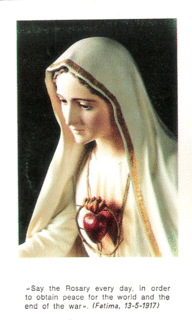
‘I want to tell you that a chapel is to be built here in My honor. I am the Lady of the Rosary. May you continue always to pray the Rosary every day. The war is going to end and the soldiers will soon return to their homes.’

‘I had many things to ask You: to cure some sick people, to convert some sinners, etc.’

‘Some yes, others no. They must amend their lives and ask pardon for their sins.’

Then taking on a more sorrowful air, Our Lady said:

‘Do not offend the Lord Our God any more, for He is already too much offended!’

‘You want nothing more from me?’ [Lucy asked.]

‘No, I want nothing more from you.’

"Then I do not ask anything more of You either."

As Our Lady ascended into Heaven, Lucy shouted: "She is going! She is going! Look at the sun!"

        The miracle announced by Our Lady then took place: the sky abruptly cleared and the sun "danced". The people were able to look at the bright sun directly, without it bothering their eyes at all. A physician, Dr. Almeida Garrett, testified:

Suddenly I heard the uproar of thousands of voices, and I saw the whole multitude spread out in that vast space at my feet … turn their backs to that spot where, until then, all their expectations focused, and look at the sun on the other side … I turned around, too, toward the point commanding their gazes, and I could see the sun, like a very clear disc, with its sharp edge, which gleamed without hurting the sight … It could not be confused with the sun seen through a fog (there was no fog at that moment), for it was neither veiled, nor dim. At Fatima, it kept its light and heat, and stood out clearly in the sky, with a sharp edge, like a large gaming table. The most astonishing thing was to be able to stare at the solar disc for a long time, brilliant with light and heat, without hurting the eyes, or damaging the retina.1

       The testimony of Avelino de Almeida, editor-in-chief of O Seculo, Lisbon’s anticlerical and Masonic daily newspaper, is similar:

And then we witnessed a unique spectacle, an incredible spectacle, unbelievable if you did not witness it. From above the road … We see the immense crowd turn towards the sun, which appeared at its zenith, clear of the clouds. It looked like a plate of dull silver, and it was possible to stare at it without the least discomfort. It did not burn the eyes. It did not blind. One might say that an eclipse had occurred.2

       Others also testified:

"It shook and trembled; it seemed like a wheel of fire." (Maria da Capelinha)3

"The sun turned like a fire wheel, taking on all the colors of the rainbow." (Maria do Carmo)4

"The sun took on all the colors of the rainbow. Everything assumed those same colors: our faces, our clothes, the earth itself." (Maria do Carmo)5

        The most terrifying aspect of the Miracle of the Sun then took place:

"We suddenly heard a clamor, like a cry of anguish of that entire crowd. The sun, in fact, keeping its rapid movement of rotation, seemed to free itself from the firmament and, blood-red, to plunge towards the earth, threatening to crush us with its fiery mass. Those were some terrifying seconds." (Dr. Almeida Garrett)6

"The sun began to dance and, at a certain moment, it appeared to detach itself from the firmament and to rush forward on us, like a fire wheel." (Alfredo da Silva Santos)7

"Finally, the sun stopped and everybody breathed a sigh of relief …" (Maria da Capelinha)8

"From those thousands of mouths I heard shouts of joy and love to the Most Holy Virgin. And then I believed. I had the certainty of not having been the victim of a suggestion. I had seen the sun as I would never see it again." (Mario Godinho, an engineer)9

       Yet another astonishing aspect of the Miracle was that all of the thousands of people, most of whom were soaked to the bone and dirty from the mud, suddenly found that their clothes were dry and clean.

"The moment one would least expect it, our clothes were totally dry." (Maria do Carmo)10

"My suit dried in an instant." (John Carreira)11

The academician Marques da Cruz testified:

This enormous multitude was drenched, for it had rained unceasingly since dawn. But – though this may appear incredible – after the great miracle everyone felt comfortable, and found his garments quite dry, a subject of general wonder … The truth of this fact has been guaranteed with the greatest sincerity by dozens and dozens of persons of absolute trustworthiness, whom I have known intimately from childhood, and who are still alive (1937), as well as by persons from various districts of the country who were present.12

       In one aspect, this is the most astonishing effect of the miracle and an indisputable proof of its authenticity: The amount of energy needed to accomplish this process of drying in a natural way and in such a short a time, would have incinerated everyone present at the Cova at that time. As this aspect of the miracle contradicts the laws of nature radically, no demon could ever have achieved it.

       Finally, many miracles of conversion, the greatest miracle God can bestow, also occurred. Here are two examples:

The captain of the regiment of soldiers on the mountain that day – with orders to prevent the gathering of the crowd – was converted instantly. Apparently so were hundreds of other unbelievers, as their testimony will show.13

"There was an unbeliever there who had spent the morning mocking the ‘simpletons’ who had gone off to Fatima just to see an ordinary girl. He now seemed paralyzed, his eyes fixed on the sun. He began to tremble from head to foot, and lifting up his arms, fell on his knees in the mud, crying out to God." (Father Lourenço)14

       A number of other cases of cures and conversions are documented in, among other places, the following books: Documentação Crítica de Fátima and Fatima from the Beginning.15

       The great Miracle of the Sun lasted for ten minutes. Many more accounts of the miracle have been taken and recorded from the masses of people present, which verify this incredible manifestation of the authenticity of the entire Fatima Message. (For more accounts, see Chapter 1 of The Devil’s Final Battle.)

        During the Miracle of the Sun, the three children were witnessing something else: the beautiful spectacle promised by Our Lady. Lucy writes:

Our Lady having disappeared in the immensity of the firmament, we saw, beside the sun, Saint Joseph with the Child Jesus and Our Lady clothed in white with a blue mantle. Saint Joseph and the Child Jesus seemed to bless the world with gestures which they made with their hands in the form of a cross.

Soon after, that apparition having ceased, I saw Our Lord and Our Lady, Who gave me the impression of being Our Lady of Sorrows. Our Lord seemed to bless the world in the same manner as Saint Joseph.

That apparition disappeared and it seemed to me that I saw Our Lady again, this time as Our Lady of Mount Carmel.

        These three successive visions are connected to one of the dominant messages of Fatima: the Rosary. In each of Her six apparitions, Our Lady asked that the Rosary be prayed and here, in these visions granted to the three children, the mysteries of the Holy Rosary were represented. With the vision of the Holy Family we find the Joyful mysteries; the Sorrowful mysteries are represented by the vision of Our Lord and Our Lady of Sorrows; and the Glorious mysteries are represented in the vision of Our Lady of Mt. Carmel.

        When the visions had disappeared and the sun was again normal, Lucy was placed on the shoulder of a man in the crowd and carried safely through the masses to the road. As she was moving past the people, she cried out to them, pleading one of the important themes in the Fatima Message: to convert, return to God and to flee sin. Her exact words were: "Do penance! Do penance! Our Lady wants you to do penance!" but Frère Michel states that in Portuguese this does not mean "performing mortifications", but rather "being converted, returning to God, fleeing sin." Through this plea Lucy was reiterating the sorrowful request Our Lady had made of humanity in Her final apparition: "Do not offend the Lord our God any more, because He is already too much offended."

        Thus the Miracle of the Sun, witnessed by 70,000 people, concluded the cycle of the apparitions at Fatima. Yet the Message of Fatima, with its great depth and scope, was to continue to be unfolded to the eldest of the three seers, Lucy. In the years to come Heaven’s Messenger would be visited and, as promised by Our Lady in the July 13 apparition, would be instructed to reveal Heaven’s plan for peace for a turbulent world: the Reparatory devotion of the Five First Saturdays and the Consecration of Russia to the Immaculate Heart of Mary.

Related Articles:

Chapter 1 of The Devil’s Final Battle

Notes:

  1. Frère François de Marie des Anges, Fatima: Intimate Joy World Event, Book One: The Astonishing Truth, (English edition, Immaculate Heart Publications, Buffalo, New York, 1993) pp. 172-173.
  2. O Seculo, article of October 15, 1917.
  3. Frère Michel de la Sainte Trinité, The Whole Truth About Fatima, Volume I: Science and the Facts, (Immaculate Heart Publications, Buffalo, New York, U.S.A., 1989) p. 337.
  4. Frère François de Marie des Anges, Fatima: The Astonishing Truth, p. 178.
  5. Ibid.
  6. Ibid.
  7. Ibid, pp. 178-179.
  8. Frère Michel de la Sainte Trinité, The Whole Truth About Fatima, Volume I, p. 340.
  9. Frère François de Marie des Anges, Fatima: The Astonishing Truth, p, 179.
  10. Ibid.
  11. Ibid.
  12. Frère Michel de la Sainte Trinité, The Whole Truth About Fatima, Volume I, p. 340. See also Father John de Marchi, I.M.C., Fatima From the Beginning, (Missoes Consolata, Fatima, Portugal, 1981, third edition, first published in 1950) p. 141; and Joseph A Pelletier, A.A., The Sun Dances at Fatima, (Doubleday, New York, 1983) pp. 129-130.
  13. John M. Haffert, Meet the Witnesses, (AMI International Press, Fatima, Portugal, 1961) p. 62.
  14. Ibid., p. 65.
  15. Documentaçáo Crítica de Fátima, Volume II, (Santuário de Fátima, 1999) 17 cases documented on pp. 277-372; and Father John de Marchi, I.M.C., Fatima From the Beginning.
http://www.fatima.org/essentials/facts/1917appar.asp
http://rachelanne25.blogspot.com/2007/10/20th-sunday-after-pentecost.html

Jesus, Mary, I love You; Save Souls!
Deus propitius esto mihi peccatori
Jesu mitis et humilis corde, Fac cor nostrum secundum Cor tuum. (ter)

Labels:

Saturday, September 26, 2009

Ember Saturday

How tall is a man that kneels!

Labels:

Monday, September 07, 2009

Hymn to the Little Flower


Jesus, Mary, I love You; Save Souls!

Little lowly flower of Jesus
In His convent garden grow,
Smile upon thy pleading rosebuds
Our petitions make thine own.

Shower thy roses sweet and free
On us children who cry to thee.
May we loyal be and true
Other little flowers like you.

Teach us dear saint in thy own way
To love Jesus more and more.
Make us holy, pure and gentle
Little flower we implore

Shower thy roses sweet and free
On us children who cry to thee.
May we loyal be and true
Other little flowers like you

Labels: ,

Friday, August 21, 2009

Pope Benedict to Catholics:

"Whosoever shall eat this bread, or drink the chalice of the Lord unworthily, shall be guilty of the Body and of the Blood of the Lord... For he that eateth and drinketh unworthily, eateth and drinketh judgment to himself, not discerning the Body of the Lord" - 1 Corinthians 11:27,28
 
 
Pope Benedict to Catholics:
Kneel and Receive on the Tongue Only

Pope Benedict XVI does not want the faithful receiving Communion in their hand nor does he want them standing to receive Christ in the Blessed Sacrament. According to Vatican liturgist, Monsignor Guido Marini, the pope is trying to set the stage for the whole church as to the proper norm for receiving Communion for which reason communicants at his papal Masses are now asked to kneel and receive on the tongue.
 

The Holy Father's reasoning is simple: "We Christians kneel before the Blessed Sacrament because, therein, we know and believe to be the presence of the One True God." (May 22, 2008) 
According to the pope the entire Church should kneel in adoration before God in the Eucharist."Kneeling in adoration before the Eucharist is the most valid and radical remedy against the idolatries of yesterday and today" (May 22, 2008)

The pope's action is in accord with the Church's 2000 year tradition and is being done in order to foster a renewed love and respect for the Eucharist which presently is being mocked and treated with contempt. The various trends and innovations of our time (guitar liturgy, altar girls, lay ministers, Communion in the hand) have worked together to destroy our regard for the Eucharist, thus advancing the spiritual death of the church. After all, the Eucharist is the very life and heartbeat of the Mystical Body around which the entire Church must revolve. 
Kneeling also coincides with the Church's centuries old ordinance that only the consecrated hands of a priest touch the Body of Christ in Holy Communion. "To priests alone has been given power to consecrate and administer to the faithful, the Holy Eucharist." (Council of Trent) This teaching is beautifully expressed by St. Thomas Aquinas in his Summa Theologica: "Because out of reverence towards this sacrament, nothing touches it, but what is consecrated; hence the corporal and the chalice are consecrated, and likewise the priest's hands, for touching this sacrament."


It is for reason that Pope Paul VI in his May 1969 pastoral letter to the world's bishops reaffirmed the Church's teaching on the reception of Communion, stating that: "This method on the tongue must be retained." (Memoriale Domini) This came in response to the bishops of Holland who started Communion in the hand in defiance of the centuries old decree from the Council of Rouen (650 A.D.) where this practice was condemned as sacrilegious. "Do not put the Eucharist in the hands of any layperson, but only in their mouths." To date this prohibition has never been overturned legally. 
 
Today Communion in the hand is carried on illegally and has become a major tool of the enemy to destory the Faith throughout the world. For this practice serves no other purpose than to warp our conception of Jesus Christ and nourish a contempt for the sacred mysteries. It's no wonder St. Basil referred to Communion in the hand as "a grave fault." 

 
That is to say, Communion in the hand is not tied with Catholic tradition. This practice was first introduced to the Church by the heretical Arians of the 4th century as a means of expressing their belief that Christ was not divine. Unfortunately, it has served to express the same in our time and has been at the very heart of the present heresy and desecration that is rampant throughout the universal Church. If we have 'abuse' problems today it is because we're abusing the Sacrament - it's backfiring on us! 


Thanks to Communion in the hand, members of satanic cults are now given easy access to come into the Church and take the Host so that they bring it back to their covens where it is abused and brutalized in the ritualistic Black Mass to Satan. They crush the Host under their shoes as a mockery to the living God, and we assist it with our casual practice? Amongst themselves the satanists declare that Communion in the hand is the greatest thing that ever happened to them, and we do nothing to stop it?
 
Hence, the Holy Father is doing his part to try to purge the Church of abuse and we as members of Christ are called upon to assist him. For your encouragement we include the following quotation from Cardinal Llovera, the new prefect for the Vatican's Congregation for Divine Worship and Discipline of the Sacraments speaking to Life Site News on July 22, 2009: "It is the mission of the Congregation for Divine Worship and Sacraments to work to promote Pope Benedict's emphasis on the traditional practices of liturgy, such as reception of Communion on the tongue while kneeling."


Also worth considering is the recent decree from Cardinal Caffarra, the Archbishop of Bologna Italy, forbidding the practice of Communion in the hand: "Many cases of profanation of the Eucharist have occurred, profiting by the possibility to receive the consecrated Bread on one’s palm of the hand... Considering the frequency in which cases of irreverent behavior in the act of receiving the Eucharist have been reported, we dispose that starting from today in the Metropolitan Church of St. Peter, in the Basilica of St. Petronius and in the Shrine of the Holy Virgin of St. Luke in Bologna the faithful are to receive the consecrated Bread only from the hands of the Minister directly on the tongue." (from his decree on the reception of the Eucharist, issued April 27, 2009)


Technically all bishops and clergy are bound to follow the Holy Father's directive on this issue, but in the meantime the faithful are not obliged to wait for the approval of their bishop in order to kneel for God. The directives of the Holy Father are not subject to the veto or scrutiny of the bishops and therefore all pastors and laity have a right and duty to put these directives into practice for the edification of their communities. 
Our Lady's Workers of Southern California"

Rev. Fr. Ignaci Raj
Apostolic Nunciature

 
Source of this article from website: 

Pope Benedict to Catholics: Kneel For Communion

Our Lady's Workers of Southern California". David Martin. jmj4today@att.net. "In the name of Jesus every knee should bend" - Philippians 2:10 ...
newsblaze.com/story/20090801065749zzzz.nb/topstory.html -

Labels:

Sunday, June 21, 2009

Rosary Crusade

A very beautiful video: http://www.gloria.tv/?media=28126


Jesus, Mary, I love You; Save Souls!

Labels:

Wednesday, June 10, 2009

St. Margaret, Widow, Queen of Scotland

Today's Epistle is taken from Prov. 31: 10-31, from the proper of the Mass, Cognovi of a Holy Woman not a Martyr.


It tells us the description of all the necessary duties and virtues of the valiant woman.

What is valiant? A simple boolean term - "define: valiant" in a google search engine came up with these:
having or showing valor; "a valiant attempt to prevent the hijack"; "a valiant soldier" 
wordnet.princeton.edu/perl/webwn
Showing courage or determination; heroic
en.wiktionary.org/wiki/valiant

etc..

But herewith tells us what makes up the valiant woman. 

Taken from the Douay-Rheims Bible online (www.drbo.org), 

10 Who shall find a valiant woman? far and from the uttermost coasts is the price of her.

11 The heart of her husband trusteth in her, and he shall have no need of spoils. 12 She will render him good, and not evil, all the days of her life.13 She hath sought wool and flax, and hath wrought by the counsel of her hands. 14 She is like the merchant's ship, she bringeth her bread from afar.15 And she hath risen in the night, and given a prey to her household, and victuals to her maidens.

16 She hath considered a field, and bought it: with the fruit of her hands she hath planted a vineyard. 17 She hath girded her loins with strength, and hath strengthened her arm. 18 She hath tasted and seen that her traffic is good: her lamp shall not be put out in the night. 19 She hath put out her hand to strong things, and her fingers have taken hold of the spindle. 20She hath opened her hand to the needy, and stretched out her hands to the poor.

21 She shall not fear for her house in the cold of snow: for all her domestics are clothed with double garments. 22 She hath made for herself clothing of tapestry: fine linen, and purple is her covering. 23 Her husband is honourable in the gates, when he sitteth among the senators of the land.24 She made fine linen, and sold it, and delivered a girdle to the Chanaanite25 Strength and beauty are her clothing, and she shall laugh in the latter day.

24 "The Chanaanite"... The merchant, for Chanaanite, in Hebrew, signifies a merchant.

26 She hath opened her mouth to wisdom, and the law of clemency is on her tongue. 27 She hath looked well to the paths of her house, and hath not eaten her bread idle. 28 Her children rose up, and called her blessed: her husband, and he praised her. 29 Many daughters have gathered together riches: thou hast surpassed them all. 30 Favour is deceitful, and beauty is vain: the woman that feareth the Lord, she shall be praised.

31 Give her of the fruit of her hands: and let her works praise her in the gates.

Click here to find out more on the Book of Proverbs.
Deus propitius esto mihi peccatori

Jesus, Mary, I love You; Save Souls!

Jesu mitis et humilis corde, Fac cor nostrum secundum Cor tuum.
(Start of novena to the Sacred Heart, Feast: 19th June 2009)

Friday, April 10, 2009

Good Friday

Labels:

Wednesday, March 25, 2009

The Annunciation

The Angelus:


The Angel of the Lord declared unto Mary

and she conceived of the Holy Ghost

Behold the handmaid of the Lord

Be it done unto me according to Thy word

And the Word was made flesh

And dwelt amongst us

Ora pro nobis, sancta Dei Genitrix;

Ut digni efficiamur promissionibus Christi

Let us pray.

Pour forth, we beseech Thee, O Lord, Thy grace into our hearts, that we, to whom the Incarnation of Christ, Thy Son, was made known by the message of an angel, may by His Passion and Cross, be brought to the glory of His Resurrection. Through the same Christ, our Lord. 

Amen.

Monday, February 02, 2009

A Prayer Before A Crucifix

Look down upon me, good and gentle Jesus, while before Thy face I humbly kneel, and with burning soul pray and beseech Thee to fix deep in my heart lively sentiments of faith, hope, and charity, true contrition for my sins and a firm purpose of amendment; and while I contemplate with great love and tender pity Thy five most precious Wounds, pondering over them within me, and calling to mind the words which David, Thy prophet, said of Thee, my Jesus: "They have pierced My hands and My feet; they have numbered all My bones." (Psalm 21: 17,18)


------

This is a very beautiful prayer which I have been thinking about since Mass yesterday. Let us storm heaven for the Pope, that He will find strength amidst all difficulties to do God's Will always. And also for His Church, and for everyone. 

It's Candlemas day today, so Happy Candlemas day!

he Purification of The Blessed Virgin Mary, CANDLEMAS:

The Feast of Candlemas, which derives its origin from the loval observance of Jerusalem, marks the end of the feasts included in the Christmas cycle of the Liturgy. It is perhaps the most ancient festival of our Lady. It commemorates not only the obedience of the Blessed Virgin of the Mosaic Law in going to Jerusalem forty days after the birth of her Child nad making the accustomed offerings, but also the Presentation of our Lord in the Temple, and the meeting of the Infant Jesus with the old man Simeon - the Occursus Domini, as the feast was anciently termed. This is the principal theme of the liturgy on this day: Jesus is taken to the Temple "to present Him to the Lord." So the Lord comes to His Temple, and is met by the aged Simeon with joy and recognition.

The procession on this day is one of the most picturesque features of the Western Liturgy. The blessing and distrubution of candles, to be carried lighted in procession, precedes the Mass today - a symbolic presentation of the truth proclaimed in the Canticle of Simeon: our Lord is the "Light for the revelation of the Gentiles." The anthems sung during this procession, eastern in origin, will express the joy and gladness of this happy festival, and the honor and praise we give to our Blessed Lady and her Divine Son by its devout observance.

-From the 1962 Roman Catholic Daily Missal

Deus propitius esto mihi peccatori.

Jesus, Mary, I love You; Save Souls!

Jesu mitis et humilis corde, Fac cor nostrum secundum Cor tuum. (ter) 

Labels: , ,

Thursday, December 25, 2008

Happy Birthday Dearest Jesus

To dear little baby Jesus lying peacefully and silently in the manger, a very happy birthday. 


A blessed Christmas to everyone.

Hail and blessed be the hour
And moment in which the Son of God
Was born of the most pure Virgin Mary,
At midnight, in Bethlehem, in piercing cold.
In that hour vouchsafe, O my God,
To hear my prayer and grant my desires,
Through the merits of Our Saviour Jesus Christ,
And of His Blessed Mother. Amen


Deus propitius esto mihi peccatori.

Jesus, Mary, I love You, Save Souls!

Jesu mitis et humilis corde, Fac cor nostrum secundum Cor tuum. (ter)

Labels:

Monday, December 15, 2008

10 Days to Christmas

It's 10 days to Christmas, in a few more days, baby Jesus comes then into our hearts, He lies in the manger, it is peaceful, it is silent, everything is calm, a soft wind blows by and baby Jesus, Saviour of the world, lies there, sleeping softly. It is amazing how He was such a little thing, but yet, the whole world depended on Him, God-made-Man. 

Stille Nacht
Stille Nacht! Heilige Nacht!
Alles schläft; einsam wacht
Nur das traute heilige Paar.
Holder Knab im lockigten Haar,
Schlafe in himmlischer Ruh!

Stille Nacht! Heilige Nacht!
Gottes Sohn! O wie lacht
Lieb' aus deinem göttlichen Mund,
Da uns schlägt die rettende Stund’.
Jesus in deiner Geburt!

Stille Nacht! Heilige Nacht!
Die der Welt Heil gebracht,
Aus des Himmels goldenen Höhn
Uns der Gnaden Fülle läßt seh'n
Jesum in Menschengestalt.

Stille Nacht! Heilige Nacht!
Wo sich heut alle Macht
Väterlicher Liebe ergoß
Und als Bruder huldvoll umschloß
Jesus die Völker der Welt.

Stille Nacht! Heilige Nacht!
Lange schon uns bedacht,
Als der Herr vom Grimme befreit,
In der Väter urgrauer Zeit
Aller Welt Schonung verhieß.

Stille Nacht! Heilige Nacht!
Hirten erst kundgemacht
Durch der Engel Alleluja,
Tönt es laut bei Ferne und Nah:
Jesus der Retter ist da!


Silent night, holy night
All is calm, all is bright
'Round yon virgin mother and Child
Holy infant so tender and mild
Sleep in heavenly peace

Silent night, holy night,
Shepherds quake at the sight.
Glories stream from heaven afar,
Heav'nly hosts sing Alleluia;
Christ the Saviour is born

Silent night, holy night,
Son of God, love's pure light.
Radiant beams from Thy holy face,
With the dawn of redeeming grace,
Jesus, Lord at Thy birth

Deus propitius esto mihi peccatori
Jesus, Mary, I love You, Save Souls! 
Jesu mitis et humilis corde, Fac cor nostrum secundum Cor tuum. (ter)

Labels: ,

Tuesday, October 07, 2008

Our Lady, Queen of the Rosary


Today's the feast day of Our Lady, Queen of the Rosary =) 

Words from Sr Lucy, one of the 3 children who saw our Lady at Fatima:

"The Most Holy Virgin in these last times in which
we live has given new efficacy in the recitation of the Holy Rosary. There
is no problem, I tell you, no matter how difficult it is, that we cannot solve
by the prayer of the Holy Rosary. With the Holy Rosary, we will save ourselves.
We will sanctify ourselves. We will console Our Lord and obtain the salvation of
many souls."

The rosary is a very beautiful prayer, my favourite prayer, enriched with much food for thought, etc. Enshrined in the most "dominant" prayer of the rosary is the Ave Maria, which is most beautiful in all respects. Dearest Mother of God, my Mother, ora pro nobis. 

And on October 3rd, =) it was the feast day of St. Therese, my patron saint and of course the patron of many others. Great saint she is, dear Little Flower - a name that she liked to call herself, even though in many respects, she is much much more than just a little flower. 

Deus propitius esto mihi peccatori.

Jesus, Mary, I love You; Save Souls!

Jesu mitis et humilis corde, Fac cor nostrum secundum Cor tuum. (ter)


Labels: ,

Tuesday, September 09, 2008

Happy Birthday Wishes to my Mother in heaven

Yesterday we celebrated the Feast day of the Nativity of the Blessed Virgin Mary =)

A bouquet of roses, I would like to present to my dearest Mother in heaven, on this her birthday. (picture later)

For you my Mother, ora pro nobis.  
Deus propitius esto mihi peccatori.
Jesus, Mary, I love You; Save Souls!
Jesu mitis et humilis corde, Fac cor nostrum secundum Cor tuum. (ter)

Labels:

Saturday, August 23, 2008

The Month of August - Dedicated to the Immaculate Heart of Mary

A tribute to the Greatest Woman ever alive: 
the Mother of my God, my mother. =) 


Aug is the month dedicated to the Immaculate Heart of Mary.

On Aug 15: was the feast of the Assumption of dear Mother

On Aug 22: was the feast of the Immaculate Heart of Mary.


Deus propitius esto mihi peccatori.
Jesus, Mary, I love You; Save Souls!
Jesu mitis et humilis corde, Fac cor nostrum secundum Cor tuum. (ter)

Labels: , ,

Thursday, July 31, 2008

St Ignatius of Loyola


+AMDG


July, The month dedicated to the Most Precious Blood.

And 

Today's also the Feast Day of St Ignatius of Loyola 

Ad Majorem Dei Gloriam


Labels: ,

Monday, June 30, 2008

June, dedicated to the Sacred Heart of Jesus

Nothing is more founded on reason, nothing is more conformed to the
doctrines of the Faith than the adoration of the Heart of Our Lord Jesus
Christ.

The heart of Jesus is what there is most profound in creation. It is the
noblest part of the holy human nature of the Word made Flesh. In our very
physical nature, the heart is everything: when it functions in an irregular
manner, life is in danger; when it ceases to beat man immediately ceases to
live. Likewise in the moral order: it is through the heart that we are
something. It is the heart which gives to thoughts, to actions, to
intentions, their value, good or bad. The good is what comes out of the
good treasure of our heart (Lk.6:45). What constitutes evil is the bad
dispositions of the heart (Mt.15:19). Also, while the eye of man takes hold
and fixes on exterior appearances, God looks only at the heart (1Kgs.16:7).
In the language of all peoples . . ., the heart has always signified
courage, virtue, and especially love. After the grave has snatched away a
cherished being from us, we believe that we still hold him completely if we
possess his heart. This part, separate from the rest of the body, seems to
remain essential.
...
---
Taken from: THE SACRED HEART OF JESUS CHRIST
Cardinal Pie
From OEuvres Sacerdotales du Cardinal Pie, Choix de Sermons et 
d'Instructions
de 1839 A 1849
["Homily for the Closing of a Novena to the Sacred Heart of Jesus," VI,
609-614].

The above is taken from "The Angelus" - May 2004 (1-800-966-7337)
www.angelusonline.org/
Deus propitius esto mihi peccatori.
Jesus, Mary, I love You; Save Souls!
Jesu mitis et humilis corde, Fac cor nostrum secundum Cor tuum. (ter)

[picture above shows Jesus appearing to St Margaret Mary Alacoque at Paray-le-monial]


Labels:

Wednesday, May 28, 2008

To My Dearest Heavenly Mother

My Dearest Mother, Queen of the May,

A bouquet of roses, just for you:  
Bring flowers of the rarest,

Bring blossoms the fairest,
From garden and woodland and hillside and dale,
Our full hearts are swelling,
Our glad voices telling
The praise of the loveliest Flower of the Vale.

O Mary, we crown Thee with blossoms today
Queen of the Angels and Queen of the May
O Mary, we crown Thee with blossoms today
Queen of the Angels and Queen of the May

Their Lady they name Thee,
Their Mistress proclaim Thee,
Oh grant that thy children on earth be as true
As long as the bowers
Are radiant with flowers,
As long as the azure shall keep its bright hue

Sing gaily in chorus,
The bright angels o’er us
Re-echo the strains we begin upon earth;
Their harps are repeating
The notes of our greeting,
For Mary Herself is the cause of our mirth.

Deus propitius esto mihi peccatori

Jesus, Mary, I love Thee; Save Souls!

Jesu mitis et humilis corde, Fac cor nostrum secundum Cor tuum. (ter)

Labels:

Monday, April 21, 2008

The Feast of St. Anselm

1) St. Anselm (centre), terra-cotta altarpiece by Luca Della Robbia (1399/1400–82); in the Museo Diocesano, Empoli, Italy. 2) St. Anselm of Cantebury.

Exams are around the corner, but since I haven't had the time to blog lately, and since today's the feast of St. Anselm, I decided to update my blog, with a post on St. Anselm. 

Here is the Catholic Encyclopedia link to learn more about who St. Anselm was. 

Here is one prayer of St.Anselm that I love a whole lot, because it is so beautiful as it recalls the greatest relationship of all times, the love, the most beautiful love, between Son of God and Mother of God, Mother and Son. To me, every-time I look at the Cross, it is never complete without the "little" figure at the bottom, His Mother at the Foot of the Cross. 

Prayer of St. Anselm to Our Lord and Our Lady

O Good Son, by the love, by which Thou lovest Thy mother, give me, I pray Thee, to love her truly, as truly Thou lovest her and will to love her. 

O Good Mother, by the love by which thou lovest thy Son and want Him to be loved, obtain for me, I pray thee, to love Him truly as thou lovest Him and willest Him to be loved.

-------

And since we are talking about Mother Mary dearest and Jesus dearest, here are also some links to a very good article (which is in three parts) with the running title: 

What Jesus owes to His Mother, According to Biblical Theology and the Middle Ages Theologians, Conférence Albert le Grand, 1959 By Rev. Fr. C. Spicq, O.P. (+ 1992)

Part IPart IIPart III

-------

Sub Tuum Praesidium

Sub tuum praesidium confugimus, sancta Dei Genitrix; nostras deprecationes ne despicias in necessitatibus; sed a periculis cunctis libera nos semper, Virgo gloriosa et benedicta.

We fly to thy patronage, O holy Mother of God! Despise not our petitions in our necessities, but deliver us always from all dangers, O Glorious and Blessed Virgin.

O Mary, conceived without sin, Pray for us those who have recourse to thee!

Deus propitius esto mihi peccatori.

Jesus, Mary, I love Thee; Save Souls!

Jesu mitis et humilis corde, Fac cor nostrum secundum Cor tuum. (ter)

Labels: , , , ,

Friday, March 14, 2008

Mater Dolorosa


Today's the feast day of the Seven Sorrows of my dearest Mother of Sorrows :)

See the nails in her hands, see the fire burning with love on her Heart, her Immaculate Heart.

See the Seven Swords, representing her Seven sorrows. How it pierces her heart. What must it be to have a sword piercing your heart. It must be so painful, so painful, but oh so very dear beautiful.

Dearest Mother Dear, please help me. :) Ora pro me. I am all yours.

The Seven Sorrows of Our Blessed Mother:

I. The First Sorrow of our Blessed Lady was when, having presented Jesus, her Divine Son, in the Temple, she heard the words of holy Simeon, "Thy own soul a sword shall pierce;" by which he foretold the Passion and Death of her Son Jesus.

II. The Second Sorrow of our Blessed Lady was when she was obliged to flee into Egypt, because King Herod was seeking the Child to destroy Him.

III. The Third Sorrow of our Blessed Lady was when,returning from Jerusalem after the feast of the Pasch, she lost her beloved Son Jesus and for three days, with St. Joseph, sought Him sorrowing.

IV. The Fourth Sorrow of our Blessed Lady was when she met on the way to Calvary her dear Son Jesus, carrying on His bruised shoulders a heavy cross, whereon He was to be crucified for our salvation.

V. The Fifth Sorrow of our Blessed Lady was when she saw her Divine Son nailed to the cross, shedding blood from all parts of His sacred body, and after three hours' agony beheld Him die.

VI. The Sixth Sorrow of our Blessed Lady was when a soldier with a spear opened the sacred Side of Jesus, and when His sacred body, being taken down from the cross, was laid on her most pure bosom.

VII. The Seventh Sorrow of our Blessed Lady was when she saw the most sacred Body of her Son Jesus laid in the sepulcher.

In honor of the tears which our Lady shed in her Dolors,that we may obtain a true sorrow for our sins and gain the holy indulgences.

Deo gratias et Mariae.

Deus propitius esto mihi peccatori.

Jesus, Mary, I love Thee; Save Souls!

Jesu mitis et humilis horde, Fac cor nostrum secundum Cor tuum. (ter)

Labels:

Saturday, March 08, 2008

St Thomas Aquinas


Yesterday was the feast day of dear Sancte Thomas Aquinas! :) He's a wonderful saint as well as a beautiful philosopher. Here's more on him, what I wrote on my blog last year, a small search on my blog on all I typed about St. Thomas Aquinas, and a beautiful prayer with attached indulgences I found in the Raccolta written by St. Thomas Aquinas himself.


I found this on one of my friend's profile on Facebook, quotes from his favourite saint too. :)


Because philosophy arises from awe, a philosopher is bound in his way to be a lover of myths and poetic fables. Poets and philosophers are alike in being big with wonder.


-Saint Thomas Aquinas, Commentary, I Metaphysics, lect. 3


It is requisite for the relaxation of the mind that we make use, from time to time, of playful deeds and jokes.


-Saint Thomas Aquinas


Sorrow can be alleviated by good sleep, a bath and a glass of wine.


-Saint Thomas Aquinas


The things that we love tell us what we are.


-Saint Thomas Aquinas


The truth of our faith becomes a matter of ridicule among the infidels if any Catholic, not gifted with the necessary scientific learning, presents as dogma what scientific scrutiny shows to be false.


-Saint Thomas Aquinas

I like the last one a whole lot. :)


Beautiful.


Deo gratias et Mariae.


Deus propitius esto mihi peccatori.


Jesus, Mary, I love Thee; Save Souls!


Jesu mitis et humilis corde, Fac cor nostrum secundum Cor tuum. (ter)

Labels:

Tuesday, February 26, 2008

a little update

=D sorry guys, I have been busy of late, many things to finish and write, so I can't spend as much time as I want to on this blog so I cant complete the post on Quid est caritas properly. BUT :) don't worry, I'll be back at it once I get over this stress - ful period ... lalala. Please pray for me. It's now Lent - how apt.

But its beautiful, I must say, now that its Lent and its time for us to really think and meditate about the Passion, the Cross. How we must bear our little crosses and perservere. Hang on there! The very cliched phrase, but how beautiful it is, if you think about it in this way, how Jesus hanged on the Cross - and perservered till the end. Love perserveres.

I love You, my dearest Jesus and my dearest Mother very much. Deo gratias et Mariae.

A beautiful Spiritual Communion - according to a formula by St Alphonsus Ligouri

My dearest Jesus, I firmly believe that Thou art really present in the Most Blessed Sacrament. I love Thee above all things and I desire to possess Thee within my soul. Since I cannot now receive Thee sacramentally, come at least spiritually into my heart. (Pause)

As though Thou wert already there, I embrace Thee, and unite myself wholly to Thee; permit not that I hsould ever be separated from Thee.

May the Body of Our Lord Jesus Christ keep my soul unto Everlasting Life. Amen.

P/S: Here's a link to a video of a solemn pontifical Mass by the Papal Nuncio in Osterreich (Austria) to commemorate the 150th Anniversaire of the Apparition of Our Lady of Lourdes. I got the link from the Sacred Heart Choir Blog. :) The narration is in deutsch but the footage alone tells a beautiful story. The Tridentine Mass is beautiful.

Deus propitius esto mihi peccatori.

Jesus, Mary, I love Thee; Save Souls!

Jesu mitis et humilis corde, Fac cor nostrum secundum Cor tuum. (ter)

Labels: ,

Sunday, February 17, 2008

2nd Sunday in Lent

Jesus, Mary, I love You; Save Souls!

Whoosh and its now already the 2nd Sunday in Lent. The post on Quid est caritas? is still on-going, additions will be coming in soon and I will update you whenever I post on it. There's still so much to say! :), but I must admit but as I wrote in the Prelude: "What I attempt to write now, my dear reader is only a feeble attempt to try to explain, to try to pen my thoughts on this one central theme, Quid est caritas? What is love (charity)? Why do I say feeble? It is because I am a mere nothing, trying to articulate this great and infinite mystery, of which I feel I am actually incapable of expressing myself in words and lines that will really befit it."

Love is beautiful as much as it is painful. :) Anyone of you will know, for Love is sacrifice.

As Ruysbroeck wrote: “To be wounded by love is the sweetest solace and the most harrowing torture which a soul can bear. To be wounded by love: there is no fuller assurance that the cure is at hand. This spiritual wound causes joy and pain at the same time."

More on who actually is Ruysbroeck (Blessed Ruysbroeck I must say, he was made a blessed by Pope Saint Pius X) can be found at the comments section of this blog post.

Next up on Quid est caritas? is this: Love makes us do things that reason sometimes alone cannot comprehend and more also on how love submits.

I was just looking through some blogs, and I found this link on the Dominican Sisters of Wanganui's blog, a news video by TVNZ of 2 novices taking the veil. Here's the link:(http://tvnz.co.nz/view/video_popup_windows_skin/1561378) And here's a short write-up for the intro: Becoming a nun seems an archaic thing to do in this modern and increasingly secular society, and yet the order of nuns at St Anthony's in Wanganui are in no short supply.

Deo gratias et Mariae.

Deus propitius esto mihi peccatori.

Jesus, Mary, I love Thee; Save Souls!

Jesu mitis et humilis corde, Fac cor nostrum secundum Cor tuum. (ter)

Labels: ,

Sunday, February 10, 2008

Quid est caritas?

Ad Majorem Dei Gloriam

Jesus, Mary, I love You; Save Souls!

The Prelude

Quid est caritas?

I have been reading through my old blog posts and I realize I have been writing on this one topic most of the time but sometimes I don’t get it across the way I want it. So this time around I will try to approach this from another angle.

I was playing the piano the other day. Instead of my usual Beethoven sonatas, I decided to play a piece by Schumann, Traumerei. Traum in German means dream. My piano teacher who is also my god-mother told me a long time ago when I was just a little girl, that this piece meant a dream of love. Schumann lived in the romantic era. His pieces are a stark different from my favourite baroque (D. Scarlatti) and classical-romantic (Beethoven) composers. I said on my blog that I play the piano. But before you have any ideas that I can play the piano very well, let me assure you that my fingers are a bunch of bananas – literally and I am very sure that the composers would turn in their grave if they heard me play. Coming back to the point, it was a change that day when I decided to take out my old pieces to play. I was pondering and wondering about this one thing, caritas or love. Why? Don’t ask me why, for the reason lies in my heart alone. There comes a time when every person wonders and thinks and reasons, I believe. I have been thinking about loads of things lately; part of growing up and loving I suppose.

Quid est caritas? What is love? Pilate asked Quid est veritas? What is truth? The answer to that question lies in pondering what really love is. There’s an old saying that love makes the world go round. Yes it does I will say right from the start. It is the very essence of the human spirit. Divine love takes this love a notch higher. It uplifts the soul. When you find this love, you comprehend a little what truth is. I can’t explain what truth is but when you find out the truth, when you ask questions and you get the correct answers, you will find, in your heart, that Veritas liberabit vos (John 8:32). Yes, the truth will set you free. It is a kind of liberation, when the knowledge sets in and knowledge then will bring understanding, then the love comes in and unites everything. So love is always the end product.

Thing is you don’t need a lot of knowledge to love. You can have all the knowledge in the world, but if you don’t love, the knowledge does not bear fruit, nothing will bear fruit. :) I must confess I do not know a lot. What I’m writing here today, is a compilation of my thought process, something that I don’t know why I like to pen down, in case I forget (a little “hyper-compulsive”) and also because in the end, you want to share the love, you feel like telling and shouting it over the mountain top, because you are happy and because the other party involved is also happy, be it the love of God or purely human love. Some of you dear readers might be married, or might be in love so I guess you know what I’m trying to say. I’m not married yet and I must state again that I do not know a great deal but here, on my blog, I’d like to write about love/charity. Be it purely divine or human love, I hope you are able to relate to it, I hope at least I will try my very best, Deo volente, God willing.

I have the tune of the Traumerei somewhere playing at the back of my mind now. My piano is next to my family altar, where we have a huge crucifix hung up. (picture) As I was playing and thinking, I looked at Jesus hanging on the Cross. It became clearer, my head. Everything I was reading about, I was thinking about – just this one simple sentence. And to think it took me so long, so long to comprehend. :)

Love is the Cross.

I don’t want to make this sound overtly religious, or it might just scare everyone into not reading this long piece of writing. (Don’t mind me because I’m also a little long-winded, my mother sometimes calls me a grandmother, for a reason I guess, yucks.) But I guess you need to understand about the way I view certain things, to put things into perspective. St. Augustine defines religion as the science of God and men. Religion to me also, is a way of living life; it shows us how to live life. I was born a Catholic, but it took me a while to be a convinced Catholic. There was a turning point way early in my life, Deo gratias et Mariae. I was then still in the novus ordo. Then I started asking questions about the Church, because I was sick of praise and worship, tired of all the fake answers to simple questions. To put it very simply, I didn’t find any answers; it was all too simplified, too “man-centered”. I come from one of the “most modern” parishes in Singapore, maybe that’s why. I stumbled into tradition and soon after that, I became a traditionalist. And I love Latin. But that’s another story, for another time if I decide to write about it. But it was all part of the process of how I became a convinced Catholic, a convinced Roman Catholic. Mein Glaube ist mir sehr wichtig. My Faith is very important to me. And I have to thank God and Mother Mary for everything.

The Cross has taught me a lot about living life.

The Cross is Sacrifice. Love is Sacrifice.

I shall start with words from my dear patron saint, Saint Thérèse of the Child Jesus and Holy Face:

Here on earth, to live for love does not mean settling on Thabor; it means climbing Calvary with Jesus and looking on the Cross as a treasure.

The Cross has always been a fascinating feature of Christianity. Holy Scripture tells us that the doctrine of the Cross is a doctrine that was taught by Christ Himself, a point to note, way before He was actually crucified. [See Matthew 16:24, just before the transfiguration. See also Mark 8:34] One of the things that we can grasp by just looking at the Cross is that we see a man, bleeding and dying, hanging on it by nails so huge. We can see that the man is making a sacrifice; a sacrifice of his own life. We ask why he is doing that. His innocence, as we can read in the gospels, was shown throughout His whole trial. Even Pilate said that He was innocent. No one could give substantial evidence against Him. All they wanted and they wanted it really badly, edged on by their leaders, were to kill Him and ensure that He died by the cruelest way possible - Crucifixion. If we look closer, we see the blood on the man; we see the body mutilated on the Cross. We can infer that he was scourged and whipped to the bone then made to carry the heavy wood, then crucified. The body of the two thieves crucified by his side looked very different from this particular man. This man was but one bloody wound. This one innocent man who died in such an unjust manner committed this one supreme act of sacrifice, no one can compare. Faith teaches us that this man is Jesus and history and evidence can prove this. Faith teaches us that Jesus died to save us from iniquity; he bore the whole brunt, the whole burden of our sins. Saint Thomas Aquinas also says that one precious drop of blood from the Son of God was sufficient for appeasement, but Jesus went all out, He went all out for you and for me.

Well, only because He loves us, so much, even I cannot comprehend; for He is infinite love as much as He is infinite everything else, because He is God.

Love and sacrifice are two things so interconnected, they cannot be separated. Let us look at this from another perspective, one that we can relate to in our daily lives. If you say that you love someone, you say that you are willing to give your whole life to that someone. You sacrifice, you give and you just keep giving, trying to make the other person happier, makes you happy. The gift of this your whole self to that other someone constitutes a sacrifice on your part. First it makes you happy, second and albeit almost simultaneously, it makes the other party happy. There is a kind of joy in giving, a joy in adversity, a joy in sacrifice when you love someone. And in marriage, when two people decide to unite because they love each other, to be together for the rest of their lives, they give of themselves freely to the other, a very noble act of sacrifice; for as long as they live, they have to be of one heart and of one mind in order for a marriage to work. The two shall become one flesh. Sacrifice thus is an integral part of love, and integral part of charity that is needed for lasting, patient love, just like the love that we see on the Cross. Besides the love between a man and a woman, let us now look at the love between a mother and a child. And the greatest of this love, I must say, is the love between dearest Mother Mary and her Son, Jesus. Look again at the Cross. We see a woman, the mother of this man at the foot of the Cross. We cannot comprehend how she feels, for the sorrow she feels surpasses all the sorrows in the world. Her own flesh and blood is dying and she is just there, at the foot of the Cross, suffering in her heart. See her agony and contemplate her sorrow. How would a mother feel, seeing her son die in a battlefield?

A mother gives her life to her children. And most mothers do that, I hope. Sacrifice and love, two things so interconnected, they cannot be separated.

I see and observe my mother daily. She’s human too, with her faults, just like me, with all my horrible defects. But I see her giving her life to us, for the family. This valuable lesson I learnt also, that love is sacrifice, from her constant example. She gave me one very precious gift and till this day I thank her, that is she showed me how to look at the Cross, how suffering must be endured in a marriage, she showed me how suffering must be endured in a family and she showed me in a way what love is. She is still showing me and so is my father showing me, in his way, don’t worry daddy, I love you too. Deo gratias et Mariae.
Because Love is Sacrifice, ...

Love Unites

Onto the second point on what love is. Love unites. It is what brings souls together. One essential point about charity is that love craves for unity, for togetherness. That’s why the love between a man and a woman leads to marriage, a very obvious example. But of course, an integral part of marriage is also sacrifice as we expounded earlier. Marriage is not all about conjugal love and passions, it is about sacrifice. Unity in love entails that the two become one flesh that the two remain as one heart for the rest of their lives – that requires sacrifice.

Love craves for union. And there’s no greater union than that of divine love, the love of Jesus with us, through the Holy Eucharist. By Faith, we believe that the bread and wine is trans-substantiated into the Body and Blood of Christ at the august sacrifice of the Mass. The Holy Mass is the un-bloody sacrifice of Christ on Calvary, repeated on our altars daily. I wrote this on the Holy Eucharist and Holy Mass sometime back last year, on Christ my King. We eat Jesus; He gives Himself entirely to us. Something, only love can comprehend. The Cross shows that love is unity and that there is no love that does not want to unite himself to the object of his love. Jesus, by His supreme act of sacrifice on the Cross, brought together almost all nations under His fold, in a certain sense, for He died for all those from all nations that would finally go to heaven to be with Him. His death on the Cross signified the start of a new religion, the religion of the Cross, as distinct from that of the old religion (of the Jews), uniting diverse peoples under one banner, that of the Cross.


Love bears Fruit

Yes, it does bear fruit. Literally, we can see this in marriages, when whole families are formed. The children come into picture; they are the fruit of their parents’ love. Love is sacrifice, love craves union, this union brings souls together, brings two people together to become one flesh, which bears fruit – very simple, we see it in our very own lives.

Divine love does exactly the same thing. And the Cross bears fruit, in a manner, very sublime. We have established a relationship in the previous section, that of the Cross, the Crucifixion and the Mass. The fruit of the love of Jesus for souls culminates in the supreme act of the giving of Himself entirely, body and soul, to us in Holy Communion. It certainly is very beautiful as much as love is painful.

As Ruysbroeck wrote: “To be wounded by love is the sweetest solace and the most harrowing torture which a soul can bear. To be wounded by love: there is no fuller assurance that the cure is at hand. This spiritual wound causes joy and pain at the same time."

Love submits.

When two hearts become one, submitting to each other’s will is essential, for a marriage to work. A wife has to submit to her husband, to his will, for the good of the family.

This analogy is similar for divine love where we see that (in Saint Thérèse’s words) Perfection consists in doing God’s will, in being that which He wants us to be. As St. Thérèse wrote, so beautifully, in her autobiography:

"Jesus saw fit to enlighten me about this mystery. He set the book of nature before me and I saw that all the flowers He has created are lovely. The splendour of the rose and the whiteness of the lily do not rob the little violet of its scent nor the daisy of its simple charm. I realised that if every tiny flower wanted to be a rose, spring would lose its loveliness and there would be no wild flowers to make the meadows gay.

It is just the same in the world of souls - which is the garden of Jesus. He has created the great saints who are like the lilies and the roses, but He has also created much lesser saints and they must be content to be the daisies or the violets which rejoice His eyes whenever He glances down. Perfection consists in doing His will, in being that which He wants us to be.

I also understood that God's love shows itself just as well in the simplest soul which puts up no resistance to His grace as it does in the loftiest soul. Indeed, as it is love's nature to humble itself, if all souls were like those of the holy doctors who have illumined the Church with the light of their doctrine, it seems that God would not have stooped low enough by entering their hearts. But God has created the baby who knows nothing and can utter only feeble cries. He has created the poor savage with no guide but natural law, and it is to their hearts that He deigns to stoop. They are His wild flowers whose homeliness delights Him. By stooping down to them, He manifests His infinite grandeur. The sun shines equally both on cedars and on every tiny flower. In just the same way God looks after every soul as if it had no equal. All is planned for the good of every soul, exactly as the seasons are so arranged that the humblest daisy blossoms at the appointed time."

Love makes us do things that reason sometimes alone cannot comprehend.

(To be continued)

In September 1939, after the invasion of Poland by Hitler’s armies, almost all the Franciscans of Niepokalanow had to leave their monastery. Before letting them leave for unknown destinations – for some exile, for others prison or death – Maximilian Kolbe said to them:

“Forget not Love.”

Deus propitius esto mihi peccatori.

Jesus, Mary, I love Thee; Save Souls!

Jesu mitis et humilis corde, Fac cor nostrum secundum Cor tuum. (ter)

Labels: , ,

The Prelude to Quid est caritas?

This is the sort of "prelude" to this set of writing. I have been working on it on a Word document so its quite messy. :P

-------

This is going to take quite some time, I must admit. Partly because I have been a pile of lazy bones – almost literally, but mostly because, in all sincerity, I don’t know how to start this piece of writing that I seem to want to write. [refer to blog post almost 3 weeks ago – Caritas enim Christi urget nos. 2 Cor 5:14]

My heart feels and wants to say many things, often times I find it hard to express myself; I find it hard to find the right words to articulate what I truly feel and believe. But that is my problem not yours. There’s no need to bother you with the many horrible monstrosities of my life, after all, each has each own fair share of crosses and I must say I have had much help carrying all my crosses throughout my life thus far.

What I attempt to write now, my dear reader is only a feeble attempt to try to explain, to try to pen my thoughts on this one central theme, Quid est caritas? What is love (charity)? Why do I say feeble? It is because I am a mere nothing, trying to articulate this great and infinite mystery, of which I feel I am actually incapable of expressing myself in words and lines that will really befit it.

As I was saying, I seem to want to write this – in fact, my fingers and my brain have been aching to start typing, but I need to get it all nicely planned out first, before I mess up what I really intend to say. Dear me, I really am a little nag and I have been wasting your time. I have wasted half a page without actually writing what I intended to write. :) Whoops.

I’m now just back to writing this, one week after writing the first 4 paragraphs. It will come out soon, most definitely – once I get my work all sorted out and once Chinese New Year is over and done with. There have been too many holidays lately (whoops). The Christmas goodies haven’t been completely eaten up yet and there’s new Chinese New Year stuff to eat. Plus it’s Lent. There’s much to complain. :)Let me bring you to a situation I found myself facing yesterday. It’s CNY and its Friday – and there are loads (and I mean loads) of wonderful, terribly wondrous tasting kuehs and cakes, pineapple tarts, prawn rolls and the worst of it all, the yummy bak kwa or roasted pork. It was a tempting spread. Something that I will have to fight with, throughout this whole Lent, especially the oily, super duper finger licking good shiny roasted pork that is so sweet, so tempting. I have a penchant for eating. So when I say I fight with myself during Lent, I mean it. Boo.

Now, why then do we do all these fasting and abstinence? There’s only one simple reason.

It’s because we love.

Deus propitius esto mihi peccatori.

Jesus, Mary, I love Thee; Save Souls!

Jesu mitis et humilis corde, Fac cor nostrum secundum Cor tuum. (ter)

Labels: ,

Saturday, February 09, 2008

Coming up ...

Jesus, Mary, I love You; Save Souls!


Boo! I'm aching to start blogging again. :) This blog has been stagnant recently, that's because I'm a little busy (of course, it's the Chinese New Year) and also because I've been lazy, I must admit. :( Still, there's much to say (yay) and I'm now working on writing about the word that's highlighted in red in the opening line. (also working on my modules, deutsch and the urops report) :P so these are the excuses for my being a little lazy on this blog... Haha.


Beautiful, nice, lovely days and feastdays have come and gone and I'm looking forward to more beautiful days and feastdays. :) yay. We have had Feb 2 and 3rd gone, Ash Wednesday and now officially, full-fledge into Lent. Time doesn't only fly, it's an everlasting sprinter. It seems to sprint away with all the stamina in the world. :) And it doesn't like to stop. It cannot stop.


Nothing much to report at home, except that my 2 hamsters are growing and growing and they are Fat, just nice, come to think about it, my 2 hamsters welcoming in the year of the rat. Not that I believe in the chinese horoscope thing, (duh), but yeaps, I officially have 2 things that look like rats plus me myself, another horrible R.A.T. at home. bleahs and whoops, I need to sleep. Alright, I'll continue soon, I have my saturday and sunday itenary all planned out for me :] more dinners, more food, BUT, I'm thankful.


Deo gratias et Mariae. Semper! Immer! Always!


O Sacred Head surrounded By crown of piercing thorn!


O Bleeding Head so wounded, Reviled and put to scorn!


Death's pallid hue comes o'er Thee, The glow of life decays,


Yet angel hosts adore Thee,


And tremble as they gaze.


From the Salve caput cruentatem by St. Bernard


Deus propitius esto mihi peccatori.


Jesus, Mary, I love Thee; Save Souls!


Jesu mitis et humilis corde, Fac cor nostrum secundum Cor tuum. (ter)

Labels: ,

Monday, January 21, 2008

The Vatican Anthem

I'm sorry that I haven't completed the other post, but time has been against me, boo, and I badly want to finish writing it, don't know why. =D maybe I've been procrastinating, dear me, I am a bag of lazy bones. bleahs.

Anyway, I was looking through several blogs today and I found this from the transalpine redemptorists blog.

Here's the Vatican Anthem:


(Lyrics from http://david.national-anthems.net/va.htm)

LATIN LYRICS

O Roma felix - O Roma nobilis.
Sedes es Petri, qui Romae effudit sanguinem,
Petri, cui claves datae sunt regni caelorum.
Pontifex, Tu successor es Petri;
Pontifex, Tu magister es tuos confirmas fratres;
Pontifex, Tu qui Servus servorum Dei,
hominumque piscator, pastor es gregis,
ligans caelum et terram.
Pontifex, Tu Christi es vicarius super terram,
rupes inter fluctus, Tu es pharus in tenebris;
Tu pacis es vindex, Tu es unitatis custos,
vigil libertatis defensor; in Te potestas.
Tu Pontifex, firma es petra, et super petram hanc
aedificata est Ecclesia Dei.
O felix Roma - O Roma nobilis.

---
ENGLISH TRANSLATION

O happy Rome - O noble Rome
You are the seat of Peter, whose blood was shed in Rome,
Peter, to whom the keys of the kingdom of heaven were given.
Pontiff, You are the successor of Peter;
Pontiff, You are the teacher, you confirm your brethren;
Pontiff, You who are the Servant of the servants of God,
and fisher of men, are the shepherd of the flock,
linking heaven and earth.
Pontiff, You are the vicar of Christ on earth,
a harbor amidst the waves, You are a beacon in the darkness;
You are the defender of peace, You are the guardian of unity,
watchful defender of liberty; in You is the authority.
You Pontiff, you are the unshakable rock, and on this rock
was built the Church of God.
O happy Rome - O noble Rome.

Deus propitius esto mihi peccatori.

Jesus, Mary, I love You; Save Souls!

Jesu mitis et humilis corde, Fac cor nostrum secundum Cor tuum. (ter)

Labels:

Saturday, January 12, 2008

Caritas enim Christi urget nos. 2 Cor 5:14


I must apologise for the long wait for this post to be finally completed. In a while, I hope, it will be done. :)

Absence makes the heart grow fonder II


Caritas enim Christi urget nos 2 Cor. 5:14


For the charity of Christ presseth us ...


Here's the link to a post I wrote on the same topic sometime late in August last year. Absence makes the heart grow fonder.


Absence does indeed make the heart grow fonder. First hand experience has taught me that. I'm sure all of you know what it means when absence makes the heart grow fonder :) I have been thinking alot lately, more than I should, I think ;) perhaps thats the reason why I'm feeling so tired every morning, for most of the thinking comes at night when im already so drained from the day's events, together with the "drowsy-inducing" anti-histamines, its no wonder i have trouble keeping my eyes open in the morning. bleahs. :[] (*yawn) don't worry, im perfectly normal and healthy, just a little itchy. :p


Enough of all my nonsense above, which I don't know why I even bother putting up ;) (most probably to tell you that i'm human too) Here are my thoughts as to why the clichéd phrase is so true, so real for me.


Fortunate indeed shall I be, if I lose all to gain Thee, my God, my treasure, my love, my all!


Read the red words in the picture on your right. The psalmist accurately wrote out what Jesus went through during His Agony in the garden. My Heart hath expected reproach and misery: and I looked for one that would grieve together with Me, but there was none: and for one that would comfort Me, and I found none. Read here, from the Mystical City of God to get more insights into Jesus's prayer in the garden and how Mary joined therein.


More later ...


Deus propitius esto mihi peccatori


Jesus, Mary, I love You; Save Souls!


Jesu mitis et humilis corde, Fac cor nostrum secundum Cor tuum. (ter)

Labels: , , , ,

Thursday, January 10, 2008

a little something ...

Its been a long time coming, (to me of course, approx. 2 weeks) I haven't been able to write about who/what I love most. (my Jesus of course) Boo. but thats because I have had my days planned out for me for the whole holidays :p but heh I had a good time. Now term's starting soon in a few days, so that means back to the laptop soon, so the next nice long post will be out soon I hope. :) when i settle down from everything. It still feels so "holiday-ish" anyway and my dear eyes still can't seem to open every morning even though I sleep way way early.. :] bleahs.

Dearest Infant Jesus, so meek, so humble, so pure, I do love Thee, with all my heart and my soul. :)

Dearest Mother Mary, please pray for me. :)

Deus propitius esto mihi peccatori.

Jesus, Mary, I love You; Save Souls!

Jesu mitis et humilis corde, Fac cor nostrum secundum Cor tuum. (ter)

Friday, December 28, 2007

Christmastide 2007


"May others seek after the goods of this earth; be Thou, O Divine Infant Jesus, my riches, my treasure, my peace, my hope in this life and in the next!"
-St. Alphonsus Ligouri


My dearest blog readers, please click here to read a very beautiful blog post from which I "stole" the picture from. :) And here's from my post last year, more meditations on these few days after the Blessed Feast of Christmas.

More blogging later when I have free time at the lab later in the day.. whoops, i realise the time only now. :p

O Dearest, Most Beautiful Baby Jesus! I love You!

Deus propitius esto mihi peccatori

Jesus, Mary, I love Thee; Save Souls!

Jesu mitis et humilis corde, Fac cor nostrum secundum Cor tuum. (ter)


Labels: , ,

Tuesday, December 25, 2007

The Divine Infant Jesus, born of the Most Pure Virgin


Merry Christmas!!! =)


I just came home from midnight mass and thought why not post my favourite christmas carol while waiting for the rest of the family for something. :)


Here's a link to the book, the Mystical City of God by Ven. Mary of Agreda, (Book IV, Chapter IV) with a lot more on the Nativity and the scene, the sentiments, the Birth of our Redeemer and Saviour, dearest, loveliest Jesus. :) Here's also the link to the Christmas post last year with some insight from another book, Alone with God by Fr. Heyrmann.


And as we mentally contemplate the beautiful nativity scene, here's my favourite hymn, Silent Night, originally written in German in 1818, Stille Nacht.


Stille Nacht! Heilige Nacht!
Alles schläft; einsam wacht
Nur das traute hoch heilige Paar.
Holder Knab’ im lockigen Haar,
Schlafe in himmlischer Ruh!

Stille Nacht! Heilige Nacht!
Gottes Sohn, o wie lacht
Lieb’ aus deinem göttlichen Mund,
Da uns schlägt die rettende Stund’.
Jesus in deiner Geburt!

O dearest baby Jesus!

Deus propitius esto mihi peccatori.

Jesus, Mary, I love Thee; Save Souls!

Jesu mitis et humilis corde, Fac cor nostrum secundum Cor tuum. (ter)

Labels: , ,

Monday, December 24, 2007

Tomorrow you shall witness HIS glory

My dearest blog readers, I wish you all - a Blessed Christmas! :)

Alone with God
Fr. J. Heyrmann S.J.

Vigil of Christmas
“Tomorrow you shall witness His glory”

1. By this time, the sense of expectation has risen to the highest point. During the first two Advent weeks the liturgy had invited us to “Come ye and adore the King that is coming”; from the third Sunday onwards that became “The Lord is nigh: Come and adore Him”; on December 21 the Laud’s antiphon promised us, “Fear not: four days more and the Lord shall be with you”; now, on the eve of Christmas the Introit of the Mass gives us the assurance, “This day ye shall know that the Lord will come, and in the morning ye shall see His glory.”

2. Petition: That in the company of Joseph and Mary we may spend this day in holy recollection, ardently longing for the Saviour, and adoring Him.

I. Glad Expectation


In most towns of the world the eve of Christmas is a day of bustling preparations; but alas! For so many Christ has been taken out of Christmas, which has become a profane festivity. At best there clingeth to it an atmosphere of homeliness and intimacy, which may remind men of the great events it commemorates.

We ourselves are likely to be busily engaged in material preparations for the external celebrations in the church or the community; but let us endeavour to keep our inner thoughts centered upon the great happenings we want to relive tomorrow.

When Moses had led the Jews out of Egypt, they had to cross the desert; there they walked in fear lest they should perish of hunger and thirst. Then one day Moses said to them, “In the evening you shall know that the Lord hath brought you forth our of the land of Egypt; and in the morning you shall see the glory of the Lord” (Ex. 16:6); and the next morning “a dew lay around about the camp”: God had rained down manna from heaven. This is the event recalled in today’s Introit, which the liturgy applies to the birth of the Saviour.

We too are awaiting salvation: tomorrow will appear the true Saviour, the true Manna from Heaven.

II. In Glory and in Poverty

There is a perplexing contrast between the manifestation of the Saviour as described by the prophets, and the reality of His appearance among us. In Isaias, e.g., we read about the Child: “The government is upon his shoulder, and his name shall be called Wonderful, Counsellor, God the Mighty, the Father of the world to come, the Prince of Peace” (9:6). Similarly the Psalmist (see the Offertory of today), “Lift up your gates, O ye princes, and be ye lifted up, O eternal gates; and the King of Glory shall enter in” (Ps. 23:7). = which evokes before our imagination some colossal portals of an Assyrian palace, a triumphal reception. And then we witness the reality: Joseph and Mary tread their way into Bethlehem at the close of day, they seek shelter and there is no room for them in the inn; at last they find a dark stable by the roadside and there they put up as best they can.

What a contemptible sight for human eyes! One needs the eyes of faith to discover, beneath the squalor the invisible glorious splendour. Behold! Far more magnificent than the most monumental gates of an imperial palace, the “blessed gate of Heaven” from which the King of Heaven and earth will step forth. The dark and wretched stable of Bethlehem is in spiritual reality the “Palace of Peace of the Nations”, wherein has just been drawn up the Charter of true Peace – not a scrap of parchment, but the tiny Body of the Child in whom “dwelleth the fullness of the Godhead”, and whose Blood will one day seal the Treaty of Peace between heaven and earth.

We hasten to welcome Mary:

The Great King’s Gate art thou, and bright
Abode of everlasting Light.
Ye ransomed nations, hail to heaven
Our Life Spring through a Virgin given.

To God the Father, God the Son
Of Mary born, be homage done;
The like to God the Spirit be:
Eternal Godhead, One in Three.

III. The Other Advent

As in the beginning of Advent, so on the eve of Christmas the Church’s liturgy recalls the second coming of Christ too, and duly connects the coming of the Redeemer with the coming of the Judge: “Tomorrow shall the iniquity of the earth be blotted out: and the Saviour of the world shall reign over us” (Gradual of today). And in the hymn of Lauds:

Great Judge of all, in that Last Day
When friends shall fail and foes combine,
Be present then with us, we pray,
To guard us with Thine arm divine.

This shows how concerned Mother Church is that, even when we rejoice at the birth of “the Child that is given to us”, we should blend together and foster both a childlike love and a childlike fear.

Prayer: “O God, who gladdenest us with the yearly expectation of our salvation, grant that we, who now joyfully welcome Thine only-begotten Son as our Redeemer, may also without fear see Him coming as our Judge, Jesus Christ our Lord Thy Son, who with Thee liveth” (Collect of the Mass of today).

Deus propitius esto mihi peccatori

Jesus, Mary, I love Thee; Save Souls!

Jesu mitis et humilis corde, Fac cor nostrum secundum Cor tuum. (ter)

Labels: ,

Tuesday, December 18, 2007

Enthronement Anniversaire

Jesus, Mary, I love You; Save Souls!

Hallo! I'm back! as I announced on the tagboard. Back from a short break from the laptop - which reminds me very much of the retreat we had last year, I want to go for another retreat! and back also from a good weekend, a treat :) with the lab and also with my dear cousins and sister of course.

Anyway, on the 9th of December was the 1st anniversaire of the enthronement of my family to the Sacred Heart! :) The 8th and the 9th were very beautiful days for me. And here's my beautiful family altar all spruced up for the occasion. yay.


More later ...

Deus propitius esto mihi peccatori.

Jesus, Mary, I love Thee; Save Souls!

Jesu mitis et humilis corde, Fac cor nostrum secundum Cor tuum. (ter)

Labels:

Saturday, December 08, 2007

The Feast of the Immaculate Conception


O Mary, conceived without sin, pray for us those who have recourse to thee!


Today's the most beautiful feast of the Immaculate Conception. I remember clearly what happened last year at this most beautiful feast and this year was also beautiful. :) Here's the link to last year's post (around this time).

Deo gratias et Mariae! for everything :)

From today's epistle, Prov. 8

Now therefore, ye children, hear me: blessed are they that keep my ways. Hear instruction, and be wise, and refuse it not. Blessed is the man that heareth me, and that watcheth daily at my gates, and waiteth at the posts of my doors. He that shall find me shall find life, and shall have salvation from the Lord.

Gegrüßet seist du, Maria, voll der Gnade, der Herr ist mit dir. Du bist gebenedeit unter den Frauen, und gebenedeit ist die Frucht deines Leibes, Jesus. Heilige Maria, Mutter Gottes, bitte für uns Sünder jetzt und in der Stunde unseres Todes. Amen.

From the Alone with God, by Fr. J. Heyrmann S.J.:

Alone with God
Fr. J. Heyrmann S.J.

The Immaculate Conception

December 8

1. On December 8, 1854, in St Peter’s at Rome, Pope Pius IX, surrounded by hundreds of Bishops and thousands of Catholics, who had assembled in the Eternal City from every part of the world, solemnly and infallibly proclaimed that Mary’s Immaculate Conception is a dogma of the Catholic Faith, revealed by God. In imagination we may assist at this glorious ceremony, remembering meanwhile how the angel appeared to Mary in the humble house of Nazareth and called her “full of grace”.

2. Petition: The grace to be moved to joy at the homage paid to our Lady, to thank God with her, and to acquire firm confidence in her powerful intercession.

I. “Saved in a More Sublime Manner”

Mary was a daughter of Adam and Eve, and therefore liable to the penalty that had befallen all Adam’s descendents. In the genealogies, which we read in the Holy Bible, many sinners are mentioned, both men and women. Mary, like ourselves, stood in need of Redemption – and Redemption by the one and only Redeemer, her Son Jesus Christ. But as Pius IX wrote in the bull proclaiming the dogma, “by a special grace and privilege, in view of the merits of Christ, Saviour of the whole human race, Mary, from the first moment of her existence was preserved from all taint, so that she was saved in a more sublime manner. She was so close to the Sun, that no shadow at all could fall upon her.” She was “full of grace”, the “all-beautiful”, the “glory of our race”. These favours were not bestowed on her because of any excellence or merit of her own, but on account of her Son and through His merits. No one was better aware of this than Mary herself; for in her Magnificat she proclaimed, “He that is mighty hath done great things to me.”

It was because she had been saved in so sublime a manner that she was so abysmally humble.

II. “For the Honour of Mary”

“To the honour and glory of the Virgin from whom He was born,” says the papal bull. “God has loved her, and adorned her; has vested her with a splendid garment.” Love feels the need of adorning and embellishing the object of its affection: in the case of Mary, He that loved was all powerful. The omnipotent Son would make His Virgin Mother all beautiful. (Tota pulchra est) He would make her worthy to mould His sacred Humanity, Body and Soul into, “the Son of Man”.

He would preserve her form the faintest breath or shadow of sin. He endowed her with the fullest measure of grace which a creature can receive.

All this grace and spiritual beauty was hers, when in the humble house of Nazareth she awaited the coming of the Divine Child. But all this beauty was interior, quite hidden form the eyes of the simple folk, who saw in her no more than the spouse of Joseph, the village carpenter.

III. “In Honour of the Holy and Undivided Trinity”

These are the opening words of the papal bull, defining the dogma of the Immaculate Conception. All the three Persons of the Blessed Trinity bear a part in the creation, the redemption, and the forming of Mary. The more complete and sublime her redemption was, the greater was her holiness, and therefore the greater the glory she gave to the Gather, to the Son, and to the Holy Ghost. No creature ever stood in such unique, such intimate relation to each of the three Persons of the Blessed Trinity.

“The Holy Ghost shall come upon thee, and the power of the Most High shall overshadow thee. And therefore also the Holy which shall be born of thee shall be called the Son of God” (Luke 1:35).

Human words, even our loftiest figures of speech, are too carnal and too gross to express adequately the mysterious relation that exists between Mary and the Father Almighty, Mary and the Word Incarnate, Mary and the Holy Ghost. An old Latin Hymn tried to express it as follows:

Thee made the Father, who knows no beginning;
On thee lay the shadow of the Father’s only Son;
Upon thee came the Holy Ghost;
Thy whole being, O Mary, is related to God.

Prayer: O God, who didst prepare worthy dwelling for Thy Son by the Immaculate Conception of the Blessed Virgin: we beseech Thee, who didst preserve her from all stain in view of the death of Thy Son, to make us through her intercession so pure as to be admitted to Thy presence. Through our Lord. (Collect, Feast of the Immaculate Conception).

Deus propitius esto mihi peccatori.

Jesus, Mary, I love Thee; Save Souls!

Jesu mitis et humilis corde, Fac cor nostrum secundum Cor tuum. (ter)


Labels: ,

Sunday, December 02, 2007

First Sunday of Advent


And now, yay, we prepare for Christmas, not as like the world, but with prayer and fasting - and sacrifice (advent, the second lent) as we gear up to get ready and prepare for the great feast that is - of Christmas. Beautiful and very beautiful baby Jesus, the Divine Infant.


Saint Alphonsus Ligouri wrote this very beautifully in his book, Uniformity with God's Will -

Who knows? Perhaps if God had given us greater talent, better health, a more personable appearance, we might have lost our souls! Great talent and knowledge have caused many to be puffed up with the idea of their own importance and, in their pride, they have despised others. How easily those who have these gifts fall into grave danger to their salvation! How many on account of physical beauty or robust health have plunged headlong into a life of debauchery! How many, on the contrary, who, by reason of poverty, infirmity or physical deformity, have become saints and have saved their souls, who, given health, wealth or physical attractiveness had else lost their souls! Let us then be content with what God has given us.


"But one thing is necessary," and it is not beauty, not health, not talent. It is the salvation of our immortal souls.


-------


As we prepare for Christmas, as we give thought to why baby Jesus had to come into the world, as we start the new liturgical year this advent, and as we hear in today's epistle and Gospel - about our last end - the particular judgment and the final judgment, let us remember: Our last end.


As with the prophet (Jeremias 12:11), They have laid it waste, and it hath mourned for me. With desolation is all the land made desolate; because there is none that considereth in the heart.


Let us consider with our hearts, let us think, as did all the great saints, as did the patron saint of missions, Saint Francis Xavier, whose blessed feast day falls tomorrow, what our last end is.


Here is a link to the story of St. Francis Xavier - Set All Afire! on St Francis and the Fishery Coast of India. Here is the link to his biography in the Catholic Encyclopedia. And here's another link on his death.


Here's also the link to Bishop Fellay's Letter #71.

Ave Maria, gratia plena, Dominus tecum. Benedicta tu in mulieribus, et benedictus fructus ventris tui, Iesus. Sancta Maria, Mater Dei, ora pro nobis peccatoribus, nunc et in hora mortis nostrae. Amen.

Gegrüßet seist du, Maria, voll der Gnade, der Herr ist mit dir. Du bist gebenedeit unter den Frauen, und gebenedeit ist die Frucht deines Leibes, Jesus. Heilige Maria, Mutter Gottes, bitte für uns Sünder jetzt und in der Stunde unseres Todes. Amen.

Je vous salue, Marie, pleine de grâce, Le Seigneur est avec vous. Vous êtes bénie entre toutes les femmes, et Jésus, le fruit de vos entrailles, est béni. Sainte Marie, Mère de Dieu, priez pour nous, pauvres pécheurs, maintenant et à l'heure de notre mort. Amen.

Deus propitius esto mihi peccatori.

Jesus, Mary, I love You; Save Souls!

Jesu mitis et humilis corde, Fac cor nostrum secundum Cor tuum. (ter)

Labels: , ,

Sunday, November 25, 2007

Last Sunday after Pentecost and St Catherine of Alexandria

Thank you for this very beautiful day, my Jesus and my Mother Mary. :) It was a happy and beautiful day. Thank you to everyone who made it nice and happy. I guess, you know who you all are.

And here's the same post I posted last year, for my sentiments are still the same, last year and this year =D haha.

The Feast Day of St. Catherine of Alexandria, Virgin and Martyr

Patron Saint of Philosophers

St. Catherine, an illustrious virgin of Alexandria in Egypt, was famous for her learning. The emperor Maximian assembled learned men to bring her to the worship of idols, but they were converted to Christianity. Maximian then ordered her to be beheaded after many cruel torments in 305.

-From the 1962 Roman Catholic Daily Missal

On this the day, Rachel Anne Thérèse would like to offer her humble thanksgivings, for her whole life, to the Most Holy Trinity, to God the Father Almighty, to God the Son, Jesus, the Redeemer of the World, to God the Holy Ghost, Holy Spirit Fount of Love, to the Most Blessed Virgin her Mother, to her Angel and all Angels, especially Saint Michael the Archangel, Saint Raphael and Saint Gabriel, and to the most beautiful seraphims, to her patron Saints (here is a list of her favourite saints), especially Saint Joseph (Foster Father of Dearest Jesus), Anne (Mother of the Most Blessed Virgin), Thérèse (The Little Flower, a Great Saint), Elizabeth (Cousin of the Most Blessed Virgin), Pius X (Staunch Anti-Modernist, Pope), Padre Pio (The Stigmatist of our times), Maria Goretti (Virgin, Martyr for Purity), Thomas Aquinas (Patron of Students/Teachers/Educators), Francis De Sales (Patron of Writers), Don Bosco (Patron of Educators), Albert the Great (Patron of Scientists), Catherine of Alexandria (Patron of Philosophers), Alphonsus Ligouri (Doctor of the Church), Anthony of Padua (“Hammer of Heretics”), Ignatius of Loyola (AMDG and the Spiritual Exercises), Philip Neri (Great Lover of Jesus whose heart grew so big for love of the Almighty), Bernadette (Visionary at Lourdes, Incorrupt), Jerome (Doctor of the Church, Translator of the Latin Vulgate), Cecilia (Patron of Musicians), John of the Cross (Doctor of the Church and reformer of Carmel with St. Teresa of Avila), Benedict (Founder of western monasticism), John the Apostle (The Apostle whom Jesus loved), John the Baptist (Jesus's cousin - the "Elias" - the precursor), Francis Xavier (Missionary), Francis of Assisi (Seraphic Doctor), Aloysius Gonzaga and to all the Saints in heaven for guiding her to spiritual salvation, for aiding her always in her wants and fancies, for everything that has happened and that will occur in her life!

She thanks God for giving her many many things, for all the trials and tribulations, all the Crosses, and also for all the graces and favors. She humbly asks Jesus to let her do what only He wills. She thanks God for her family, her close friends, her everything. For she knows she is nothing without Him.

She consecrates her family and herself to the Most Sacred Heart of Jesus and the Most Immaculate Heart of Mary.

She asks you humbly, if you have the time, to please offer a small prayer for her intentions, Let us Storm Heaven together! =)

1) For a very important special intention

2) For her family

3) For her close family and friends

4) For those who have asked for her prayers

5) For her coming exams on the 26th of November, 4th and 6th of December

She asks Jesus and Mother Mary dearest to bless all.

She thanks her Daddy, Mummy and her dearest Sister (nisey), her other family members, the dear spiritual fathers, her spiritual director, her god-parents and god-siblings, her fellow brethren, and all very important others (a long list to name) that have helped her so very much, so far, in this her temporary sojourn on earth.

She asks all of whom she has made angry or whom she has displeased for forgiveness and she recommends herself to your prayers.


She thanks you for reading her blog and she asks you to pray for her.

Deo gratias et Mariae!

Deus propitius esto mihi peccatori.

Jesus, Mary, I love Thee; Save Souls!

Jesu mitis et humilis corde, Fac cor nostrum secundum Cor tuum. (ter)

Labels: ,

Friday, November 23, 2007

Yesterday, the Feast of St. Cecilia

Ad Majorem Dei Gloriam!

Yesterday was the Feast of St. Cecilia! =D Patron Saint of Musicians :)

Here's more that you can read about her, from the Catholic Encyclopedia.

And here's a link to the Sacred Heart Choir blog which has a very beautiful prayer, asking St. Cecilia to pray for us :) which I will reproduce below:

OREMUS

St. Cecilia, glorious Virgin and Martyr of Jesus Christ, I admire the courage with which you professed your faith in the face of severe persecution, and the generous love with which you offered your life in withness to your belief in the Blessed Trinity. I thank God with you for the wonderful graces He had bestowed upon you to make your life holy and pleasing to Him even in the midst of the wealth that was yours. I thank Him for the privilege offered to you of receiving the glorious crown of martyrdom.

Saint Cecilia, I also admire the purity of love that bound you to the Savior, which was greater in your eyes than any human affection, so that you declared yourself before the enemies of the Church, "I am the bride of my Lord Jesus Christ." Pray for me that in imitation of you I may keep my body pure and my soul holy, and that I may love Jesus with all my heart.In these times so full of pleasure seeking and so lacking in faith, teach us to profess our faith courageously and to be willing to sacrifice ourselves in practicing it, so that our good example may lead others closer to Christ and the Church He as founded.

In thanksgiving to God for the graces he bestowed on St Cecilia: Our Father. Hail Mary. Glory be. St. Cecilia, Virgin and Martyr of Jesus Christ, pray for us.

Amen.

-------

Deus propitius esto mihi peccatori.

Jesus, Mary, I love Thee; Save Souls!

Jesu mitis et humilis corde, Fac cor nostrum secundum Cor tuum. (ter)

Labels:

Wednesday, November 21, 2007

Feast of the Presentation of the Blessed Virgin Mary


Today's also the Feast of the Presentation of the Blessed Virgin Mary. It's a very beautiful feast and you can read more about it from the book, the Mystical City of God by Ven. Mary of Agreda. :)


Next, some interesting stuff:

Relics of St. Therese of Lisieux in Rome

The relics of St. Therese of the Child Jesus are once again making a pilgrimage across Italy, between November 9 and December 27. The reliquary was taken to St. Peter’s Square on November 14, for the general weekly audience of Benedict XVI.

This pilgrimage commemorates several anniversaries: the journey made to Italy 120 years ago by the little Therese, in order to ask Leo XII if she could enter the Carmel while she was still only 15 years old (1887); the death of St. Therese 110 years ago (1897); the 80th anniversary of her proclamation as Patroness of the Missions by Pius XI (1927).
(Sources: Apic/AMI)

Beautiful ... :)

-------


I don't like the exams only because everything else seems so much more interesting than actually studying for the exams ... :) it's always the case. Anyway, here's a link to a very interesting article by Sandro Magister, A Great Reunion: Romano Amerio and the Changes in the Catholic Church.


That, is so much more interesting than studying immunology, human physiology and microbiology ... lol. :)


I can't wait for the exams to be over... Deo gratias et Mariae, in the meantime, I need all the prayers I can get, please pray for me dear blog readers as I go back to my notes now.


Deus propitius esto mihi peccatori.


Jesus, Mary, I love Thee; Save Souls!


Jesu mitis et humilis corde, Fac cor nostrum secundum Cor tuum. (ter)

Labels: , ,

Sunday, November 18, 2007

The Cross: The School of Love

† Ad Majorem Dei Gloriam


I'd like to spend a little time today, before I start on my examination preparation, to write a little on what I heard and have been thinking about lately, especially the past few weeks, with the sermon last week on our last ends (Heaven or Hell; Death or Eternity; Purgatory) and today's sermon on the last bit of the Pater Noster (Our Father), the Sed libera nos a malo, or the But deliver us from evil.


The Cross is the School of Love.


What then is Love? Saint Paul in his first epistle to the Corinthians tells us very beautifully (1 Cor. 13):


Charity is to be preferred before all gifts.


1 If I speak with the tongues of men, and of angels, and have not charity, I am become as sounding brass, or a tinkling cymbal. 2 And if I should have prophecy and should know all mysteries, and all knowledge, and if I should have all faith, so that I could remove mountains, and have not charity, I am nothing. 3 And if I should distribute all my goods to feed the poor, and if I should deliver my body to be burned, and have not charity, it profiteth me nothing. 4 Charity is patient, is kind: charity envieth not, dealeth not perversely; is not puffed up; 5 Is not ambitious, seeketh not her own, is not provoked to anger, thinketh no evil;


6 Rejoiceth not in iniquity, but rejoiceth with the truth; 7 Beareth all things, believeth all things, hopeth all things, endureth all things. 8 Charity never falleth away: whether prophecies shall be made void, or tongues shall cease, or knowledge shall be destroyed. 9 For we know in part, and we prophesy in part. 10 But when that which is perfect is come, that which is in part shall be done away.


11 When I was a child, I spoke as a child, I understood as a child, I thought as a child. But, when I became a man, I put away the things of a child. 12 We see now through a glass in a dark manner; but then face to face. Now I know I part; but then I shall know even as I am known. 13 And now there remain faith, hope, and charity, these three: but the greatest of these is charity.


Love. The Cross is the School of Love because Love is always mystically tied to suffering.


Of the last words of Jesus, in His last discourse to His Apostles right before His Passion, as recorded by Saint John, the apostle whom Jesus loved, who knew the Heart of Jesus, (John 15:13), Jesus said this:


"Greater love than this no man hath, that a man lay down his life for his friends."


And we always remember the last words of a dearest dearest friend, because well, they mean very much to us.


The Cross teaches us that Love is Sacrifice. Love = Sacrifice. Love and Sacrifice are 2 things so interconnected, they cannot be separated. If you say you love someone, you say that you are willing to give your life for that someone. And, how beautiful that love is, so gentle, so warm, so tender, so infinite, that He would give up his life, hanging on something most disgusting, in order to bear the burden of our sins, our iniquities?


The Cross indeed is a treasure:


The Passion and The Death of Jesus Christ


By St, Alphonsus Ligouri


Page 112


II


St. Augustine says, there is no death more bitter than that of the cross: “Among all the different kinds of death, there was none worse.” Because, as St. Thomas observes, those who are crucified have their hands and their feet pierced through, parts which, being entirely composed of nerves, muscles, and veins, are the most sensitive to pain; and the very weight of the body itself which is suspended from them, causes the pain to be continuous and ever increasing in its intensity up to the moment of death.


But the pains of Jesus were far beyond all other pains for, as the Angelic Doctor (St. Thomas Aquinas) says, the body of Jesus Christ being perfectly constituted, was more quick and sensitive to pain – that body which was fashioned for him by the Holy Spirit, expressly with a view to his suffering as he had foretold; as the Apostle testifies, A body thou hast fitted to Me.- Heb. X.5. Moreover, St. Thomas says that Jesus Christ took upon himself an amount of suffering so great as to be sufficient to satisfy for the temporal punishment merited by the sins of all mankind. Tiepoli tells us that, in the crucifixion, there were dealt twenty-eight strokes of the hammer upon his hands, and thirty-six upon his feet.


O my soul, behold thy Lord, behold thy life, hanging upon that tree: And thy life shall be, as it were, handing before thee.-Deut. Xxviii.66 Behold how, on that gibbet of pain, fastened by those cruel nails, he finds no place of rest. Now he leans his weight upon his hands, now upon his feet; but on what part soever he leans, the anguish increases. He turns his afflicted head, now on one side, now on the other: if he lets it all towards his breast, the hands, by the additional weight, are rent the more; if he lowers it towards his shoulders, the shoulders are pierced with the thorns; if he leans it back upon the cross, the thorns enter the more deeply into the head.Ah, my Jesus, what a death of bitterness is this that Thou art enduring! O my crucified Redeemer, I adore Thee on this throne of ignominy and pain. Upon this cross I read it written that Thou art a king: Jesus of Nazareth, King of the Jews – J.N.R.J. – John, xix. 19. But apart from this title of scorn, what is the evidence that Thou dost give of being a king? Ah, these hands transfixed with nails, this head pierced with thorns, this throne of sorrow, this lacerated flesh, make me well know that Thou art king, but king of Love! With humility, then, and tenderness do I draw near to kiss Thy sacred feet, transfixed for love of me; I clasp in my arms this cross, on which Thou, being made a victim of love, wast willing to offer Thyself in sacrifice for me to the divine justice: being made obedient unto death, the death of the cross – Phil.ii.8. O blessed obedience which obtained for us the pardon of our sins! And what would have become of me, O my Saviour hadst Thou not paid the penalty for me! I thank Thee O my love, and by the merits of this sublime obedience do I pray Thee to grant me the grace of obedience in everything to the divine will. All that I desire paradise for is, that I may love Thee forever, and with all my strength.
-------


Jesus gives us the Cross but He knows how much we can take since He made us and knows us inside out, thus He gives us only that which we are able to carry.


Father gave this phrase from St Paul's second epistle to the Corinthians (2 Cor. 12: 7-10) which set me thinking. We have Saint Paul here telling us about how he was tempted and how our Crosses are the means to reach our very end, dearest Jesus in Heaven.


"And lest the greatness of the revelations should puff me up, there was given me a thorn for the flesh, a messenger of Satan, to buffet me. Concerning this I thrice besought the Lord that it might leave me. And he has said to me, "My grace is sufficient for thee, for strength is made perfect in weakness." Gladly therefore I will glory in my infirmities, that the strength of Christ may dwell in me. Wherefore I am satisfied, for Christ's sake, with infirmities, with insults, with hardships, with persecutions, with distresses. For when I am weak, then I am strong."


Confounding words, for when I am weak, then I am strong. Confusing words that showcase very well, the irony of the Cross, the beautiful irony of the Cross. Why do I say so? To one who does not understand the Cross, one might see and say why suffer, why this and why that. The school of the Cross teaches us that Love, is something very beautiful, that love is painful, that it is through Love (Charity) that all things can be conquered. Death was conquered by Jesus through His love for us on the Cross. Only true suffering (in the true sense of the word) do we attain true happiness, for our treasure is in heaven alone. There is a certain sense of joy in suffering for someone you love, only because this joy is brought about by the love that you have for that someone.


As Ruysbroeck wrote: “To be wounded by love is the sweetest solace and the most harrowing torture which a soul can bear. To be wounded by love: there is no fuller assurance that the cure is at hand. This spiritual wound causes joy and pain at the same time."


St. Alphonsus Maria de Ligouri on the Crucifixion and the Love of Jesus the Christ.


And I, if I be lifted up from the earth, will draw all things to Myself. But this He said, signifying what death He should die. – John xii. 32


Jesus Christ said that when He should have been lifted up upon the Cross, He would, by His merits, by His example, and by the power of His love, have drawn towards Himself the affection of all souls: “He drew all the nations of the world to His love, by the merit of His blood, by His example, and by His love.” Such is the commentary of Cornelius a Lapide. St. Peter Damian tells us the same: “The Lord, as soon as he was suspended upon the cross, drew all men to Himself through a loving desire.” And who is there, Cornelius goes on to say, that will not love Jesus, who dies for love of us? “For who will not reciprocate the love of Christ, who dies out of love for us?”


Behold, O redeemed souls (as Holy Church exhorts us), behold your Redeemer upon that Cross, where His whole form breathes love, and invites you to love Him: His head bent downwards to give us the kiss of peace, His arms stretched our to embrace us, His heart open to love us: “His whole figure” (as St. Augustine says) “breathes love, and challenges to love Him in return: His head bent downwards to kiss us, His hands stretched out to embrace us, His bosom open to love us.”Ah, my beloved Jesus, how could my soul have been so dear in Thy sight, beholding, as Thou didst, the wrongs that Thou wouldst have to receive at my hands! Thou, in order to captivate my affections, wert willing to give me the extremist proofs of love. Come, ye scourges, ye thorns, nails and cross, which tortured the sacred flesh of my Lord, come ye, and wound my heart; be ever reminding me that all the good that I have received, and all that I hope for, comes to me through the merits of his Passion. O Thou master of love, others teach by word of mouth, but Thou upon this bed of death dost teach by suffering; others teach from interested motives, Thou from affection, asking no recompense excepting my salvation. Save me, O my love, and let my salvation be the bestowal of the grace ever to love and please Thee; the love of Thee is my salvation.


-------


The Passion and the Death of Jesus Christ


St Alphonsus Maria de Ligouri


Pg 217


The Death of Jesus


V.


O God, had the vilest of all men suffered for me what Jesus Christ has suffered; had I beheld a man torn with scourges, fastened to a cross, and made the laughing stock of the people in order to save my life, could I remember his sufferings without feeling for him the tenderest affection? And were the likeness of my expiring lover brought before me, could I behold it with indifference, and say, Oh! the miserable man has died thus in torture for the love of me? Had he not loved me he would not have died for me. Alas, how many Christians keep a beautiful crucifix in their room, but only as a fine piece of furniture! They praise the workmanship an the expression of grief, but it makes as little impression on their hearts as if it were not the image of the incarnate Word, but of a man who was a stranger and unknown to them.


Ah, my Jesus, do not permit me to be one of them. Remember that Thou didst promise that when Thou wouldst be elevated on the cross, Thou wouldst draw all hearts to Thee. Behold, my heart, softened into tenderness by Thy death, will no longer resist Thy calls. Ah, draw all its affections to Thy love. Thou hast died for me, and I wish to live only for Thee. O sorrows of Jesus, O ignominies of Jesus, O death of Jesus, O love of Jesus! May you be fixed in my heart, and may the sweet remembrance of you remain there forever, to wound me continually, and to inflame me with love. O Eternal Father, behold Jesus dead for my sake, and, through the merits of this Son, show me mercy. My soul, be not diffident on account of the sins thou hast committed against God. It is the Father himself that has given the Son to the world for our salvation, and it is the Son that has voluntarily offered Himself to atone for our sins. Ah, my Jesus, since to pardon me Thou hast not spared Thyself, behold me with the same affection with which Thou didst one day behold me, agonizing for me on the cross. Behold me and enlighten me; and pardon particularly my past ingratitude to Thee, in thinking so little of Thy Passion, and on the love Thou hast shown me in Thy sufferings. I thank Thee for the light which Thou givest me, in making me see in these wounds and lacerated members, as through so many lattices, Thy great and tender affection for me. Unhappy me, if, after this light, I should neglect to love Thee, or if I loved anything out of Thee. May I die (I will say with the enamoured St. Francis of Assisi) for the love of Thee, O my Jesus, who hast condescended to die for the love of me. O pierced heart of my Redeemer, O blessed dwelling of loving souls! Do not disdain to receive also my miserable soul. O Mary, O mother of sorrows! Recommend me to thy Son, whom thou dost hold lifeless in thy arms. Behold his lacerated flesh, behold his divine blood shed for me, and see in them how pleasing it is to him that thou shouldst recommend my salvation to him. My salvation consists in loving himl this love thou hast to obtain for me, but let it be a great and eternal love.Commenting on the words of St. Paul, The Charity of Christ presseth us, (Charitas Christi urget nos) – 2 Cor. V.14. St Francis de Sales says: “Since we know that Jesus, the true God, has loved us so as to suffer death, and the death of the cross, for our salvation, must not our hearts be under a press which squeezes and forces love from them by a violence which is strong in proportion as it is amiable?” (Love of God by St Francis de Sales) The saint afterwards says that “the hill of Calvary is the mountain of lovers.” He then adds: “Ah, why, then, do we not cast ourselves on Jesus crucified, in order to die on the cross with him who has voluntarily died upon it for the love of us? I will hold him, we ought to say, and will never forsake him; I will die with him, and will burn in the flames of his love. One and the same fire shall consume this divine Creator and his miserable creature. My Jesus gives himself to me, and I give myself entirely to Him. I will live and die on His bosom; neither life nor death shall separate me from him. O eternal love! My soul seeks Thee, and chooses Thee for eternity. Ah! Come, O Holy Ghost, and inflame our hearts with the love of Thee. Either to love or to die. To die to every other love, in order to live to that of Jesus. O Saviour of our souls! Grant that we may sing for eternity: “Live Jesus; I love Jesus. Live Jesus, whom I love; I love Jesus, who lives forever and ever.”Let us, in conclusion, say: O Lamb of God, who hast sacrificed Thyself for our salvation! O victim of love, who hast been consumed by sorrows on the cross! Oh that I knew how to love Thee as Thou dost deserve to be loved! Oh that I could die for Thee, who hast died for me! By my sins I have been a cause of pain to Thee during Thy entire life; grant that I may please Thee during the remainder of my life, living only in Thee, my love, my all. O Mary, my mother, thou art my hope after Jesus; obtain for me the grace to love Jesus.O Dearest Angels and Saints, please help me!


Jesus invites us to take up our Cross and to follow Him in Charity


As recorded by St John on the island of Patmos near 100A.D. in the Apocalypse (Apocalypse 3:19-21), Jesus said:


As for me, those whom I love I rebuke and chastise. Be earnest therefore and repent. Behold, I stand at the door and knock. If any man listens to my voice and opens the door to me, I will come in to him and will sup with him, and he with me. He who overcomes, I will permit him to sit with me upon my throne; as I also have overcome and have sat with my Father on his throne.


-------


Dear blog readers, please pray for me for a very special intention and also for my upcoming exams. Deo gratias et Mariae. :) My dearest Jesus, Fiat voluntas tua, sicut in caelo et in terra!


Dearest Mother dear, beneath thy mantle I kneel, obedient unto death. Help me dear Mother, help me. :)


Deus propitius esto mihi peccatori.


Jesus, Mary, I love Thee; Save Souls!


Jesu mitis et humilis corde, Fac cor nostrum secundum Cor tuum. (ter)

Labels: , , ,

Thursday, November 15, 2007

Saint Albert the Great (Albertus Magnus)


Today's the Feast of Saint Albert the Great! The patron saint of scientists! =)

The picture on your right shows Saint Albert the Great and Saint Thomas Aquinas, Professor and Student, and very good friends!, wonderful servants of God. :) Saint Thomas is the one on the left while Saint Albert is the one on the right with the bishop's mitre. (Convent of Albertinum in Fribourg Switzerland)

Here’s more about Albertus Magnus from the Catholic Encyclopedia. Very good article on this beautiful saint. :)

I was just about to write about something I heard almost 1 year ago, so here goes my thoughts on time and death again. ;)

Time flies, it doesn’t wait for you. I feel so helpless every time I think of time (because of the way it just slips past you), but at the same time, a sense of strength and confidence that one day, in time to come, my time will come. It’s almost like a paradox, but I think St Peter explains this really well and beautifully if you think about it, in his second epistle: “But of this one thing be not ignorant, my beloved, that one day with the Lord is as a thousand years, and a thousand years as one day. ” (2 Peter 3:8)

I remember some time last year before the men went for their first ever Ignatian retreat, we had Fr. Pfeiffer passing by Singapore en route to Batam to co-preach the men’s retreat together with Fr. Couture. Fr. Pfeiffer gave a Sunday sermon, a very interesting one on Saint Albert the Great and how he became a saint, his life and how Mother Mary helped him in his life. It was hilarious and thought provoking at the same time and o dear me, very very interessant. I will try to relate what I remembered hearing from Fr. Pfeiffer’s sermon, but please forgive me if I do get the facts wrong because, like I said, I heard this 1 year ago. :) Like how one day when Saint Albert was young, he was so very helpless in his studies. He decided to run away from where he was studying, and when he was running away (or something to this extend) Mother Mary dearest appeared to him and told him to go back for she would help him. And when he went back to his studies, he became a genius. Its very amazing how God uses people to fulfill His will. For in this manner, the Mother of God prepared Albertus Magnus, dear saint, to be the teacher of another very dear dear saint, Saint Thomas Aquinas!! Both professor and student, Saint Albert and Saint Thomas Aquinas worked together at the Universität von Köln (Cologne). And of course, my dear reader, you know how great Saint Thomas was and still is. Thomistic Philosophy rocks! Saint Thomas’s Summa has helped the Church in so many ways and it gives the answer to many difficult questions in this our modern times. Thomism is the only answer to Modernism, as Pope Saint Pius X knew very well and as we can see from his encyclical Pascendi. Then, when Saint Thomas died and when after Saint Albert helped to defend his pupil’s writings, Saint Albert reverted back to what he was before Mother Mary appeared to him as a child. (or something like that) For I know he suffered a lapse of memory; his strong mind became clouded and his body weakened.

Saint Albert the Great was beatified by Pope Gregory XV in 1622, his feast is celebrated on 15th November. The bishops of Germany assembled in Fulda in September 1872 and sent to the Holy See a petition for his canonization. Saint Albert the Great, became, finally, Saint Albert the Great (was canonized) in 1931.

Saint Albert trained and directed a pupil (St. Thomas) who gave the world a concise, clear and perfect scientific exposition and defence of Christian doctrine; under God, therefore, we owe to Albertus Magnus the “Summa Theologica” of St. Thomas.

On a side note, St Thomas Summa has also helped me very well when I was writing my history essays. I found the only rational definition of what a war really is from his book, and dear Saint Thomas explains things so rationally, truthfully and beautifully, the dear saint helped me a lot to “grow up”, in a way. =) Deo gratias et Mariae.

Well now, back to dear St Albert Magnus. He’s the patron saint of scientists and a very good and dear saint, I must say. ;) I was having an email discussion with a friend [Anthony Tardiff @ http://hardsayings.blogspot.com/] some time ago and we were talking about Saint Albert and Saint Thomas. Most of what I’m about to post is stuff I took from emails from him, so thus, credit all goes to him. =)


Saint Albert the Great is the patron saint of scientists for a reason.

He was the one who correctly interpreted Aristotle as saying something different from Plato when he spoke of forms. Before, everyone tried to interpret Aristotle in neoplatonic terms, but it was Albert who showed that Aristotle actually disagreed with his teacher, Plato, and had a very different idea of matter and form. This proper understanding of Aristotle allowed Albert to utilize the scientific method to study natural science. Albert was a great natural scientist. Our entire tradition of experimental science can be traced back to Albert and to this period in the 13th century — that was the REAL scientific revolution, not the 17th century like so many people think. It was in the 13th century that the Latin west got the complete works of Aristotle for the first time, and discovered that 80% of his works were natural science, rather than what we think of as philosophy. Using Aristotle as a base, natural science took off. People think the medieval times were "dark ages," but they most decidedly were not — they were very enlightened, far more than the "enlightenment" later on! It was then, in the 13th century that the system of experimental science that is used today first came to be practiced, because of the influx of Aristotle's writings on the natural sciences into the Latin West, and the works of great men like Albert the Great and Thomas Aquinas in interpreting Aristotle correctly (others at the time were trying to interpret him as a Platonist, which caused no end of problems).

Of course, with the influx of all this science there was an apparent conflict between the new science and religion. Until that time, the Catholic Faith had always been intellectually articulated in neoplatonic, Augustinian terms, which did not mesh well with the view of the world that Aristotle gave, the view which allowed for the new science. Albert was concerned with finding a way to reconcile the two, arguing that since science and faith both have the same end — truth — they must agree. St. Thomas took up this great work of reconciliation with resounding success, and gave us a new intellectual articulation of the Catholic Faith in Aristotelian terms, including scientific proof of God's existence! (yay, see how Thomistic philosophy rules!)

Saint Albert the Great, together with his contemporary, Roger Bacon, proved to the world that the Church is not opposed to the study of nature, that faith and science may go hand in hand; their lives and their writings emphasize the importance of experiment and investigation.

The 13th century was when the true scientific revolution occurred! =)

“The aim of natural science is not simply to accept the statements [narrata] of others, but to investigate the causes that are at work in nature” (De Miner., lib. II, tr. ii, i).

“In studying nature we have not to inquire how God the Creator may, as He freely wills, use His creatures to work miracles and thereby show forth His power: we have rather to inquire what Nature with its immanent causes can naturally bring to pass” (De Coelo et Mundo, I, tr. iv, x).

Dearest Sancte Albertus Magnus, ora pro nobis!

From the Collect of today’s Holy Mass:

O God, Who didst make blessed Albert, Thy Bishop and Doctor, great by his bringing human wisdom into captivity to divine faith: grant us, we beseech Thee, so to follow the guidance of his teaching that we may enjoy perfect light in heaven. Through our Lord Jesus Christ.

Deus propitius esto mihi peccatori

Jesus, Mary, I love Thee; Save Souls!

Jesu mitis et humilis corde, Fac cor nostrum secundum Cor tuum. (ter)

Ad Majorem Dei Gloriam!

Labels: , , , , ,

Saturday, November 10, 2007

Deus caritas est.


Deus caritas est - infinitus! =D

I did something "crazy" today. :) With only homework staring straight at me everytime I think of my table in my room (haha, ewww...) and with the nice Saturday afternoon in my hands, I decided to walk home from school. And walked home I did. (!)

It was a beautiful, long walk, but one long walk that I badly needed I think. I was thinking about many things, I saw many things, I laughed (to myself of course and also my darling angel guardian :), for I was alone) at the things I saw and O dear me, I was sincerely happy. The things I saw, really ordinary, but somehow today, they all seemed different and new, and beautiful. I wish I had a camera - for the things I saw, like the many trees, the grass, the fallen branches and leaves etc ... and yes, I was happy that I wasn't in any of the cars that seemed to zoom by me every second, for I walked along the pavement that was beside the road. Some how or rather, I liked the idea of my two legs bringing me home. (really lol, i think i'm getting funnier by the day, haha). The time spent looking and seeing and thinking along the way, was time well spent. Deo gratias et Mariae for the nice long walk. :)

We are constantly surrounded by nature, even in the highly build-up singapore that I live in. The birds, the trees, the grass, the little flowers, the wild mushrooms, the colour of the sky, the little squirrel that we might see along our way, the tree lizards, are to me, very beautiful expressions of the love of God for us. The best expression of the love of God for us, I will say its the Most Holy Eucharist, but God also tells us in many ways that He loves us truly. And here, I remember this, I read, and which gave me great pleasure (it still does make me smile, for it is beautifully written) when I was young:


Ecclesiastes

This book is called Ecclesiastes, or the Preacher, (in Hebrew, Coheleth) because in it Solomon, as an excellent preacher, settled forth the vanity of the things of this world, in order to withdraw the hearts and affections of men from such empty toys.

(Chapter 3)


All human things are liable to perpetual changes. We are to rest on God's providence, and cast away fruitless cares.


1 All things have their season, and in their times all things pass under heaven. 2 A time to be born and a time to die. A time to plant, and a time to pluck up that which is planted. 3 A time to kill, and a time to heal. A time to destroy, and a time to build. 4 A time to weep, and a time to laugh. A time to mourn, and a time to dance. 5 A time to scatter stones, and a time to gather. A time to embrace, and a time to be far from embraces.


6 A time to get, and a time to lose. A time to keep, and a time to cast away. 7 A time to rend, and a time to sew. A time to keep silence, and a time to speak. 8 A time of love, and a time of hatred. A time of war, and a time of peace. 9 What hath man more of his labour? 10 I have seen the trouble, which God hath given the sons of men to be exercised in it.


11 He hath made all things good in their time, and hath delivered the world to their consideration, so that man cannot find out the work which God hath made from the beginning to the end. 12 And I have known that there was no better thing than to rejoice, and to do well in this life. 13 For every man that eateth and drinketh, and seeth good of his labour, this is the gift of God. 14 I have learned that all the works which God hath made, continue for ever: we cannot add any thing, nor take away from those things which God hath made that he may be feared. 15 That which hath been made, the same continueth: the things that shall be, have already been: and God restoreth that which is past.


16 I saw under the sun in the place of judgment wickedness, and in the place of justice iniquity. 17 And I said in my heart: God shall judge both the just and the wicked, and then shall be the time of every thing. 18 I said in my heart concerning the sons of men, that God would prove them, and shew them to be like beasts. 19 Therefore the death of man, and of beasts is one, and the condition of them both is equal: as man dieth, so they also die: all things breathe alike, and man hath nothing more than beast: all things are subject to vanity. 20 And all things go to one place: of earth they were made, and into earth they return together.


19 "Man hath nothing more"... Viz., as to the life of the body.


21 Who knoweth if the spirit of the children of Adam ascend upward, and if the spirit of the beasts descend downward? 22 And I have found that nothing is better than for a man to rejoice in his work, and that this is his portion. For who shall bring him to know the things that shall be after him?


21 "Who knoweth"... Viz., experimentally: since no one in this life can see a spirit. But as to the spirit of the beasts, which is merely animal, and become extinct by the death of the beast, who can tell the manner it acts so as to give life and motion, and by death to descend downward, that is, to be no more?

And here's the beautiful opening of the book of Ecclesiastes:

1 The words of Ecclesiastes, the son of David, king of Jerusalem. 2 Vanity of vanities, said Ecclesiastes vanity of vanities, and all is vanity. 3 What hath a man more of all his labour, that he taketh under the sun? 4 One generation passeth away, and another generation cometh: but the earth standeth for ever. (Ecclesiastes 1: 1-4)

-------

Of one of the many things I thought of, in the 2 hour solid walk, here's it, which will form much of my post for today. Taken from the first epistle of Saint John, beautiful Apostle :) for this Saint John was one of the first few who knew the Most Sacred (and Sweet) Heart of Jesus. This Saint John was the one whom Jesus gave His dearest Mother too, at the foot of the Cross, the one who symbolically represents us: Son, Behold Thy Mother. This Saint John knew and loved wholeheartedly the dearest Hearts of Jesus and Mother Mary. This Saint John is the Apostle whom Jesus loved. Let us read a part of his epistle, which so beautifully explains Deus caritas est, God is love.

Deus caritas est.

Love unites us with God

(Chapter 4)

6 We are of God. He that knoweth God, heareth us. He that is not of God, heareth us not. By this we know the spirit of truth, and the spirit of error. 7 Dearly beloved, let us love one another, for charity is of God. And every one that loveth, is born of God, and knoweth God. 8 He that loveth not, knoweth not God: for God is charity. 9 By this hath the charity of God appeared towards us, because God hath sent his only begotten Son into the world, that we may live by him. 10 In this is charity: not as though we had loved God, but because he hath first loved us, and sent his Son to be a propitiation for our sins.


11 My dearest, if God hath so loved us; we also ought to love one another. 12 No man hath seen God at any time. If we love one another, God abideth in us, and his charity is perfected in us. 13 In this we know that we abide in him, and he in us: because he hath given us of his spirit. 14 And we have seen, and do testify, that the Father hath sent his Son to be the Saviour of the world. 15 Whosoever shall confess that Jesus is the Son of God, God abideth in him, and he in God.
16 And we have known, and have believed the charity, which God hath to us. God is charity: and he that abideth in charity, abideth in God, and God in him. 17 In this is the charity of God perfected with us, that we may have confidence in the day of judgment: because as he is, we also are in this world. 18 Fear is not in charity: but perfect charity casteth out fear, because fear hath pain. And he that feareth, is not perfected in charity. 19 Let us therefore love God, because God first hath loved us. 20 If any man say, I love God, and hateth his brother; he is a liar. For he that loveth not his brother, whom he seeth, how can he love God, whom he seeth not?


18 "Fear is not in charity"... Perfect charity, or love, banisheth human fear, that is, the fear of men; as also all perplexing fear, which makes men mistrust or despair of God's mercy; and that kind of servile fear, which makes them fear the punishment of sin more than the offence offered to God. But it no way excludes the wholesome fear of God's judgments, so often recomended in holy writ; nor that fear and trembling, with which we are told to work out our salvation. Phil. 2. 12.


21 And this commandment we have from God, that he, who loveth God, love also his brother.

(Chapter 5)

The Basis of Love

1 Whosoever believeth that Jesus is the Christ, is born of God. And every one that loveth him who begot, loveth him also who is born of him. 2 In this we know that we love the children of God: when we love God, and keep his commandments. 3 For this is the charity of God, that we keep his commandments: and his commandments are not heavy. 4 For whatsoever is born of God, overcometh the world: and this is the victory which overcometh the world, our faith. 5 Who is he that overcometh the world, but he that believeth that Jesus is the Son of God?

-------

Beautiful.

Here's something from St. Alphonsus, regarding perfection:

Perfection is founded entirely on the love of God: Charity is the bond of perfection; and perfect love of God means the complete union of our will with God's.

-------

I was thinking of this too, when I reached home, remembering what I read from dinoscopus, on wagner. Very interessant I must say.

My most sweet Jesus, I firmly believe that Thou art truly present in the Most Blessed Sacrament. I love Thee above all things and I desire to possess Thee within my soul. Since I cannot now receive Thee sacramentally, come at least spiritually into my heart. And as though Thou wert already there, I embrace Thee, and unite myself wholly to Thee; permit not that I should ever be separated from Thee. May the Body of Our Lord Jesus Christ keep my soul unto Everlasting Life. Amen.

(Spiritual Communion, formula by St. Alphonsus Ligouri)

My Most Sweet Jesus, help me to do only what Thou would want me to do. Thy Will is most sweet, most perfect. Fiat voluntas tua.

Dearest Mother Dear, please help me, please pray for me. Sancta Maria, ora pro nobis.

Deus propitius esto mihi peccatori.

Jesus, Mary, I love Thee; Save Souls!

Jesu mitis et humilis corde, Fac cor nostrum secundum Cor tuum. (ter)

Labels: , , , ,

Thursday, November 08, 2007

The Crucifixion

Indulgenced Prayer before a Crucifix:


Behold, O Kind and most Sweet Jesus, I cast myself upon my knees in Thy sight, and with the most fervent desire of my soul I pray and beseech Thee to impress upon my heart lively sentiments of faith, hope, and charity, with true repentance for my sins, and a firm purpose of amendment, whilst with deep affection and grief of soul I ponder within myself, and mentally contemplate Thy five most precious wounds; having before my eyes that which David spoke in prophecy of Thee, O good Jesus: "They have pierced My hands and My feet; they have numbered all My bones."


-------


Here's a beautiful picture I stole from the book, The Catechism in Pictures, incidentally, my sister's confirmation present. :) I can't seem to find a nice picture of this online thus you see a picture from the copy of the book I have. It's very very beautiful, especially when you think about the sufferings of Jesus on the Cross, and that of the sufferings of Mother Mary at the foot of the Cross. The love that must have passed between them both whom I love very much and whom I am very sure all of you love too. ;)


Here's a link to Chapter VIII of Book 6, Part II of the abridged version of the beautiful book, The Mystical City of God - The Divine History and Life of the Virgin Mother of God by Ven. Mary of Agreda, on the Crucifixion and how Mother Mary joined therein. It's so beautiful, I had to post it up. This book, has been one of my favourites ever since I was introduced to this book. Loads of food for thought, and words directly from our Dear Heavenly Queen and Mother to Ven. Mary of Agreda, the 17th century Spanish nun who saw in ecstasy all the events recorded in the book.


An introduction to this beautiful book: (taken from the back cover of this abridgement)

The Mystical City of God by Venerable Mother Mary of Jesus of Agreda (1602-1665) is a monumental four volume, 2676 page history of the life of the Blessed Virgin Mary, as revealed by Our Lady to this 17th century Spanish nun. Venerable Mary saw in ecstasy all the events recorded here. Later, Our Lady told her to write them down in a book - the result is The Mystical City of God, acclaimed by Popes, cardinals and theologians, a book which has inspired the laity and the clergy for over 300 years and which has gone into sixty editions in various languages.

More than just the life of the Blessed Virgin Mary, this book also contains information about the creation of the world, the meaning of the Apocalypse, Lucifer's rebellion, the location of Hell, the hidden life of Jesus, Mary and Joseph, intimate details about Our Lord's life, and many other enthralling topics.

The translator, Father George J. Blatter, a Chicago priest, first read the book in German and was so impressed that he learned Spanish in order to make a proper translation into English. His first edition appeared in 1912, ten years after he had started work.

The purpose of this popular abridgement is to bring to an even wider readership the sublime truths found in The Mystical City of God.

"Just as I have told you that he who knows Me knows also My Father, so I now tell you that he who knows My Mother knows Me."

-The Mystical City of God, Vol. III, p. 765.

Deus propitius esto mihi peccatori.

Jesus, Mary, I love Thee; Save Souls!

Jesu mitis et humilis corde, Fac cor nostrum secundum Cor tuum. (ter)

Labels: , ,

Friday, November 02, 2007

The Feast of All Souls

Today's the Feast of All Souls! Here's something I wrote on death. And it being the Feast of All Souls, a little prayer for the dear souls in purgatory. Oh how so many of them just entered heaven today beacause of all the masses offered up for them, its so beautiful. Eternal rest grant unto them O Lord, (Requiem aeternam dona eis, Domine) and let perpetual light shine upon them. (Et lux perpetua luceat eis). May they rest in peace. (Requiescant in pace.) Amen.

Prayer for Mercy for the Souls in Purgatory:

Have mercy, O gentle Jesus, on the souls detained in purgatory. Thou Who for their ransom didst take upon Thyself our human nature and suffer the most cruel death, pity their sighs and the tears shed when they raise their longing eyes toward Thee; and by virtue of Thy Passion, cancel the penalty due to their sins. May Thy Blood, O tender Jesus, Thy Precious Blood, descend into purgatory to solace and refresh those who there languish in captivity. Reach forth Thy hand to them, and lead them into the realms of refreshment, light and peace. Amen.


From the book Alone with God by Fr. J. Heyrmann S.J. here's the meditation for today:

ALL SOULS’ DAY

1. The Martyrology announces this day in the following terms: “This day, the Commemoration of all the Faithful Departed, by which our loving Mother the Church, immediately after she has endeavoured to glorify with appropriate tokens of homage all her children who enjoy the bliss of heaven, seeks to bring by her powerful intercession with her Lord and Bridegroom, aid and comfort to all who still suffer in purgatory, so that soon they may be admitted to the blessed company of those that are in heaven.”

2. Petition: The grace of a more lively realization of our union in Christ, the Communion of Saints: so that with greater fraternal love we may offer prayer and penance for our departed brethren.

I. The Christian’s Death

“The wages of sin is death. But the grace of God, life everlasting in Christ Jesus our Lord” (Rom. 6:23). When God had made man to His image and likeness, and had called him to be a partaker of His divine nature, “He saw all the things that he had made, and they were very good” (Gen. 1:31). In that plan of God there was no room, there could be no room, for death, no more than for sin, of which death is the wages, that is, the punishment. Punishment, by its very nature, is something painful: hence the fact that man shrinks from death. Even the great Apostle could have wished things were otherwise: “For we also, who are in this tabernacle (our body), do groan, being burdened; because we could not be unclothed, but clothed upon, that that which is mortal, may be swallowed up by life” (2 Cor. 5:4).

Death is separation from whatever is on earth; it is the tearing asunder of two things that were naturally made for each other, the body and the soul. But death is not a goal: it is a passage to something else, a transition from one state to another. A poet compared the transition to the swan’s going to the pond: with little grace and much effort the bird waddles down the bank, but as soon as it is on the surface of the water, it sails away swiftly and majestically and pursues its stately course. The soul’s natural environment is God Himself. “Thou hast made us,” said St. Augustine, “Thou hast made us for thyself, and our hearts find no rest but in Thee.” But to come to God, we must pass through death. Therefore St. Paul, though depressed at the thought of inescapable death, does long for it: “For to me to live is Christ: and to die is gain … I desire to be dissolved and to be with Christ, a thing by far the better” (Phil. 1:21-23). But death is also the soul’s meeting with Him who is All-Holy.

II. The Final Cleansing: Purgatory

In the prayers for the agonizing, the Church thus addresses her dying children: “Depart from this world, Christian soul, in the name of the Lord… Mayest thou this day abide in the Lord’s peace, and may holy Sion be thy dwelling place.” She is aware that in many cases the full debt has not yet been paid, and that every blemish has not yet been wiped from the soul. Her infallible teaching is that such souls, after death, will pass through a stage of final purification: they love God with their whole heart, and they can will nothing but what God wills. God’s peace fills their soul; still they suffer painful pangs of love.

In her remarkable treatise on purgatory St. Catherine of Genoa wrote: “No peace on earth can be compared with the peace of the souls in purgatory, except the peace of the souls in heaven … Nor can any pain or grief on earth be compared with the pain and grief of those souls.”

Some mystics experience on earth something of the weal and woe of that cleansing beyond the grave. Ruysbroeck wrote: “To be wounded by love is the sweetest solace and the most harrowing torture which a soul can bear. To be wounded by love: there is no fuller assurance that the cure is at hand. This spiritual wound causes joy and pain at the same time.”

The Church does not propose any particular teaching about the other sufferings of purgatory, nor about their duration: one thing she tells us: these sufferings shall come to an end.

In Newman’s Dream of Gerontius the Guardian Angel has guided the soul till the gate of purgatory, and bids farewell thus:

Farewell, but not for ever! Brother dear
Be brave and patient on thy bed of sorrow;
Swiftly shall pass night of trial here,
And I will come and wake thee on the morrow.

III. How to Assist the Souls in Purgatory?


For them the time of earning merit is past; but they patiently bear the cleansing of crucifying love. From Holy Writ, from the practice of the Church (from very early times the liturgy of the Mass contained prayers for the faithful departed), from her doctrine, it is clear that God is pleased to accept prayers and sacrifices made for the deliverance of the souls in purgatory. In what measure and in what manner such suffrages benefit those souls is God’s own secret.

The doctrine of purgatory reminds us that God, who is all-holy, demands complete purity from sin; it should encourage us to bear patiently sufferings and trials; we shall consider, and accept, the pains and sufferings connected with death, as a beginning on earth of our purgatory.

(Note: The so-called “heroic act”, by which a person here on earth forgoes all the expiatory value of his prayers and good works in favour of the souls in purgatory, is founded on sound reason, and theologically justifiable. It is a highly praiseworthy act.)

Prayer: O God, Creator and Redeemer of all the faithful, grant to the souls of Thy servants remission of all their sins, that our pious prayers may obtain for them the forgiveness that they have constantly longed for, who livest and reignest … (For all the faithful departed).

Deus propitius esto mihi peccatori.


Jesus, Mary, I love Thee; Save Souls!


Jesu mitis et humilis corde, Fac cor nostrum secundum Cor tuum. (ter)

p/s: yay, Deo gratias et Mariae!!!, we did our first western blot nicely today. :)

Labels: ,

Thursday, November 01, 2007

The Feast of All Saints! ;)


Today's the Feast of All Saints'! =D Its a very very beautiful feast. I'm happy because all the saints are happy. I sound so childish, but that's just how I feel now. :P Oh, I can't wait! ...

Wisdom. 3:1-2,3
The souls of the just are in the hand of God,
and the torment of malice
shall not touch them:
in the sight of the unwise they seemed to die,
but they are in peace. Alleluia.
(Offertory of Today's Mass)

yay I have some free time now, in the middle of learning how to do a Western Blot from a friend in the lab :) ...

Here's something from Alone with God by Fr. J. Heyrmann S.J. on the Feast of All Saints:

ALL SAINTS’ DAY

1. Today and tomorrow we ought to foster in our hearts a lively sense of the communion of Saints. Today the Church bids us look up to the Heavenly Jerusalem, our true home, where she triumphs in all her children who enjoy eternal bliss, and where she sings the praises of her Bridegroom; tomorrow she commemorates those of her children, who, for a while, abide in purgatory, where they are being cleansed of the least stain; and she asks us to assist them by prayer and penance.

2. Petition: The grace to rejoice in the Lord over the bliss of the “great multitude, which no man could number, of all nations and tribes and peoples, and tongues … clothed with white robes, and palms in their hands, crying with a loud voice, Salvation to our God, who sitteth upon the throne, and to the Lamb” (Apoc. 7:9,10).

I. “Many Mansions in Our Father’s House”

Man has never been able to reconcile himself to the notion that for him death is the end of all things, even though he may have failed to grasp the nature of future life, and may not have had the full certitude of its existence.

In this manner too Jesus brought us good tidings from on high. “He that believeth in me, although he be dead shall live: and every one that liveth and believeth in me, shall not die for ever” (John 11:25,26). Shortly before He departed from them, Jesus said to His disciples, “In my Father’s house there are many mansions. If not, I would have told you: because I go to prepare a place for you” (John 14:2).

All those who believe in Him, who eat His Flesh, who have fed and clothed and nursed Him in the least of His brethren, who have been faithful to Him in little things, all these will enter into the joy of their Lord.

It is true that Jesus did give us solemn warnings: there is danger lest we tread the broad road which leads to perdition; whosoever believes not, is not faithful, does not love his neighbour, will be lost. But today we have beheld “that great multitude, which no man could number, of all nations and tribes and peoples and tongues …” passing before our eyes. This fills us with hope for those that have been dear to us, “God’s servants who, bearing the seal of faith, have gone before us, and rest in the sleep of peace” (Canon of the Mass). Therefore, we all rejoice in the Lord.

II. “What Eye Hath Not Seen”

“Eye hath not seen, nor ear heard: neither hath it entered into the heart of man, what things God hath prepared for them that love him” (1 Cor. 2:9).

When Jesus addressed the humble country folk of Galilee, He adapted Himself to their simple ideas, and compared heavenly bliss to a great banquet, or to a wedding feast, to which all are invited. And in St John’s Apocalypse the final victory of the Church Triumphant concludes with the wedding of the Lamb (19:7).

“To enter into the joy of the Lord,” is to enter into a joy, which nothing can disturb, endless and ever fresh; a joy of which on earth we have no adequate concept. The source of this joy will be the sight, face to face, of the eternal Wisdom, eternal Truth, eternal Beauty, eternal Goodness.

St. Augustine concludes his great work “Of the City of God” with these lyrical words, which some one compared to four strokes of the eagle’s wings, “In heaven we shall rest and see, see and love, love and praise. That shall be the end without end!” Then “we shall sing with the angels and the archangels, with the thrones and dominations, and with the entire heavenly host, the hymn of Thy glory: saying for ever, Holy, Holy, Holy!” (Sanctus, Sanctus, Sanctus!)

III. Joy and Confidence

“We all rejoice in the Lord, whilst celebrating this feast in honour of all the Saints;” we rejoice because “they who have gone before us, bearing the seal of faith” are happy for ever; because they, who have reached their true home, are interceding for us, poor wayfarers, and imploring for us protection and perseverance.

“The bliss of heaven belongs to those who will remember it, who labour and suffer for it, who help others to obtain it.” With this glorious prospect before us, “we faint not” but though our outward man is corrupted, yet the inward man is renewed day by day. For that which is at present momentary and light of our tribulation worketh for us above measure exceedingly an eternal weight of glory” (2 Cor. 4: 16,17).

We have confidence in God, who has created us that we may for ever be happy with Him; who has sent us His own Son to show us the way, and to open to us the eternal portals; who uses His supreme power, His infinite goodness, and His boundless wisdom to save all.

Prayer: That Thou lift up our minds to heavenly desires, we beseech Thee, Lord, hear us (Litany of All Saints).

Read 3 Imitation of Christ, 48,49.

Chapter 48 point 6: But blessed is the man, who for Thee, O Lord, lets go all things created; who offers violence to his nature, and through fervor of spirit crucifies the lusts of the flesh: that so, his conscience being cleared up, he may offer to Thee pure prayer, and may be worthy to be admitted among the choirs of angels, having excluded all things of the earth both from without and within.

My Jesus, my heart is all Thine own, take it and mould it, let it be more and more so, like unto Thine own Heart, take it and let me only do what Thou wilt want me to do and help me always and only to fulfill it accordingly as only what Thou wilt want me to do it. I love Thee, my Jesus, my King, my Heart, my All.

Dearest Mother Dear, please help me, help me Mother, to will only what Jesus wills, to do what only He wants me to do. Please help me and guide me, give me the grace to persevere. Aid me in this journey, protect me under thy mantle for I am also all thine own. Never cease praying for me until thou dost see me safe at thy feet in heaven, praising, singing and loving Thy Son and thee for all eternity. I love Thee, my Mother, my Mother dearest, who gave me my Jesus.

Deus propitious esto mihi peccatori

Jesus, Mary, I love Thee; Save Souls!

Jesu mitis et humilis corde, Fac cor nostrum secundum Cor tuum. (ter)

Ad Majorem Dei Gloriam !

Labels: ,

Sunday, October 28, 2007

The Kingship of Our Lord Jesus Christ

“Indeed,” says St. Augustine, “Jesus is not a King who levies tribute, marshals mighty armies, or puts his enemies to the sword; He is a King who reigns in the hearts, who promises eternal goods, who will lead into the Kingdom of heaven all those who believe, who hope, who love.”


The royalty of Christ rests upon a twofold basis. He is our King by right of birth and by right of conquest. The first refers us to the personality of the Son of God, whereby, in His divine nature as God and by virtue of the hypostatic union, He is the sovereign Lord and Master. The second places before us the God-Man coming down on earth to rescue fallen man from the slavery of Satan, and by the labors and sufferings of His life, and passion, and death, to win a glorious victory for us over sin and hell.


-As taken from the 1962 Roman Catholic Daily Missal-


Here's the link to what I wrote last year, on Christ the King :) And here's a link to a sermon by Archbishop Lefebvre on the 28th October, 1979 at Ecône, on the Feast of Christ the King.

And now for today, let me introduce to you, in my own little and insignificant way, my King, my Love and my All! :), my Jesus:

Everything I post here, was taken from a variety of sources, all put together. None of it was writtten wholly by me. I'm just trying to stitch together, as i said, in a very insignificant way, who my Jesus is. :)


The above pictures give you the hymn for today's vespers, which describes very beautifully, Holy Mother Church's sentiments on this beautiful feast day.


But my Jesus, is more than just a King, He is the King of Hearts, in a very very special way ...


From this post, Le Sacré-Coeur de Jésus,


"Behold the Heart which has so loved men! I can no longer contain the love which I am consumed for them. I have come ot ask them love for Love, life for Life, heart for Heart. I am sad, they forget Me, they outrage Me! I desire to be consoled. I ask that reparation be give Me by the establishment of a universal feast in honour of My Divine Heart. I claim for It a triumphal homage, for it is by My Heart that I will reign.


Come, keep Me company in reparatory adoration. Come, convert the world by the Holy Hour. Come, above all, to communicate fervently. Come! I thirst to be adored and loved in the Holy Sacrament of the altar.

Win souls for Me, many souls. Introduce Me into their homes. Bring Me near to hearts that suffer, near to the death bed of hardened sinners, and then you will see the glory and the wonders of My love.

Take and receive My divine Heart. I give It to you in the Holy Eucharist. It belongs to you. Let It be yours entirely. Love this divine Heart. O love It and permit It to reign by love."

My King gave me His Heart

Jesus gives Himself to me and also to you - entirely. He's whole self, He's whole body, He's whole soul, He's whole divinity, the fullness of Himself, His Most Precious Blood, shed for me and also for you. He's whole heart, He's whole being - All Divine! given to us, preciously in the Most Holy Eucharist. That one simple piece of bread, by Faith alone, is Jesus, Jesus's body and blood, soul and divinity, a supreme act of love, as St. Thomas Aquinas so beautifully describes, Amor amorum, the love of all loves.

Jesus stays in the tabernacle, so devoid of all majesty and earthly beauty, not because of anything, but because of only one thing - the great love He has, for you and for me. Nothing, stop short of His love, entices Him to stay there. Just for me, Just for you.

And from this post, after much reflection, thinking and meditation, after a struggle inside of me, after much "growing up" I must admit, after not being able to attend daily mass as often as I want too, after an absence , after so many things, Deo volente, that I realised how true this cliched phrase is, Absence does make the Heart grow fonder.


Jesus didn't want to be absent from us. He's 33 years on earth was not enough, not sufficient to quench His thirst, His love for souls. He had to be with us, as He said in the Gospels, till the very end, till the last hour, the last minute, the last second, till the end of time. Thus, as Saint Pio beautifully describes, "It is easier for the earth to exist without the sun than without the holy Sacrifice of the Mass.”

And that's the beauty of the Most Holy Eucharist, the beauty of the Mass, and the beauty of His Passion and also the beauty of the Compassion of it All. His Heart, burning with the fire of divine love, His Mother, dearest Mother Mary, full of Sorrow, yet so Immaculate and so Compassionate.

What must Jesus have felt, from the depths of His dearest, most amiable, most beautiful wounded heart, not withstanding all the sorrow He had to go through His passion etc., when He went through the Passion, the Crucifixion and all that He went through throughout His entire life? The love that must have been burning in His Heart for souls, so pure, so chaste, so beautiful, must be the driving force for every single action, every single thought, every single word of our dearest Jesus, our Redeemer, for though it was through one man, Adam that caused the downfall of men, it was through this new Adam, my Jesus :) and your Jesus too :), that the Redemption of mankind was secured.


My King gave me His Life


I write here something, read from a most beautiful book, The Passion and Death of Jesus Christ by St. Alphonsus Ligouri, no one has done so beautifully for his/her loved one. Amor meus crucifixus est. My Love is crucified, my love is crucified. Yes, my dearest Jesus is crucified. He was crucified some 2007 years ago, 33 A.D. And His Passion, His Crucifixion, is repeated daily, yes daily, at the august Sacrifice of the Most Holy Mass.

The beautiful Mass, so sublime, so subtle! Every action, every rubric, every turn, every step, every bell, every word, every part of the Mass - all washed with the blood of the Lamb. Most priceless. Most beautiful. Saint Pio, dear Padre, whose picture you now see, the berühmt (famous) stigmatist of our times lived the Mass, for almost 50 years of his life.

Every part of the rite of the Tridentine Mass, beautifully stitched together, every time you open the Missal, every time a Mass is said, it is the Passion and Crucifixion of my Jesus. And as you flip through a Missal, as you read and as you say the prayers of the Mass, as you follow the Mass with your heart and your mind, you see a book, covered with blood, a book covered with the sweat, the blood, the tears, the labour of all the Saints, all the Martyrs, you see the sorrow, the Passion, the Compassion, you might feel, in your very dear heart, that supreme love, that supreme act of justice, that your redeemer went through for you. For it is there, at Mass, that the priest takes the place of Jesus and offers up the victim (who is none other than Jesus Himself) for us, for souls, for all the intentions.

My King gave me His All

And when it comes to the consecration, we see Jesus arriving at Calvary, after His long patience with all the scourgings, the crowing with thorns, the carrying of the cross, ready and about to be sacrificed. The priest says the Hanc igitur softly, spreading his hands over the oblation, the offering of the Victim, and gives the Victim to God.

My Jesus, pardon and mercy, by the merits of Thy Holy Wounds!

Then the priest says the words of the Consecration and the Elevation takes place. The 12th station of the cross: the Cross is raised.

"Father, forgive them!", "Behold thy Mother!", "I thirst!" ...


The Most beautiful words, uttered in a silent whisper, again, only by the priest, over the hosts that are to be consecrated, Hoc est enim Corpus Meum. The Bread becomes the Body and Blood of Jesus. Boom! The "magic", the love, the faith of it all. Jesus is really present in the Most Holy Sacrament of the Altar!


The priest genuflects, this represents the nailing of His most precious hands to the ignominous wood of the Cross.


The 2nd consecration, the cross is raised (as in the chalice is raised). And the Blood flows. Jesus is on the Cross for 3 hours and He utters 7 words. 7 most precious words. The priest again says the words of the consecration. For this is the Chalice of My Blood, of the new and eternal testament. The mystery of faith: which shall be shed for you and for many unto the remission of sins.


Be mindful O Lord, of thy creature whom Thou hast redeemed by Thy most Precious Blood,


O Blood of Jesus, Most Precious Blood shed for me, Thou art all my hope! In Thee I seek refuge.


The Body and the Blood of Jesus. All there, All for me, All for you, each time we kneel at the communion rail, after the striking of our breasts, saying or remembering the words of the centurion of Capharnum (with profound humility and unshaken confidence), Domine, non sum dignus, ut intres sub tectum meum, sed tantum dic verbo, et sanabitur anima mea. Lord, I am not worthy that Thou shouldst enter under my roof, but only say the word, and my soul shall be healed.


Jesus appears to His Mother on Easter morning.


O dearest Mother, when He lifts His Face, to thy sweet embrace, O speak to Him, O Mother of me. Tell Him how much I want to love Him, teach me dearest Mother, how much I should treasure Him, teach me mother, how I should carry Him, so tenderly, in my heart. Teach me Mother, Help me, dearest Mother.


We kneel down at the communion rail, the moment arrives, My Jesus gives Himself entirely to me, I give myself entirely to Him.


And He is all Mine. My King is all Mine, yes, my dearest King is all Mine, and I am all His.


And that is the beauty of the Mass and the Holy Eucharist, that is the beauty of my King, Our Lord, Jesus Christ. :)

My Jesus, help me only to do Thy Most Holy Will.


Cor Jesu sacratissimum, Miserere nobis. (ter)


Deus propitius esto mihi peccatori.


Jesus, Mary, I love Thee; Save Souls!


Jesu mitis et humilis corde, Fac cor nostrum secundum Cor tuum. (ter)


Christ Conquers! Christ Reigns! Christ Commands!

Labels: , ,

Tuesday, October 23, 2007

Beautiful Martyrs

Today's the Feast day of St. Anthony Mary Claret, tomorrow's the Feast day of one (of the 3) of the 7 archangels whose names we know: St. Raphael, who appeared to Tobias. Raphael means Medicine of God in the hebrew.

And I was reading this just the other day, its so beautiful, the way the martyrs lived and died. Here is the link to the District of Asia's most recent newsletter with a huge dossier on Japanese Catholicism, including a letter by St. Francis Xavier himself. Here's a beautiful excerpt from an article from the newsletter: A Pilgrim's Diary of a very Memorable Japanese Pilgrimage.

"Then, after an intense walk in a light rain, while reciting the Rosary for Asian and especially Japanese vocations, we arrived on the bank of the Kamo river which crosses Kyoto, and were shown, inserted in the hedge on the side of the road, a simple stone-monument, with some Japanese inscription on it. This monument which was put up in spite of much opposition only a few ten years ago, recalls the martyrdom of 55 Catholics, on October 6, 1619. That day is called “The Great Kyoto Martyrdom”.

(When I came home I found the following details on that event:)

There were more than 300,000 Catholics in Japan at that time. That is why the Shogun (highest military commander), fearing his authority was seriously in danger, decided, under the influence of his Buddhists advisers, to eliminate the Christians.
In The Christian century in Japan (1951), one can read of an Englishman who was there, on that very day of October 6, 1619, and who describes how he saw ‘fifty-five persons of all ages and both sexes burnt alive on the dry bed of the Kamo River, and among them little children of five or six years old in their mothers’ arms, crying out, ‘Jesus, receive their souls!’ ” Here is the description of one of these executions:

“The ordeal was witnessed by 150,000, according to some writers, or 30,000 according to other and in all probability more reliable chroniclers. When the fagots were kindled, the martyrs said sayonara (farewell) to the onlookers who then began to entone the Magnificat, followed by the psalms Laudate pueri Dominum and Laudate Dominum omnes gentes, while the Japanese judges sat on one side ‘in affected majesty and gravity, as in their favorite posture’. Since it had rained heavily the night before, the faggots were wet and the wood burnt slowly; but as long as the martyrdom lasted, the spectators continued to sing hymns and canticles. When death put an end to the victims’ suffering, the crowd intoned the Te Deum.” (C.R. Boxer, The Christian Century in Japan, University of California Press, 1951, pp.342,343, 349)

These 55 Martyrs are among the 188 Martyrs that were declared Venerable last June 1, 2007, and should be beatified in the very near future. And among them is this heroic family of John Hashimoto Tahyôe, his wife Thecla and their five children, Catharina 13, Thomas 12, Franciscus 8, Petrus 6 and Ludovica 3. During the execution, the fire actually freed Catharina who was tied to a separate cross at a short distance from the cross where her mother and the 3 youngest children were tied together. She ran to her mother saying, ‘Mother, I can’t see!’ Her mother replied, ‘pray to Jesus and Mary’. The last thing bystanders saw of the mother was that she was drying tears from her 3 year old baby who was in her arms. After the flames and the smoke abided, the mother was still seen holding her youngest, tight in her arms, both dead.

The image of them offering their lives along with those of their children became a symbol of the martyrdom of the Japanese Church. (cf. The Great Kyoto Martyrdom: October 6, 1619, Yūki Ryōgo, 1987)"


Certainly very beautiful and most admirable! Deo gratias et Mariae. I am reminded of something I read in the Epistle that St. Paul wrote to the Hebrews, Chapter 13.

Divers admonitions and exhortations.

1 Let the charity of the brotherhood abide in you. 2 And hospitality do not forget; for by this some, being not aware of it, have entertained angels. 3 Remember them that are in bands, as if you were bound with them; and them that labour, as being yourselves also in the body. 4 Marriage honourable in all, and the bed undefiled. For fornicators and adulterers God will judge. 5 Let your manners be without covetousness, contented with such things as you have; for he hath said: I will not leave thee, neither will I forsake thee.

4 "Marriage honourable in all"... Let marriage be honourable in all-- That is, in all things belonging to the marriage state. This is a warning to married people, not to abuse the sanctity of their state, by any liberties or irregularities contrary thereunto. Now it does not follow from this text that all persons are obliged to marry, even if the word omnibus were rendered, in all persons, instead of in all things: for if it was a precept, St. Paul himself would have transgressed it, as he never married. Moreover, those who have already made a vow to God to lead a single life, should they attempt to marry, they would incur their own damnation. 1 Tim. 5. 12.

6 So that we may confidently say: The Lord is my helper: I will not fear what man shall do to me. 7 Remember your prelates who have spoken the word of God to you; whose faith follow, considering the end of their conversation, 8 Jesus Christ, yesterday, and today; and the same for ever. 9 Be not led away with various and strange doctrines. For it is best that the heart be established with grace, not with meats; which have not profited those that walk in them. 10 We have an altar, whereof they have no power to eat who serve the tabernacle.

11 For the bodies of those beasts, whose blood is brought into the holies by the high priest for sin, are burned without the camp. 12 Wherefore Jesus also, that he might sanctify the people by his own blood, suffered without the gate. 13 Let us go forth therefore to him without the camp, bearing his reproach. 14 For we have not here a lasting city, but we seek one that is to come. 15 By him therefore let us offer the sacrifice of praise always to God, that is to say, the fruit of lips confessing to his name.

13 "Bearing his reproach"... That is, bearing his cross. It is an exhortation to them to be willing to suffer with Christ, reproaches, persecutions, and even death, if they desire to partake of the benefit of his suffering for man's redemption.

16 And do not forget to do good, and to impart; for by such sacrifices God's favour is obtained. 17 Obey your prelates, and be subject to them. For they watch as being to render an account of your souls; that they may do this with joy, and not with grief. For this is not expedient for you. 18 Pray for us. For we trust we have a good conscience, being willing to behave ourselves well in all things. 19 And I beseech you the more to do this, that I may be restored to you the sooner. 20 And may the God of peace, who brought again from the dead the great pastor of the sheep, our Lord Jesus Christ, in the blood of the everlasting testament,

21 Fit you in all goodness, that you may do his will; doing in you that which is well pleasing in his sight, through Jesus Christ, to whom is glory for ever and ever. Amen. 22 And I beseech you, brethren, that you suffer this word of consolation. For I have written to you in a few words. 23 Know ye that our brother Timothy is set at liberty: with whom (if he come shortly) I will see you. 24 Salute all your prelates, and all the saints. The brethren from Italy salute you. 25 Grace be with you all. Amen.

Deus propitius esto mihi peccatori

Jesus, Mary, I love Thee; Save Souls!

Jesu mitis et humilis corde, Fac cor nostrum secundum Cor tuum. (ter)

Labels: , , , ,

Saturday, October 20, 2007

What is Faith?

God, Church and Soul


I stole this video from The Sleepless Eye's blog. Do watch it. It's so beautiful and plus its way cool. Way way cool. =) God Bless the person who did this ;)


And from Joyce's blog, I got the link to H.E. Bishop Williamson's blog. Here's the link. It's Dinoscopus for you.


And from the Sacred Heart Choir blog, there's some beautiful news, coming from the Vatican...

Pope Ratzinger seems to be stepping up the tempo. The curia will have a new office with authority in the field of sacred music. And the choir of the Sistine Chapel is getting a new director...

by Sandro Magister

ROMA, October 18, 2007 – In the span of just a few days, a series of events have unfolded at the Vatican which, taken all together, foretell new provisions – at the pope's behest – to foster the rebirth of great sacred music. ... (Click here to read more)


Absolutely beautiful. Deo gratias et Mariae.

And now, my dear blog readers, What is Faith?

As St. Thérèse my dearest patron said:

And, here's what St. Paul writes, so beautifully, in his epistle to the Hebrews, Chapter 11, on Faith:

What faith is. Its wonderful fruits and efficacy demonstrated in the fathers.

1 Now faith is the substance of things to be hoped for, the evidence of things that appear not. 2 For by this the ancients obtained a testimony. 3 By faith we understand that the world was framed by the word of God; that from invisible things visible things might be made. 4 By faith Abel offered to God a sacrifice exceeding that of Cain, by which he obtained a testimony that he was just, God giving testimony to his gifts; and by it he being dead yet speaketh. 5 By faith Henoch was translated, that he should not see death; and he was not found, because God had translated him: for before his translation he had testimony that he pleased God.

6 But without faith it is impossible to please God. For he that cometh to God, must believe that he is, and is a rewarder to them that seek him. 7 By faith Noe, having received an answer concerning those things which as yet were not seen, moved with fear, framed the ark for the saving of his house, by the which he condemned the world; and was instituted heir of the justice which is by faith. 8 By faith he that is called Abraham, obeyed to go out into a place which he was to receive for an inheritance; and he went out, not knowing whither he went. 9 By faith he abode in the land, dwelling in cottages, with Isaac and Jacob, the co-heirs of the same promise. 10 For he looked for a city that hath foundations; whose builder and maker is God.

8 "He that is called Abraham"... or, Abraham being called.

11 By faith also Sara herself, being barren, received strength to conceive seed, even past the time of age; because she believed that he was faithful who had promised, 12 For which cause there sprung even from one (and him as good as dead) as the stars of heaven in multitude, and as the sand which is by the sea shore innumerable. 13 All these died according to faith, not having received the promises, but beholding them afar off, and saluting them, and confessing that they are pilgrims and strangers on the earth. 14 For they that say these things, do signify that they seek a country. 15 And truly if they had been mindful of that from whence they came out, they had doubtless time to return.

16 But now they desire a better, that is to say, a heavenly country. Therefore God is not ashamed to be called their God; for he hath prepared for them a city. 17 By faith Abraham, when he was tried, offered Isaac: and he that had received the promises, offered up his only begotten son; 18 (To whom it was said: In Isaac shall thy seed be called.) 19 Accounting that God is able to raise up even from the dead. Whereupon also he received him for a parable. 20 By faith also of things to come, Isaac blessed Jacob and Esau.

19 "For a parable"... That is, as a figure of Christ, slain and coming to life again.

21 By faith Jacob dying, blessed each of the sons of Joseph, and adored the top of his rod. 22 By faith Joseph, when he was dying, made mention of the going out of the children of Israel; and gave commandment concerning his bones. 23 By faith Moses, when he was born, was hid three months by his parents; because they saw he was a comely babe, and they feared not the king's edict. 24 By faith Moses, when he was grown up, denied himself to be the son of Pharao's daughter; 25 Rather choosing to be afflicted with the people of God, than to have the pleasure of sin for a time,

21 "Adored the top of his rod"... The apostle here follows the ancient Greek Bible of the seventy interpreters, (which translates in this manner, Gen. 47. 31.,) and alleges this fact of Jacob, in paying a relative honour and veneration to the top of the rod or sceptre of Joseph, as to a figure of Christ's sceptre and kingdom, as an instance and argument of his faith. But some translators, who are no friends to this relative honour, have corrupted the text, by translating it, he worshipped, leaning upon the top of his staff; as if this circumstance of leaning upon his staff were any argument of Jacob's faith, or worthy the being thus particularly taken notice of by the Holy Ghost.

26 Esteeming the reproach of Christ greater riches than the treasure of the Egyptians. For he looked unto the reward. 27 By faith he left Egypt, not fearing the fierceness of the king: for he endured as seeing him that is invisible. 28 By faith he celebrated the pasch, and the shedding of the blood; that he, who destroyed the firstborn, might not touch them. 29 By faith they passed through the Red Sea, as by dry land: which the Egyptians attempting, were swallowed up. 30 By faith the walls of Jericho fell down, by the going round them seven days.

31 By faith Rahab the harlot perished not with the unbelievers, receiving the spies with peace. 32 And what shall I yet say? For the time would fail me to tell of Gedeon, Barac, Samson, Jephthe, David, Samuel, and the prophets: 33 Who by faith conquered kingdoms, wrought justice, obtained promises, stopped the mouths of lions, 34 Quenched the violence of fire, escaped the edge of the sword, recovered strength from weakness, became valiant in battle, put to flight the armies of foreigners: 35 Women received their dead raised to life again. But others were racked, not accepting deliverance, that they might find a better resurrection.

36 And others had trial of mockeries and stripes, moreover also of bands and prisons. 37 They were stoned, they were cut asunder, they were tempted, they were put to death by the sword, they wandered about in sheepskins, in goatskins, being in want, distressed, afflicted: 38 Of whom the world was not worthy; wandering in deserts, in mountains, and in dens, and in caved of the earth. 39 And all these being approved by the testimony of faith, received not the promise; 40 God providing some better thing for us, that they should not be perfected without us.

Deus propitius esto mihi peccatori.

Jesus, Mary, I love Thee; Save Souls!

Jesu mitis et humilis corde, Fac cor nostrum secundum Cor tuum. (ter)

Labels: , , ,

Wednesday, October 17, 2007

My beautiful Jesus


Today's the Feast day of St. Margaret Mary Alacoque. :) Jesus appeared to her in the 1600s at Paray-le-monial as the Sacred Heart. Click on the link to read more about the essentials of what the dearest Sacred Heart of Jesus has to say.

Very beautiful. A Heart, so beautiful, a love so tender and so beautiful. How much love there is in the Passion, the Cross, the Sorrow and the Compassion. How much love there must have been and still is, just between the Most Sacred Heart of Jesus and the Most Sorrowful and Immaculate Heart of Mary. How must the greatest Mother in the world have felt, looking at her Son on the Cross. How must dearest Mother Mary have felt from the foot of the Cross. The intensity of the love must have been so great - especially for Jesus and Mother Mary. The Son and the Mother.

Ah! I can't write more, I've got to go back to doing work, but this is so beautiful. :)

Ejaculatory prayer: My Jesus, help me only to do what Thou wilt, I am all Thine own, Thou alone art sufficient for me.

A Short Visit to the Blessed Virgin Mary:
St. Bernard calls Mary "the royal road of the Saviour;" the safe road by which to find the Saviour and salvation. Since, then, it is true, O Queen, that thou art, as the same saint says, "the chariot in which our souls go to God," - the one who guides us to him,-ah, Lady, thou must not suppose that I shall advance towards God, if thou dost not carry me in thine arms! Carry me, carry me; and if I resist, carry me by main force; do al lthe violence that thou canst by the sweet attractions of thy charity to my soul and to my rebellious will, that they may leave creatures, to seek for God alone and his divine will. Show the court of heaven the greatness of thy power. After so many wonders of thy mercy, show this one more: make a poor creature who is far from God wholly his.

Ejaculatory prayer: O Mary, thou canst make me a saint; I hope for this grace from thee!, O my Mother, my dear Mother, save me.

Deus propitius esto mihi peccatori.

Jesus, Mary, I love Thee; Save Souls!

Jesu mitis et humilis corde, Fac cor nostrum secundum Cor tuum. (ter)

Labels: , , ,

Sunday, October 14, 2007

The 20th Sunday After Pentecost


Today's the 20th Sunday after Pentecost. And the above is taken from the Alleluia of today's Holy Mass. Paratum cor meum, Deus. I love Thee, my Jesus. :)


90 years ago, yesterday, the 13th of October 1917, was the Miracle of the Sun at Fatima! The beauty of history, in my humble opinion and also the beauty of dearest Mother Mary - tota pulchra est! The dearest Immaculate Heart, Mother Dearest, Mother Fairest. My mother, my dearest dearest Mother. :)


Here's an excerpt from an article from the Fatima network (http://www.fatima.org/):


Circumstances and Dialogue of the 1917 Apparitions
Click on this link for the whole article.


October 13, 1917

There were about 70,000 people present at the Cova da Iria for the October 13 apparition and Miracle of the Sun. Beginning the night before and persisting throughout the morning of the 13th, a cold rain fell on the crowd. The ground was muddy and the rain soaked everything. At the time when Our Lady was due to arrive, Lucy begged the people to close their umbrellas, which they did at once.

‘What does Your Grace want of me?’ [Lucy asked.]

‘I want to tell you that a chapel is to be built here in My honor. I am the Lady of the Rosary. May you continue always to pray the Rosary every day. The war is going to end and the soldiers will soon return to their homes.’

‘I had many things to ask You: to cure some sick people, to convert some sinners, etc.’

‘Some yes, others no. They must amend their lives and ask pardon for their sins.’

Then taking on a more sorrowful air, Our Lady said:

‘Do not offend the Lord Our God any more, for He is already too much offended!’

‘You want nothing more from me?’ [Lucy asked.]

‘No, I want nothing more from you.’

"Then I do not ask anything more of You either."

As Our Lady ascended into Heaven, Lucy shouted: "She is going! She is going! Look at the sun!"

The miracle announced by Our Lady then took place: the sky abruptly cleared and the sun "danced". The people were able to look at the bright sun directly, without it bothering their eyes at all. A physician, Dr. Almeida Garrett, testified:

Suddenly I heard the uproar of thousands of voices, and I saw the whole multitude spread out in that vast space at my feet … turn their backs to that spot where, until then, all their expectations focused, and look at the sun on the other side … I turned around, too, toward the point commanding their gazes, and I could see the sun, like a very clear disc, with its sharp edge, which gleamed without hurting the sight … It could not be confused with the sun seen through a fog (there was no fog at that moment), for it was neither veiled, nor dim. At Fatima, it kept its light and heat, and stood out clearly in the sky, with a sharp edge, like a large gaming table. The most astonishing thing was to be able to stare at the solar disc for a long time, brilliant with light and heat, without hurting the eyes, or damaging the retina.1

The testimony of Avelino de Almeida, editor-in-chief of O Seculo, Lisbon’s anticlerical and Masonic daily newspaper, is similar:
And then we witnessed a unique spectacle, an incredible spectacle, unbelievable if you did not witness it. From above the road … We see the immense crowd turn towards the sun, which appeared at its zenith, clear of the clouds. It looked like a plate of dull silver, and it was possible to stare at it without the least discomfort. It did not burn the eyes. It did not blind. One might say that an eclipse had occurred.2

Others also testified:

"It shook and trembled; it seemed like a wheel of fire." (Maria da Capelinha)3

"The sun turned like a fire wheel, taking on all the colors of the rainbow." (Maria do Carmo)4

"The sun took on all the colors of the rainbow. Everything assumed those same colors: our faces, our clothes, the earth itself." (Maria do Carmo)5

The most terrifying aspect of the Miracle of the Sun then took place:

"We suddenly heard a clamor, like a cry of anguish of that entire crowd. The sun, in fact, keeping its rapid movement of rotation, seemed to free itself from the firmament and, blood-red, to plunge towards the earth, threatening to crush us with its fiery mass. Those were some terrifying seconds." (Dr. Almeida Garrett)6

"The sun began to dance and, at a certain moment, it appeared to detach itself from the firmament and to rush forward on us, like a fire wheel." (Alfredo da Silva Santos)7

"Finally, the sun stopped and everybody breathed a sigh of relief …" (Maria da Capelinha)8

"From those thousands of mouths I heard shouts of joy and love to the Most Holy Virgin. And then I believed. I had the certainty of not having been the victim of a suggestion. I had seen the sun as I would never see it again." (Mario Godinho, an engineer)9

Yet another astonishing aspect of the Miracle was that all of the thousands of people, most of whom were soaked to the bone and dirty from the mud, suddenly found that their clothes were dry and clean.

"The moment one would least expect it, our clothes were totally dry." (Maria do Carmo)10

"My suit dried in an instant." (John Carreira)11

The academician Marques da Cruz testified:

This enormous multitude was drenched, for it had rained unceasingly since dawn. But – though this may appear incredible – after the great miracle everyone felt comfortable, and found his garments quite dry, a subject of general wonder … The truth of this fact has been guaranteed with the greatest sincerity by dozens and dozens of persons of absolute trustworthiness, whom I have known intimately from childhood, and who are still alive (1937), as well as by persons from various districts of the country who were present.12

In one aspect, this is the most astonishing effect of the miracle and an indisputable proof of its authenticity: The amount of energy needed to accomplish this process of drying in a natural way and in such a short a time, would have incinerated everyone present at the Cova at that time. As this aspect of the miracle contradicts the laws of nature radically, no demon could ever have achieved it.

Finally, many miracles of conversion, the greatest miracle God can bestow, also occurred. Here are two examples:

The captain of the regiment of soldiers on the mountain that day – with orders to prevent the gathering of the crowd – was converted instantly. Apparently so were hundreds of other unbelievers, as their testimony will show.13

"There was an unbeliever there who had spent the morning mocking the ‘simpletons’ who had gone off to Fatima just to see an ordinary girl. He now seemed paralyzed, his eyes fixed on the sun. He began to tremble from head to foot, and lifting up his arms, fell on his knees in the mud, crying out to God." (Father Lourenço)14

A number of other cases of cures and conversions are documented in, among other places, the following books: Documentação Crítica de Fátima and Fatima from the Beginning.15

The great Miracle of the Sun lasted for ten minutes. Many more accounts of the miracle have been taken and recorded from the masses of people present, which verify this incredible manifestation of the authenticity of the entire Fatima Message. (For more accounts, see Chapter 1 of The Devil’s Final Battle.)

During the Miracle of the Sun, the three children were witnessing something else: the beautiful spectacle promised by Our Lady. Lucy writes:

Our Lady having disappeared in the immensity of the firmament, we saw, beside the sun, Saint Joseph with the Child Jesus and Our Lady clothed in white with a blue mantle. Saint Joseph and the Child Jesus seemed to bless the world with gestures which they made with their hands in the form of a cross.

Soon after, that apparition having ceased, I saw Our Lord and Our Lady, Who gave me the impression of being Our Lady of Sorrows. Our Lord seemed to bless the world in the same manner as Saint Joseph.

That apparition disappeared and it seemed to me that I saw Our Lady again, this time as Our Lady of Mount Carmel.

These three successive visions are connected to one of the dominant messages of Fatima: the Rosary. In each of Her six apparitions, Our Lady asked that the Rosary be prayed and here, in these visions granted to the three children, the mysteries of the Holy Rosary were represented. With the vision of the Holy Family we find the Joyful mysteries; the Sorrowful mysteries are represented by the vision of Our Lord and Our Lady of Sorrows; and the Glorious mysteries are represented in the vision of Our Lady of Mt. Carmel.

When the visions had disappeared and the sun was again normal, Lucy was placed on the shoulder of a man in the crowd and carried safely through the masses to the road. As she was moving past the people, she cried out to them, pleading one of the important themes in the Fatima Message: to convert, return to God and to flee sin.

Her exact words were: "Do penance! Do penance! Our Lady wants you to do penance!" but Frère Michel states that in Portuguese this does not mean "performing mortifications", but rather "being converted, returning to God, fleeing sin."

Through this plea Lucy was reiterating the sorrowful request Our Lady had made of humanity in Her final apparition: "Do not offend the Lord our God any more, because He is already too much offended."

Thus the Miracle of the Sun, witnessed by 70,000 people, concluded the cycle of the apparitions at Fatima. Yet the Message of Fatima, with its great depth and scope, was to continue to be unfolded to the eldest of the three seers, Lucy. In the years to come Heaven’s Messenger would be visited and, as promised by Our Lady in the July 13 apparition, would be instructed to reveal Heaven’s plan for peace for a turbulent world: the Reparatory devotion of the Five First Saturdays and the Consecration of Russia to the Immaculate Heart of Mary.

Related Articles:
Chapter 1 of The Devil’s Final Battle

Notes:
Frère François de Marie des Anges, Fatima: Intimate Joy World Event, Book One: The Astonishing Truth, (English edition, Immaculate Heart Publications, Buffalo, New York, 1993) pp. 172-173.
O Seculo, article of October 15, 1917.
Frère Michel de la Sainte Trinité, The Whole Truth About Fatima, Volume I: Science and the Facts, (Immaculate Heart Publications, Buffalo, New York, U.S.A., 1989) p. 337.
Frère François de Marie des Anges, Fatima: The Astonishing Truth, p. 178.
Ibid.
Ibid.
Ibid, pp. 178-179.
Frère Michel de la Sainte Trinité, The Whole Truth About Fatima, Volume I, p. 340.
Frère François de Marie des Anges, Fatima: The Astonishing Truth, p, 179.
Ibid.
Ibid.
Frère Michel de la Sainte Trinité, The Whole Truth About Fatima, Volume I, p. 340. See also Father John de Marchi, I.M.C., Fatima From the Beginning, (Missoes Consolata, Fatima, Portugal, 1981, third edition, first published in 1950) p. 141; and Joseph A Pelletier, A.A., The Sun Dances at Fatima, (Doubleday, New York, 1983) pp. 129-130.
John M. Haffert, Meet the Witnesses, (AMI International Press, Fatima, Portugal, 1961) p. 62.
Ibid., p. 65.
Documentaçáo Crítica de Fátima, Volume II, (Santuário de Fátima, 1999) 17 cases documented on pp. 277-372; and Father John de Marchi, I.M.C., Fatima From the Beginning.


Deus propitius esto mihi peccatori.


Jesus, Mary, I love Thee; Save Souls!


Jesu mitis et humilis corde, Fac cor nostrum secundum Cor tuum. (ter)


Labels: , , ,

Thursday, October 11, 2007

The Divine Maternity of the Blessed Virgin Mary


Dearest Mother Dear! My mother! =D
I am all yours! A loving slave only of Jesus and Mary. :)


Today's the Most Blessed Feast Day (II Class), celebrating the Divine Maternity of Mother Dearest, Mother Fairest!


It's most beautiful, blessed and lovely to have our Dearest Lady as our Mother. I feel most secure, most loved in her presence, under her never failing mantle, even in the most dreadful situation. She's like the light at the end of a black tunnel, the lighthouse to sailors in distress in this world. Her legions of angels she sends out to all her loved ones on this earth. Her unfailing arm she lends to poor sinners, like me, always helping, rebuking only mildly. Mother Dearest, Mother Fairest! My dear dearest Mother! :)


By her one word, Jesus melts =) for He loves her so very much. Their hearts are so intertwined, their love for each other, as Son to Mother and Mother to Son, so beautiful, and there's so much love in that one union.

St. Anselm has a beautiful prayer:

O Good Son, by the love, by which Thou lovest Thy mother, give me, I pray Thee, to love her truly, as truly Thou lovest her and will to love her.


O Good Mother, by the love by which thou lovest thy Son and want Him to be loved, obtain for me, I pray thee, to love Him truly as thou lovest Him and willest Him to be loved

Mother Mary's Fiat which was unconditional, submitting herself to the will of God, the most Holy Will of God, that we repeat each time we say the Angelus, "Behold the handmaid of the Lord, Be it done unto me according to Thy Word." Mother Mary contributed so much to our salvation. By her one word, she "allowed" the birth of Jesus, she made the first committed step. God asked her, through His angel Gabriel, and she agreed. That is most sublime, most beautiful, this mystery of the incarnation of the Word.


Here's more you can read, on what I posted on the Feast of the Annunciation. Verbum caro factum est. Infinitely beautiful. :) And here's something I wrote on decision making, also from some thoughts after I said the Angelus one day last year after before a CA.


"So great was this huge decision that was made, that this changed the entire course of events for the whole world. It was because of this decision that dearest Mother Mary, through the grace of the Most High, made, that allowed for the Saviour of the world to come into this darkness.


It was this decision, that thereby, the fate of all souls since the beginning of time to the end of time was changed. She was the one that said yes to God and thus, to a certain extent, helped accomplish for us, our salvation. In a sense, she made the first committed step, and there was no turning back after she said yes to God. This is one of the reasons why the dearest Blessed Virgin has been given the title, the Co-Redemptrix of mankind, our salvation, because, by virtue of this huge decision she made, she helped save mankind. That is why, we Catholics love her as our dearest Mother." For she accepted to be the Mother of Our Lord, at the Annunciation, when she gave her Fiat so unconditionally, and she became our dearest Mother, at the most solemn moment, at the foot of the cross. Stabat juxta crucem Mater eius. :)


Today's feast day, as taken from the 1962 Roman Catholic Daily Missal:


To commemorate in the liturgy the fifteenth centenary of the Council of Ephesus (held in 431), which vindicated the title of Theotokos or "Mother of God" for our Lady, Pope Pius XI in the year 1931 instituted this feast to be observed by the whole Church as a double of the second class.


Remember, Mother Mary dearest also spent time (i think 2 years, but I must check it) with the Church in Ephesus with St. John after the Crucifixion. Here's the link to the most beautiful book, The Mystical City of God by Ven. Mary of Agreda, on the Divine History and Life of the Most Blessed Virgin.


Beautiful.


From the Chapter of today's Vespers: Ecclus. 24:12-13


He that made me, rested in my tabernacle, and said unto me: Let thy dwelling be in Jacob, and take root among Mine elect.


From the Antiphon at the Magnificat, also of today's Vespers:


Thy Motherhood, O Virgin Mother of God, heralded joy to the whole world: for out of thee has arisen the sun of justice, Christ our God.


Ave Maris Stella! Here's the link to the midi file.

Ave maris stella, Dei mater alma,Atque semper virgo, Felix caeli porta.

Sumens illud Ave Gabriélis ore,Funda nos in pace Mutans Hevæ nomen.

Solve vincla reis, Profer lumen cæcis,Mala nostra pelle, Bona cuncta posce.

Monstra te esse matrem,Sumat per te precesQui pro nobis natus Tulit esse tuus.

Virgo singuláris,Inter omnes mitis, Nos culpis solútosMites fac et castos.

Vitam præsta puram,Iter para tuum,Ut vidéntes Jesum Semper collætémur.

Sit laus Deo Patri,Summo Christo decus,Spirítui Sancto Tribus honor unus.

Amen.

Since I'm learning Deutsch now, as you might know from the previous post, here's the beautiful Ave Maria in Deutsch:

Gegrüßet seist du, Maria, voll der Gnade, der Herr ist mit dir. Du bist gebenedeit unter den Frauen, und gebenedeit ist die Frucht deines Leibes, Jesus. Heilige Maria, Mutter Gottes, bitte für uns Sünder jetzt und in der Stunde unseres Todes. Amen.

Deus propitius esto mihi peccatori.

Jesus, Mary, I love Thee; Save Souls!

Jesu mitis et humilis corde, Fac cor nostrum secundum Cor tuum. (ter)

Labels:

Sunday, October 07, 2007

Our Lady of the Holy Rosary


This is the month of October, the month of the Most Holy Rosary and also the Holy Angels :)


Today's the Feast of Our Lady of the Holy Rosary! =) Beautiful Feast I must say, here's what the Feast is all about, from the 1962 Roman Catholic Daily Missal:


In its present form, the Rosary (according to accepted Tradition) is due to St. Dominic, the founder of the Order of Friars Preachers, his objective being to stem the flood of the Albigensian heresy, then spreading far and wide throughout Europe. He propagated this form of prayer in obedience to a revelation received from the Blessed Virgin, to whom he had recourse for this purpose, about the year 1206, and to him we owe the spread of a devotion, which for many centuries has produced the most marvelous results in the Christian world. The decisive defeat of the Turks at the famous battle of Lepanto (1571) and at Belgrade (1716) gave occasion to the institution of this feast and to its extension to the Universal Church.


Here's the beautiful Hymn at Vespers for today's feast, it says so much, so beautifully:


1. Thee, who in joy didst bear thy Child,
Thee, pierced with grief and sorrowing,
Thee, in abiding glory placed,
Thee, Virgin Mother, do we sing.

2. Hail, in thy joyful mysteries,
Conception, Visitation, Birth,
The Offering, Finding, of thy Son,
O Mother, blessed in thy mirth.

3. Hail, bearing in thy heart with grief
Thy Son’s great Agony, the blows,
The thorny crown,
The Cross itself:
Queen of all Martyrs in thy woes.

4. Hail, in the triumphs of thy Son,
In fiery tongues of Pentecost,
In light and exaltation made
The Queen of glory, heaven’s boast.

5. O come, ye nations, gather now
And let these mysteries roses prove;
Sweet garlands weave for Heav’n’s Queen.
The glorious Mother of fair love.

6. O Jesus, Virgin-born, to Thee,
Eternal glory be and praise.
To Father and to Paraclete
Our songs of glory too we raise. Amen.

V. Queen of the most holy Rosary, pray for us.
R. That we may be made worthy of the promises of Christ.

And here, the Antiphon at the Magnificat also from today's Vespers:


O Blessed Mother and unspotted Virgin, glorious Queen of the world, may all who celebrate thy solemnity of the most holy Rosary experience thy help.


-------


For my recent German homework, we had to write a short introduction about ourselves, Ich über mich. (Me about myself). Here's an excerpt of my corrected hausaufgaben (homework):


...Ich bin römisch katholisch, genau wie meine Familie. Mein Glaube ist mir sehr wichtig. Einer meiner Lieblings heiligen ist der heilige Thomas Aquinas. Er studierte an der Universität von Köln. Ich möchte eines Tages nach Köln reisen... ...Meine Lieblingsfarbe ist Blau. Meine Hobbys sind Lesen und Klavier spielen und klassische Musik hören. Mein Lieblings komponist ist Beethoven. Er kommt auch aus Deutschland. Meine Lieblingsblume ist die Rose. Mein Lieblings gebet ist der Rosenkranz.


I think you might be able to understand it :) The bolded phrase translates: My favourite prayer is the Rosary. =) yes it is!


The Rosary. It's origin, from Dearest Mother herself to her beautiful Saint, Dominic in the 1200s. Modelled after the 150 psalms as the ancients used to recite daily, the 15 decades of the Most Holy Rosary make up to 150 Ave Marias.


Rosary - means Garden of Roses or Crown of Roses. :) It is said that each time you recite one Ave Maria lovingly while saying the Rosary, you actually offer a Rose to dearest Mother Mary in heaven. Please see verse 5 of the hymn at Vespers, Sweet garlands weave for Heaven's Queen! :) everytime people say the Rosary devoutly they place a crown of 150 - 3 red roses and 16 white roses upon the heads of Jesus and Mary. Being heavenly flowers, these roses will never fade or lose their exquisite beauty.


From the book, the Secret of the Rosary by St. Louis de Montfort, as in the picture you see at the side of this text, here's the origin of the Rosary in its present form:


I will tell you the story of how he received it, which is found in the very well-known book "De Dignitate Psalterii" by Blessed Alan de la Roche. Saint Dominic seeing that the gravity of the people's sins was hindering the conversion of the Albigensians withdrew into a forest near Toulouse where he prayed unceasingly for three days and three nights. During this time he did nothing but weep and do harsh penances in order to appease the anger of Almighty God. He used his discipline so much that his body was lacerated, and finally he fell into a coma.


At this point Our Lady appeared to him, accompanied by three angels and she said:


"Dear Dominic, do you know which weapon the Blessed Trinity wants to use to reform the world?"


"Oh my Lady" answered Saint Dominic, "you know far better than I do because next to your Son Jesus Christ you have always been the chief instrument of our salvation."


Then Our Lady replied:


"I want you to know that, in this kind of warfare, the battering ram has always been the Angelic Psalter which is the foundation stone of the New Testament. Therefore if you want to reach these hardened souls and win them over to God, preach my Psalter."


So he arose comforted, and burning with zeal for the conversion of the people in that district he made straight for the Cathedral. At once, unseen angels rang the bells to gather the people together and Saint Dominic began to preach.


At the very beginning of his sermon, an appalling storm broke out the earth shook the sun was darkened and there was so much thunder and lightning that all were very much afraid. Even greater was their fear when looking at a picture of Our Lady exposed in a prominent place they saw her raise her arms to heaven three times to call down God's vengeance upon them if they failed to be converted, to amend their lives, and seek the protection of the Holy Mother of God.


God wished, by means of these supernatural phenomena, to spread the new devotion of the Holy Rosary and to make it more widely known.


At last, at the prayer of St. Dominic, the storm came to an end, and he went on preaching. So fervently and compelling did he explain the importance and value of the Holy Rosary that almost all the people of Toulouse embraced it and renounced their false beliefs. In a very short time a great improvement was seen in the town; people began leading Christian lives and gave up their former bad habits."


How beautiful it is. :)


At Fatima, Mother Mary implored again and again, for people to say the Rosary. [More on Fatima.org]


May 13th 1917: "Say the Rosary every day, in order to obtain peace for the world and the end of the war" (the Great War). June 13th 1917: (To Sr. Lucia) "Jesus wishes to make use of you to serve as His instrument to make me known and loved. He wants to establish in the world devotion to my Immaculate Heart. To whoever who embraces this devotion, I promise salvation; these souls shall be dear to God, as flowers placed by me to adorn His throne ... My dauther ... I shall never abandon you! My Immaculate Heart will be your refuge and the way which will lead you to God. July 13th 1917: "I want you ... to continue praying the Rosary everyday in honour of Our Lady of the Rosary, in order to obtain peace for the world ... because only she can help you! Sacrifice yourselves for poor sinners often saying, especially when you make some sacrifice: "O Jesus, it is for the love of Thee, for the conversion of sinners, and in reparation for the sins committed against the Immaculate Heart of Mary." (The same day, following the vision of hell): "You have seen hell where the souls of poor sinners go. To save them, God wishes to establish in the world devotion to my Immaculate Heart. If people do what I request, many souls will be saved and there will be peace ..." Our Lady warned however that if men refused and did not cease offending God, Divine Justice would manifest itself in new and greater chastisements. However she declared: "IN THE END, MY IMMACULATE HEART WILL TRIUMPH." Then she added: "When you say the beads, say after each mystery: "O my Jesus, forgive us our sins, save us from the fires of hell, and lead all souls to Heaven, especially those most in need of Thy mercy!" August 19th 1917: "Pray, pray very much, and make sacrifices for poor sinners; for many souls go to hell because there are none to make sacrifices and pray for them." October 13th 1917: "I want a Chapel to be built here in my honour. I am Our Lady of the Rosary. Continue to say the Rosary every day... People must amend their lives and ask pardon for their sins ... They must not offend Our Lord any more for He is already too much offended."

Say the Rosary! =D It's an order from the Dearest Queen of Heaven, our Mother. :)Who knows and loves us the best after Jesus!

Mother Dear, O pray for me and never cease thy care, till in heaven eternally, thy love and bliss I share.

Here's a picture of my own handmade Rosary :) I thank my parents and my sister for their love :) I thank my god-parents for teaching me how to make this Rosary from stratch. I thank God and Mother Mary for everything. Deo gratias et Mariae.

Deus propitius esto mihi peccatori.


Jesus, Mary, I love Thee; Save Souls!


Jesu mitis et humilis corde, Fac cor nostrum secundum Cor tuum. (ter)


Labels: , , , , , ,

Wednesday, October 03, 2007

St. Thérèse of the Child Jesus and Holy Face

Today's the most beautiful Feast day of my dearest dearest patron, Saint Thérèse of the Child Jesus and Holy Face! :) Yesterday and today were beautiful days for me. :) There was time (yay!) to go for morning Mass (yay!) and everything was beautiful even amidst all the tests and work that has to be done. I wonder how it must be in heaven. I can't wait. Haha. Pray for me, my dear blog readers, patience really is a necessary virtue.

Now, I'd like to write a little more about St. Thérèse. Here's a link to all I have written about her on my blog. I am sure many of you know a lot about her, after all, she's really really famous =D, "the greatest saint of modern times!" as Pope Saint Pius X said, almost prophetically, way before even St. Thérèse became Saint Thérèse. :) (I mean way before St. Thérèse was canonized.) Thus, I will write more about her prayers and her writings that really characterize and "show-off" what a beautiful most pretty and dear dearest soul St. Thérèse is. Most dear to Jesus and Mary! :)

[All excerpts and phrases etc, taken from various sources, including, The Story of the Soul, St Thérèse of Lisieux By Those Who Knew Her, the 1962 Roman Catholic Daily Missal, Douay-Rheims Holy Bible etc. etc.]

Her ideal throughout her entire life was simple, direct and heroic: "I want to be a saint." and that was all. Her whole life centred on this one ideal. "I want to spend my heaven doing good on earth." Her beautiful autobiography, The Story of a Soul, changed my life in a way I didn't know possible. Deo gratias et Mariae.

As Saint Paul in his second epistle to Timothy wrote: "For God has not given us the spirit of fear, but of power and of love and of prudence." (2 Tim. 1:7) St. Thérèse brought this truth to light for us especially in this modern (or rather now, post modern) world in which we live in. Her holiness, a holiness founded on unshakeable confidence in God and absolute love for Him. Her doctrine of sanctity is enshrined for the ages in her own phrase, "the little way of spiritual childhood." This teaching was not original with St. Thérèse. It was Jesus Himself who taught it. Jesus Himself who urged His followers to become "as little children", as we read in today's Gospel. And today's Epistle is also very very beautiful. This epistle, taken from the old testament (the prophet Isaias) was something special to St, Thérèse during her short but extremely beautiful life. Here it is:

"Thus saith the Lord: Behold I will bring upon her as it were a river of peace, and as an overflowing torrent the glory of the Gentiles which you shall suck; you shall be carried at the breasts, and at the knees they shall caress you. As one whom his mother caresseth, so will I comfort you: and you shall be comforted in Jerusalem. You shall see and your heart shall rejoice, and your bones shall flourish like an herb, and the hand of the Lord shall be known to his servants." (Is.66:12-14)

And also, the Gradual of the Mass today is also very very beautiful:

"I confess to Thee, O Father, Lord of heaven and earth, because Thou hast hid these things from the wise and prudent and hast revealed them to little ones. My hope, O Lord, from my youth." (Mt. 11:25; Ps. 70:5)

What is love?

St. Thérèse explains in her own good way:

Here's an excerpt from a testimony by Sister Marie-Joseph of the Cross, O.S.B. who was the maid and governess under the service of M. Guerin, St Thérèse's uncle, before she joined the Benedictine nuns of the Blessed Sacrament at Bayeaux. She was the 8th witness and she testified this on 12-15 December 1910:

"Shortly after her first communion, when she was about twelve, she used to talk to me about God: how good he was to those who loved him, the love he bore each of us individually. As I did not feel all that much love for him, and said as much to her, she explained that love was not a matter of what you felt but of practising virtue, and that we should always try to please God in the least of our actions, without any attempt to draw attention to ourselves."


When the witness, Marcelline, before she became a nun, told St Thérèse that she intended to become a nun, St Thérèse told her this:

"we must always Love God a great deal, and to prove that love we must make all the sacrifices he asks of us. Don't worry, I'll be praying for you. Love God so that you won't be too afraid of him; he is so kind, really! Remember too to pray for those who do not love him, so that we can convert many souls."

As such, love of God equates love of sacrifice. The true definition of love is:

Love = Sacrifice

Love and Sacrifice are 2 things so interconnected, they cannot be separated. If you say you love someone, you say that you are willing to give your life for that someone. And, how beautiful that love is, so gentle, so warm, so tender, so infinite, that He would give up his life, hanging on something most disgusting, in order to bear the burden of our sins, our iniquities?

God chose St. Thérèse to dramatize this truth, to love and be like "little children", anew, reminding us always that great love, not great deeds, is the essence of sanctity.

What is perfection?

Perfection consists in doing His will, in being that which He wants us to be.

As St. Thérèse wrote in her autobiography.

"Jesus saw fit to enlighten me about this mystery. He set the book of nature before me and I saw that all the flowers He has created are lovely. The splendour of the rose and the whiteness of the lily do not rob the little violet of its scent nor the daisy of its simple charm. I realised that if every tiny flower wanted to be a rose, spring would lose its loveliness and there would be no wild flowers to make the meadows gay.

It is just the same in the world of souls - which is the garden of Jesus. He has created the great saints who are like the lilies and the roses, but He has also created much lesser saints and they must be content to be the daisies or the violets which rejoice His eyes whenever He glances down. Perfection consists in doing His will, in being that which He wants us to be.

I also understood that God's love shows itself just as well in the simplest soul which puts up no resistance to His grace as it does in the loftiest soul. Indeed, as it is love's nature to humble itself, if all souls were like those of the holy doctors who have illumined the Church with the light of their doctrine, it seems that God would not have stooped low enough by entering their hearts. But God has created the baby who knows nothing and can utter only feeble cries. He has created the poor savage with no guide but natural law, and it is to their hearts that He deigns to stoop. They are His wild flowers whose homeliness delights Him. By stooping down to them, He manifests His infinite grandeur. The sun shines equally both on cedars and on every tiny flower. In just the same way God looks after every soul as if it had no equal. All is planned for the good of every soul, exactly as the seasons are so arranged that the humblest daisy blossoms at the appointed time."

Beautiful. Dearest Jesus, help me only to do what Thou wilt want me to do. Thy Holy Will is most perfect.

Saint Thérèse's name in religion was Thérèse of the Child Jesus and Holy Face.

She composed a beautiful prayer in honour of His Most Holy Face:

"Jesus, Who in Thy bitter Passion didst become "the reproach of men and the Man of Sorrows", I venerate Thy Holy Face on which shone the beauty and gentleness of Divinity. In those disfigured features I recognize Thine infinite love, and I long to love Thee and to make Thee loved ...

May I behold Thy Glorious Face in Heaven!"

And here's a beautiful prayer I'd like to add here in this post to dearest St. Thérèse, my patron:

St. Thérèse, the little flower, please pick me a rose from the heavenly garden and send it to me with a message of love. Ask God to grant me the favour I thee implore and tell Him I will love Him each day more and more.

And here's an excerpt from Alone with God by Fr. Heyrmann S.J.:

October 3

St. Thérèse of the Child Jésus and Holy Face

1. In the Mass we read a passage of the Gospel hat is most appropriate to this Saint. It sounds as if Jesus was introducing “Little Thérèse” to the modern world: “Amen I say to you, unless you be converted and become as little children, you shall not enter into the kingdom of heaven” (Mt. 18:3). Thérèse of Lisieux never had any need of being converted: she was a child to the very marrow of the bones; never was she anything else; never did she wish to be anything else. She said, “Even if I were to live many more years, I would take care to remain a little child.”

2. Petition: The grace to grasp the Lord’s doctrine about becoming like little children: may we tread courageously the “Little Way” of St. Thérèse, which she paved and followed so heroically.

I. Little in Appearance

At first sight, and on a superficial estimate, St Thérèse does by no means appear a “grand Saint”. She made no foundations, worked no striking miracles, had no ecstasies, did nothing extraordinary, taught no wonderful doctrine. Her “teaching”, however original and personal it may have been, was exceedingly simple: “My little doctrine,” as she used to say. Nothing in her life, before or after her entrance into religion, could be described as extraordinary. When at the age of 24 she died, a fellow religious is recorded to have observed, “I wonder what one can say about her in her obituary notice.” Of that, God Himself had taken care. At the command of her Superior, she herself had written an account of her life. She did know that God had something to say to the world through her.

Yet, in her own eyes, she was and remained little. God was her Father and she was His child; and of this relation of child to Father she was fully convinced; this fact pervaded her whole life and her spirituality. Her style of writing and her figures of speech are childlike – perhaps they border on the childish; she is a ball with which Jesus plays as He pleases; if she meets an obstacle, she does not dash against it; being small, “she creeps beneath”.

“I am too little to be damned,” she once said humorously, yet very profoundly; her style bristles with diminutives.

If in all sincerity the great St. Paul could think and say that in him “God hath chosen the foolish things of the world, and the things that are contemptible, and the things that are not, that he might bring to nought things that are” (1 Cor. 1:27, 28), then we can readily understand what a poor opinion little Thérèse entertained of herself. But because of this poor opinion God chose to do great things through her.

II. Great in Truth

In this “little soul”, there is nothing that is petty, or childish. She loves to draw her figures of speech from the world of children, but in her spiritual life she is an adult, perfectly mature, and brave, who, like St. Paul, “had put away the things of a child”. Sensible devotion and consolation in prayer, anxiety to calculate what progress one is making or to gather merits she had gone beyond all these trappings of the spiritual life, that she might cling firmly to God’s holy will. “I have only one joy: to suffer for Jesus; and this joy, though not a matter of feeling, still surpasses every other joy … I have found the secret how to suffer in peace and joy: we need only will what God wills.” She was courageous: True courage,” she wrote, “consists in this: to desire the cross, even with dread in your heart, and with internal repugnance, as Jesus in the garden.” Her “Little Way” of total surrender to God in self-forgetting love, comes indeed very close to the “yet a more excellent way”, of which St Paul wrote to the Corinthians (1 Cor. 12:31).

Her zeal for the Missions throughout the world, and the letters she wrote to missionaries, proved the largeness of her heart: from the narrow window of her cell her eyes surveyed the whole world. Pope Pius XI appointed her Patroness of the Missions, together with St. Francis Xavier, the great Apostle of modern times.

III. God’s Work in Her

Little Thérèse was aware that she was a privileged child of God, and that God wanted to give through her a message to the Church. “Mother,” she once said to her Prioress, “you thought you were not imprudent when you told me that God had enlightened my soul, and had given me the experience of mature years. I am too small to grow vain on that account; too small to look for appropriate words to express how humble I am; I prefer to say the simple truth: He that is mighty hath done great things to me.” Throughout life her love of truth and of absolute sincerity was very great. She abhorred whatever savoured of sham, or pretence, or insincerity. To the world, and more still to all who in religion strive after perfection, she has announced the glad tidings that the greatest perfection can be achieved in the humblest surroundings, and in the most complete separation from the world.

Prayer: O Lord, who hast said, Unless you become as little children you shall not enter into the Kingdom of heaven; we ask of Thee the grace so to follow, by humility and simplicity of heart, in the footsteps of the virgin Saint Thérèse, that we may win eternal rewards. Who livest and reignest world without end (Collect of the Mass of today).

(as with St. Thérèse:) O Mon Dieu, comment je T'aime!

Deus propitius esto mihi peccatori

Jesus, Mary, I love Thee; Save Souls!

Jesu mitis et humilis corde, Fac cor nostrum secundum Cor tuum. (ter)

Labels: ,

Tuesday, October 02, 2007

The Holy Guardian Angels =D

Today's the Feast of the Holy Guardian Angels =D What a beautiful day! My darling angel guardian, I love thee! :) Here's an excerpt from Alone with God by Fr Heyrmann S.J. on the Feast of the Holy Guardian Angels.

Alone with God

By Fr. J. Heyrmann S.J.

October 2

Feast of the Holy Guardian Angels

1. There is nothing childish in the belief that God has appointed His angels to guard and protect man: it expresses the wonderful mutual relationship, which Providence in its ineffable goodness has established between ourselves and the heavenly spirits. It is a pity that this ancient belief, for which there is proof in Scripture, is proposed generally to children only. It is comforting and salutary to every man to reflect how God Almighty, in His loving kindness has appointed higher beings to render service to others of an inferior rank.

2. Petition: The grace to gain a better understanding of the wondrous manner in which almighty God rules the world of spirits: may we be duly grateful for His paternal kindness; and may we pay due homage to, and have perfect confidence in our Guardian Angel, our faithful and lifelong companion.

I. The Doctrine of the Church

In the Old Covenant God said to Moses: “Behold I will send my angel, who shall go before thee, and keep thee in thy journey, and bring thee into the place that I have prepared” (Ex. 23:20). The Church, in her liturgy, applies to every Christian what God promised to the leader of Israel, and in him to the whole chosen people. At the time of Baptism the child of God is entrusted to one of the “thousands of thousands”, whom John beheld “round about the throne” (Apoc. 5:11). These are the courtiers of the Lord of hosts, who uses them as His messengers to men, and as helpers in the great work of salvation. In Psalm 90 God comforts Israel saying: “He hath given His angels charge over thee, to keep thee in all thy ways” (11). God sent the Archangel Raphael to guide and protect young Tobias on his long journey, and to bring him home in safety.

In the Gospels the angels are mentioned often: they are always represented as God’s ministers and man’s guardians. Jesus especially showed them to us as protectors of little children when he warned against scandal. “See that you despise not one of these little ones: for I say to you that their angels in heaven always see the face of my Father who is in heaven” (Mt. 18:10).

Jacob’s vision gives us a striking picture of that invisible, yet very real and very active communication between heaven and earth, in which God uses the ministry of His angels: “And he saw in his sleep a ladder standing upon the earth, and the top thereof touching heaven: the angels also of God ascending and descending by it” (Gen. 28:12).

We offer thanks to God, “who does wonderfully order and dispose the service of angels and of men” (Collect, St. Michael).

II. In The Service of Men

If not every man, certainly every Christian at Baptism, has been entrusted by God to an angel, whose duty it is to guide and protect him throughout life, till the hour of death. We do not quite understand how he, a pure spirit, finds means to protect us in the spiritual and in the material order; how he influences our thoughts and our actions; how he can safeguard our thoughts and our actions; how he can safeguard us against danger. But if God has entrusted such an office to our Guardian Angel, He has surely given him the means of fulfilling it. And we may rest assured that he acquits himself of his duty with loving devotion. St. Peter tells us, and we repeat it every day at Compline, that our adversary the devil, like a roaring lion, goes about seeking whom he may devour (1 Pet. 5:8). We ought to remember that another spirit faithfully watches over us until death, a spirit that never lapsed from heaven, and that is stronger than the fallen angel.

Cardinal Newman, who had a great devotion to the angels, places the following words in the mouth of the Guardian Angel of Gerontius, whilst he leads the latter’s soul to God immediately after death:

My work is done
My task is o’er,
And so I come,
Taking it home
For the crown is won
Alleluia
For ever more.
My Father gave
In charge to me
This child of earth
E’en from its birth,
To serve and save,
Alleluia,
And saved is he!
(The Dream of Gerontius)

III. Our Duty

Remembering those truths, we should thank God, our heavenly Father, who has appointed His angels to help us: we will remember the presence and the devoted care of the companion whom God has given us during our pilgrimage, and we should keep our soul every open to his influence. (According to St. Thomas spirits know one another simply by so willing.) We will confidently appeal to his protection in all difficulties and dangers: so did many saints, for instance St. Frances of Rome, whom “in addition to other gifts, God ennobled by familiar intercourse with an angel” (Collect of the Mass). Tell me the company thou keepest, and I will tell thee what kind of man thou art. Familiar intercourse with the pure spirit, who is our faithful companion throughout life, must inevitably have an elevating and spiritualizing influence on our soul.

Prayer: O God, who showest Thy ineffable Providence in graciously appointing Thy holy Angels as our guardians: grant that we, who humbly pray to Thee, may be always defended and protected by them, and may enjoy their company for all eternity. Through our Lord (Collect of the Mass of today).


Deus propitius esto mihi peccatori.

Jesus, Mary, I love Thee; Save Souls!

Jesu mitis et humilis corde, Fac cor nostrum secundum Cor tuum. (ter)

Labels: ,

Saturday, September 29, 2007

The Feast of the Dedication of St. Michael the Archangel

Today's the Feast of the Dedication of St. Michael the Archangel. On this day, the Basilica was consecrated to St. Michael by Boniface II on the site of the Roman circus.

Also, it's towards the end of September, now moving on to October (in 1 day) - which will be the month of the Holy Angels =D with the feast day of the Holy Guardian Angels on Oct 2 and my dearest patron, Sancte Therese on Oct 3! So today's Feast day of St. Michael is in preparation for the month of October, the month of the dearest Angels, all the dearest Angels, the nine choirs of whom we know only 3 names of the greatest angels that are: St Michael (Who Is Like God), St Gabriel (Strength of God) and St Raphael (Medicine of God), who see the face of God and that help and guide us along our pathway, our journey towards eternity in this earthly life. :)


"And obviously great is the mystery of godliness: Which was manifested in the flesh, was justified in the spirit, appeared to the angels, was preached to Gentiles, believed in the world, taken up in glory."

-The First Epistle of St. Paul to Timothy 3:16-

From the Hymn at Vespers today:

O Thou, the Father’s glorious Might,
Jesus, true life of every heart,
Thee do we praise amid Angels bright
Whose hope and light alone Thou art.

A thousand thousand hosts, for Thee,
Of glorious warriors, battle wage;
But Michael waves Thy standard free,
Salvation’s cross and victory’s gage.

The dragon fierce with stubborn crown
He hurls to lowest depths of hell;
The rebel crew, their prince overthrown,
He thrusts from heaven’s high citadel.

The prince of pride may we, too, fight,
And follow this, our captain true,
That so the crown with glory dight
By Jesus given, may be our due.

Glory be to God the Father,
Who protects by His Angels,
Those whom the Son redeemeth
And the Holy Ghost anointeth. Amen.

V. The Angel stood by the altar of the temple.
R. Holding in his hand a censer of gold.

Beautiful! :)

From the Antiphon at the Magnificat of First Vespers today:

While John was beholding the sacred mystery, the Archangel Michael sounded a trumpet. Forgive us, O Lord our God, Thou who openest the book, and loosest the seals thereof. Alleluia.

Deus propitius esto mihi peccatori.

Jesus, Mary, I love Thee; Save Souls!

Jesu mitis et humilis corde, Fac cor nostrum secundum Cor tuum. (ter)

Labels: , ,

Thursday, September 27, 2007

A Wondrous Exchange


"A Wonderous Exchange"

Jesus is the Holy Eucharist, the Holy Eucharist is Jesus, [Jesus (Body,Blood,Soul,Divinity) =Holy Eucharist]

There's no other way to better describe what is the Holy Eucharist, the greatest love residing, so devoid of the majesty that He is supposed to get, all for love of us. Dearest Sacred and Eucharistic Heart of Jesus, Have Mercy on us!

Excerpts from Alone with God by Fr. J Heyrman S.J. and The Holy Eucharist by St. Alphonsus Ligouri

At Holy Mass, something happens which can be compared to a commercial transaction - but Holy Mass is so so so much more than just a commercial transaction. :) It is the actual sacrifice on Calvary, repeated daily, at every Mass, by the hands of a consecrated man, the very important priest.

We offer ourselves as holocausts, a humble offering of ourselves (our whole lives, all that we have, all that we are, heart to Heart) to the Almighty. But what do we get in exchange? We get, by Faith, the Body and the Blood of His Son, Our Lord Jesus Christ, all present Body, Blood, Soul and Divinity in the Most Holy Eucharist.

This exchange is out of proportion. Totally.

It is an utterly unequal, a wondrous, a divine exchange: through the Consecration Jesus has been made present under the appearances of bread and wine, and through the hands of the priest He offers Himself to the Father; and the Father gives us back our oblation, which is now Christ Himself. as a sacrificial banquet in Holy Communion.

It is a sublime exchange resulting in a most awe-inspiring and most ineffable union: "He that eateth my flesh and drinketh my blood abideth in me, and I in Him" (John 6:57).

By Faith we know that this is true and real; we know it with a certitude, surpassing all human certitude, yet a certitude wrapped in the darkness of faith.

Taught by Christ, the Church maintaineth
That the Breath its substance changeth
Into Flesh, the wine to Blood.
Doth it pass thy comprehending?
Faith, the law of sight transcending,
Leaps to things not understood.

But in order to grasp the truth, our proud spirit must renounce its conceit and humbly bow before the power of God "with whom no word shall be impossible".

I believe all the Son of God has spoken,
Than truth’s own word, there is no truer token.

"Ego autem non contradico." - Isa. I.5 (And I do not resist). Jesus in the Most Holy Sacrament remains there without moving Himself; HE allows Himself to be placed where men will, be it for exposition in the remonstrance, or to be enclosed in the tabernacle. He allows himself to be carried wheresoever He is borne, be it in houses or through the streets; He allows Himself to be given in Holy Communion to whomsoever He is administered, be they just or sinners. St. Luke says that whilst He dwelt on earth He obeyed the Most Blessed Virgin Mary and St. Joseph; but in this Sacrament, he obeys as many creatures as there are priests on earth: and I do not resist. Amor amorum - the Love of all Love.

As St. Thomas Aquinas so beautifully puts it in the Adoro Te Devote

Jesus, whom for the present veiled I see,What I so thirst for, oh! vouchsafe to me:That I may see Thy countenance unfolding,And may be blest Thy glory in beholding.

From the Holy Mass, we can see the beauty of the priesthood, what a priest really is! The priesthood exists solely for the continuation of the Holy Sacrifice of the Mass.

"Holy Orders, however, not only bestows on the priest the graces which he will require to perform his priestly functions fittingly, but imprints upon his soul an indelible seal (the character) by which he receives the power to accomplish sublime acts of worship and of sanctification (the Mass and the Sacraments) with a power almost divine."

Here's what Archbishop Lefebvre spoke about, on the true nature of the Priesthood. From the Apologia pro Marcel Lefebvre, Vol. 3, Chapter LV. What is the Priesthood?

O Mary, Queen of the Clergy, Pray for us and send us many and Holy Priests! (ter)

The Golden Arrow

May the most holy, most sacred, most adorable, most mysterious and unutterable Name of God be always praised, blessed, loved, adored and glorified in heaven on earth and under the earth, by all the creatures of God, and by the Sacred Heart of our Lord Jesus Christ in the most Holy Sacrament of the altar.

This prayer was revealed by Our Lord to a Carmelite Nun of Tours in 1843 as a reparation for blasphemy.

"This Golden Arrow will wound My Heart delightfully." He said, "and heal the wounds inflicted by blasphemy."

Deus propitius esto mihi peccatori

Jesus, Mary, I love Thee; Save Souls!

Jesu mitis et humilis corde, Fac cor nostrum secundum Cor tuum. (ter)

Labels: ,

Sunday, September 23, 2007

The Seven Sorrows of Our Dearest Mother

See the Passion and the Compassion, the greatest Love and the greatest Pain, contemplate the two most beautiful and sorrowful hearts in the world: the most Sacred Heart of Jesus and the most Immaculate and Sorrowful Heart of Mary.

Here is THE Most Beautiful Seven Sorrows of Our Dearest Mother:

Exercises and Prayers

In Honour of Our Lady of Seven Dolours

Taken from "The Servite Manual: BEHOLD THY MOTHER" pages 169-176

The CROWN or ROSARY of the SEVEN DOLOURS OF OUR LADY

An Act of Contrition

Oh my most loving Saviour, behold me before Thy divine presence, full of confusion for the many offences I have committed against Thee. I repent of them from my whole heart, and detest them above all evils, because they offend Thine infinite goodness; and I firmly purpose to wash my soul in the Sacrament of Penance, and never to offend Thee again. Forgive me, my crucified Svaiour, in Thine infinite mercy. And thou, most tender Virgin, Refuge of Sinners, do thou, by thy bitter pains, obtain for me the pardon of all my sins, and grace never to crucify thy Son again.

Come, O Holy Ghost, fill the hearts of Thy faithful and inkindle in them the fire of Thy love.

V. Send forth Thy Spirit and they shall be created.

R. And Thou shalt renew the face of the Earth.

V. Remember Thy congregation.

R. Which THou hast possessed from the beginning.

V. O Lord, hear my prayer.

R. And let my cry come unto Thee.

Let us pray.

Enlighten our minds, we beseech Thee, Oh Lord, with thelight of Thy brightness, that we may see what we ought to do, and be able to do what is right. Through Jesus Christ our Lord. Amen.

I. The First Sorrow of our Blessed Lady was when, having presented Jesus, her Divine Son, in the Temple, she heard the words of holy Simeon, "Thy own soul a sword shall pierce;" by which he foretold the Passion and Death of her Son Jesus.

Our Father ... Hail Mary ... V. Virgin most sorrowful, R. Pray for us.

II. The Second Sorrow of our Blessed Lady was when she was obliged to flee into Egypt, because King Herod was seeking the Child to destroy Him.

Our Father ... Hail Mary ... V. Virgin most sorrowful, R. Pray for us.

III. The Third Sorrow of our Blessed Lady was when, returning from Jerusalem after the feast of the Pasch, she lost her beloved Son Jesus and for three days, with St. Joseph, sought Him sorrowing.

Our Father ... Hail Mary ... V. Virgin most sorrowful, R. Pray for us.

IV. The Fourth Sorrow of our Blessed Lady was when she met on the way to Calvary her dear Son Jesus, carrying on His bruised shoulders a heavy cross, whereon He was to be crucified for our salvation.

Our Father ... Hail Mary ... V. Virgin most sorrowful, R. Pray for us.

V. The Fifth Sorrow of our Blessed Lady was when she saw her Divine Son nailed to the cross, shedding blood from all parts of His sacred body, and after three hours' agony beheld Him die.

Our Father ... Hail Mary ... V. Virgin most sorrowful, R. Pray for us.

VI. The Sixth Sorrow of our Blessed Lady was when a soldier with a spear opened the sacred Side of Jesus, and when His sacred body, being taken down from the cross, was laid on her most pure bosom.

Our Father ... Hail Mary ... V. Virgin most sorrowful, R. Pray for us.

VII. The Seventh Sorrow of our Blessed Lady was when she saw the most sacred Body of her Son Jesus laid in the sepulcher.

Our Father ... Hail Mary ... V. Virgin most sorrowful, R. Pray for us.

In honor of the tears which our Lady shed in her Dolors, that we may obtain a true sorrow for our sins and gain the holy indulgences.

Hail Mary ...

Optional:

The Stabat Mater

V. Pray for us, most sorrowful Virgin.

R. That we may be made worthy of the promises of Christ.

Let us pray.

Grant, we beseech Thee, Oh Lord Jesus Christ, that the most blessed Virgin Mary, Thy Mother, whose most holy soul was pierced with the sword of sorrow in the hour of Thy Passion, may intercede for us before the throne of Thy mercy, now and at the hour of our death. Through Thee, Jesus Christ, Savior of the world, who, with the Father and the Holy Ghost, livest and reignest world without end. Amen.

In honor of the Seven Holy Founders, who were so devoted toour Blessed Lady.

Our Father ... Hail Mary ... Glory be to the Father ...

For our benefactors, living and dead, and for those whopractice this devotion.

Hail Holy Queen ...

For the Sovereign Pontiff, the wants of Holy Church, andfor all our necessities, spiritual and temporal.

V. Virgin most sorrowful, R. Pray for us.

V. May the sorrowful Virgin Mary

R. Bless us with her loving Child.

Deus propitius esto mihi peccatori

Jesus, Mary, I love Thee; Save Souls!

Jesu mitis et humilis corde, Fac cor nostrum secundum Cor tuum. (ter)

Labels:

Wednesday, September 19, 2007

Ember Wednesday

Today's Sept 19, Ember Wednesday in the month of September (Month of the Seven Dolours [sorrows] of Our Lady) and also the blessed Feast day of St. Januarius and Companions, Martyrs. What is most beautiful and miraculous about St. Januarius is that his blood, which is preserved in a phial liquifies on this, his feast day, every year. The church where his phial is kept is a church dedicated to the Assumption of Our Lady, located in Naples, Italy.

Below is a picture of the Reliquary with the Blood of St. Januarius taken from the District of Asia's (SSPX) Rome Pilgrimage in 2000. (The link can be found here, please see the entry for Day 3: Monday, August 7 St Cajetan, Confessor)

Today, while resting from school work, I was flipping through a beautiful book I received as a Christmas present last year, The Raccolta. I found this really beautiful prayer of St. Thomas Aquinas to obtain the grace of a devout life. It was so beautiful, I could not resist not putting it up for your perusal, thus here goes:


A Prayer to Obtain the Grace of A Devout Life

Grant me, O merciful God, to desire eagerly, to investigate prudently, to acknowledge sincerely, and to fulfil perfectly those things that are pleasing to Thee, to the praise and glory of Thy holy Name.

Do Thou, my God, order my life; and grant that I may know what Thou wilt have me to do; and give me to fulfil it as is fitting and profitable to my soul.

Grant me, O Lord, my God, the grace not to faint either in prosperity or adversity, that I be not unduly lifted up by the one, nor unduly cast down by the other. Let me neither rejoice nor grieve at anything, save what either leads to Thee or leads away from Thee. Let me not desire to please anyone, nor fear to displease anyone save only Thee.

Let all things that pass away seem vile in my eyes, and let all things that are eternal be dear to me. Let me tire of that joy which is without Thee, neither permit me to desire anything that is outside Thee. Let me find joy in labour that is for Thee; and let all repose that is without Thee be tiresome to me.

Give me, my God, the grace to direct my heart towards Thee, and to grieve contiually at my failures, together with a firm purpose of amendment.

O Lord, my God, make me obedient without gainsaying, poor without despondency, chaste without stain, patient without murmuring, humble without pretense, cheerful without dissipation, serious without undue heaviness, active without instability, fearful of Thee without abjectness, truthgul without double-dealing, devoted to good works without presumption, ready to correct my neighbour without arrogance, and to edify him by word and example, without hypocrisy.

Give me, Lord God, a watchful heart which shall be distracted from Thee by no vain thoughts; give me a generous heart which shall not be drawn downward by any unworthy affection; give me an upright heart which shall not be led astray by any perverse intention; give me a stout heart which shall not be crushed by any hardship; give me a free heart which shall not be claimed as its own by any unregulated affection.

Bestow upon me, O Lord my God, an understanding that knows Thee, diligence in seeking Thee, wisdom in finding Thee, a way of life that is pleasing to Thee, perseverance that faithfully waits for Thee, and confidence that I shall embrace Thee at the last. Grant that I may be chastised here by penance, that I may make good use of Thy gifts in this life by Thy grace, and that I may partake of Thy joys in the glory of heaven: Who livest and reignest God, world without end. Amen.

(St. Thomas Aquinas)

An indulgence of 3 years once a day.

A plenary indulgence on the usual conditions, provided that the daily recitation of this prayer be continued for a month (S.C. Ind., Jan.17, 1888; S.P.Ap., July 31,1936).

Deus propitius esto mihi peccatori

Jesus, Mary, I love Thee; Save Souls!

Jesu mitis et humilis corde, Fac cor nostrum secundum Cor tuum. (ter)

Labels: ,

Saturday, September 15, 2007

Mater Dolorosa


What words can ever describe the unspeakable anguish that rent the sacred heart of Mary as she looked upon her Divine Son hanging on the cross! Every wound in Jesus' body was also a wound in the heart of Mary: every fiber, every nerve throbbing in agony, every pang He suffered re-echoed in her heart. She endured by her compassion a share in all the anguish of His Passion. Why did Mary suffer all this? That she might be our Mother, the Mother of mankind. She who brought forth her Divine Son without a pang suffered many a piercing pang when from the cross her dying Son commended to her the sinful sons of men. It was indeed a motherhood of sorrow that she suffered for our sins: for mine.


- As taken from the 1962 Roman Catholic Daily Missal.


More on the The Seven Sorrows of Our Lady: An Introduction Part I of Behold Thy Mother.

Alone with God
By Fr. J. Heyrmann S.J.

OUR LADY OF DOLOURS

15th September

Although the feast of our Lady of Dolours, which used to be kept on this Friday (Friday of Passion Week), has been suppressed, yet we deem it fit to meditate on this subject, because Mary, more than any one else had a share in the bitter and saving passion of her Son. Jesus willed that His Mother should be in a very special manner connected with the work of our salvation, even, in a way, associated with it.

1. Mary stands near the cross and hears Jesus saying to her, “Woman, behold thy son! … and to the disciple, Behold thy mother” (John 19:26,27).

2. Petition: The grace to be given a share in the sufferings of Mary, the grace to understand better her motherhood of men.

I. Mary’s Via Dolorosa

By her unconditional Fiat at the time of the visit of the Angel, Mary had accepted whatever was implied in being the Mother of the Redeemer. This would be gradually revealed to her and experienced by her.

Gabriel had said that her Son “would be great, the Son of the Most High, seated on the throne of David …” But much had happened to her since that moment: Old Simeon had told her that her Child, who was to reign in the house of Jacob for ever, “was set for the fall and the resurrection of many in Israel, and for a sign which shall be contradicted” and “thy own soul a sword shall pierce …” Her destiny will therefore be closely linked with that of her Son, which will be a tragic one. These forebodings she surely has kept in her heart, pondering over them.

During the years of the public ministry Mary remains in the background. That He is “a sign which is contradicted”, she learns soon enough, in her own neighbourhood, and from her own kith and kin. Again and again she hears reports of the hostility of the Pharisees; she is aware of the violence of their hatred; she knows they are plotting to take her Son’s life. Mary accepts it all, maintaining her Fiat, though the sword ever enters deeper into her heart.

These things are not mentioned in the Gospel. Was there any need to mention them? “The Evangelists supposed that we have common sense” is St. Ignatius’ annotation in connection with the meager details found in the Scriptures concerning Mary. All the more precious, then, to us are the details which St. John supplies in his account of the Passion.

During those days before the Passover Mary was at Jerusalem, and she would thus be a witness of the great tragedy. Did she, after the arrest of our Lord, follow from a distance all the proceedings? Did she hear the mad yells of the mob, “Not this man, but Barrabas” … “Crucify him!”? If so they were so many torturing thrusts of the sword penetrating ever more deeply into her soul. Did Jesus meet His Mother along the Via Dolorosa? … These are devout surmises to supplement the sober Gospel account.

But one thing is absolutely certain: Mary, in the company of John, of Mary Cleophas and of Mary Magdalen, went up to Mount Calvary and stood by the Cross of her dying Son. It has all the appearance of a summons from God Himself: When the Word was made Flesh to dwell among us, she had by her Fiat called Him down and welcomed Him. The sacrifice whereof that was the beginning is now about to be consummated: she ought, therefore, to be present at its completion too, and by her ultimate Fiat to be associated with its final oblation.

II. Christ’s Creative Words

“When Jesus therefore had seen His Mother and the disciple standing whom He loved, He said to His Mother, Woman, behold thy son. After that He said to His disciple, Behold Thy Mother. And from that hour the disciple took her to his own” (John 19:26,27). Words most painful to hear, but how “blessed” too!

St. Bernard has pointed out to us in burning accents how soul-torturing they must have been for Mary. “What an exchange! In the place of Jesus thou receivest John, the servant in stead of the Lord, the disciple in place of the Master, the son of Zebedee to replace the Son of God, a mere man in exchange for the true God. How is it impossible that at the hearing of those words thy soul should not have been pierced through, since the mere remembrance of them breaks our hearts of stone and steel?”

Painful words to Mary, but how full of solace to us, nay creative words, according to the opinion of many theologians and exegetes. By these simple words, quietly spoken, now that “His hour is come”, Jesus in the fullness of His power solemnly appoints Mary Mother of all those who, like John, will believe in Him. Thus in sorrow and pain Mary becomes the Mother of all the living. And so she is for ever associated in a unique manner with her Son in the work of redemption, becoming the Mediatrix of all graces.

Just as, “from that moment, the disciple took her to his own”, i.e. took her into his house as the Mother of Jesus and his own Mother, so will we give to Mary in our lives the place that is her due as the Mother of Jesus and our own Mother.

III. Mary Unites Her Sacrifice with That of Her Son

At no other moment did Mary feel, live, and suffer so closely in union with her divine Son as when He, utterly surrendering Himself to the Father, consummated His work of salvation. By a most sublime Fiat she associated herself with and acceded to, the Sacrifice which achieved our and her own redemption. “As Jesus, with arms stretched out on the cross, and His Body naked, offered Himself to the Father a willing victim for our sins, so that nothing remained in Him which was not entire offered in sacrifice” (4 Imitation of Christ 8:1), so also Mary, standing by the Cross, offered herself to the Father, together with her Son and through Him, with all her powers and desires, a pure and holy sacrifice. Consummatum est. It is consummated.

Prayer: O God, at whose Passion, as Simeon had prophesied, the most gentle soul of Mary, Thy Virgin Mother, was pierced with a sword of sorrow; mercifully grant through the glorious merits and intercession of all the Saints who loyally stood around Thy Cross, that we, who devoutly recall to mind her transfixion and sorrows, may attain to the happiness won for us by Thy Passion; Who livest and reignest world without end.
(Collect of today’s Mass).

Deus propitius esto mihi peccatori

Jesus, Mary, I love Thee; Save Souls!

Jesu mitis et humilis corde, Fac cor nostrum secundum Cor tuum. (ter)

Labels: ,